Tuesday, December 4, 2012

The Line that Held (II)

Cemetery Ridge, view down the line of monuments marking the Union line of July 3. Here stood the men from Pennsylvania, New York, Massachusetts, Rhode Island, Connecticut, and Vermont  who repelled Pickett's Charge.

View from the Union line across the mile of open ground that the Confederates had to cross.

Union guns ringing the Angle, the only spot where Confederates actually reached the Union line. Every attacker who crossed the stone wall was either killed or captured. "From this point on," one Union officer later wrote, "the Confederate march was toward Appomattox."

The Line That Held (I)

I was in Gettysburg today for a meeting, and I had time afterward to revisit my favorite parts of the battlefield. Above, the view from the summit of Little Round Top, with the statue of Gouverneur Warren who organized its defense. Below, Confederate's eye view of the little ridge defended by the 20th Maine, with their monument to the right.

Stand firm ye boys from Maine, for not once in a century are men permitted to bear such responsibility for freedom and justice, for God and humanity as are now placed upon you.

Mr. Cogito Meditates on Suffering

All attempts to remove
the so-called cup of bitterness—
by reflection
frenzied actions on behalf of homeless cats
deep breathing
religion—
failed

one must consent
gently bend the head
not wring the hands
make use of the suffering gently moderately
like an artificial limb
without false shame
but also without unnecessary pride

do not brandish the stump
over the heads of others
don’t knock with the white cane
against the windows of the well-fed

drink the essence of bitter herbs
but not to the dregs
leave carefully
a few sips for the future
accept but simultaneously isolate within yourself and if it is possible create from the matter of suffering a thing or a person
play
with it
of course
play
entertain it
very cautiously
like a sick child
forcing at last
with silly tricks
a faint
smile

--Zbigniew Herbert

Dichlorophenols and Food Allergies

Food allergies are on the increase in the US and Europe, and nobody knows why. Its quite mysterious, really; why, after 10,000 years of living on wheat, are Europeans and Euro-Americans becoming allergic to gluten?

This mystery has led some scientists to investigate whether there might be an environmental cause. Could some of the weird chemicals we are now exposed to be responsible? Maybe. A new study published this week found a strong correlation between food allergies and exposure to dichlorophenols. These chemicals are found in many pesticides and are also used to chlorinate water, so we are all exposed to them.

I am far from convinced, but if some combination of chemicals is not responsible, what could be?

Boredom and Depression

Boredom and depression seem to have something in common:
A host of studies have found that people who are easily bored may also be at greater risk for depression, anxiety disorders, gambling addictions, eating disorders, aggression and other psychosocial issues. Boredom can also exacerbate existing mental illness. And, according to at least one 2010 study, people who are more easily bored are two-and-a-half times more likely to die of heart disease than people who are not.

Why is unclear. Take depression: “One possibility is that boredom causes depression; another is that depression causes boredom; another is that they’re mutually causative; another is that boredom is an epi-phenomenon or another component of depression; and another is that there’s another third variable that causes both boredom and depression,” explains Dr. John Eastwood, a clinical psychologist at York University in Toronto. “So we’re at the very beginning stages of trying to figure it out.”
Seems to me that I am often bored because I lack the energy to get out and do something fun, and that this lack of psychic energy might be at the root of depression as well.

Monday, December 3, 2012

The Swedish Theory of Love

I've spent some time this evening reading stuff by religious conservatives about individualism and family life. I find much of this surreal, especially since I know some of these conservative authors who are worried about the decline of family life have no children, and over here in my agnostic corner I have five. In Europe and America there is a relationship between religion and child-bearing, but it is not nearly as big as you might think, and fertility has fallen nearly as fast among Mormons as among atheists. But, anyway, I do find the topic interesting.

From one of these pieces I learned that the Nordic governments have lent their names to a report authored by some sociologists on the "Nordic Way." The point of the report is to argue that Scandinavians are not leftists in any simple sense. Rather, they put a very high value on personal autonomy, and they value the state as a way of guaranteeing their autonomy. Thus, state-sponsored medical care makes them free of their employers and families when it comes to their own health; close regulation of hiring and firing by private businesses makes their careers (as they see it) more dependent on their own efforts and reduces their need to curry favor with their bosses; and so on:
Though the path hasn’t always been straight, one can discern over the course of the twentieth century an overarching ambition in the Nordic countries not to socialize the economy but to liberate the individual citizen from all forms of subordination and dependency within the family and in civil society: the poor from charity, the workers from their employers, wives from their husbands, children from parents – and vice versa when the parents become elderly. . . legislation has made the Nordic countries into the least family-dependent and most individualized societies on the face of the earth.
Which is a very interesting perspective on the whole arc of modernity.

And now we get to the amusing part, because this document suggests that there is such a thing as a “Swedish theory of love”, which asserts that
authentic relationships of love and friendship are only possible between individuals who do not depend on each other or stand in unequal power relations. Thus autonomy, equality and (statist) individualism are inextricably linked to each other.
Which I find as romantic as, I don't know, prison food, or root canals.

Back Digging Up Colonial Delaware

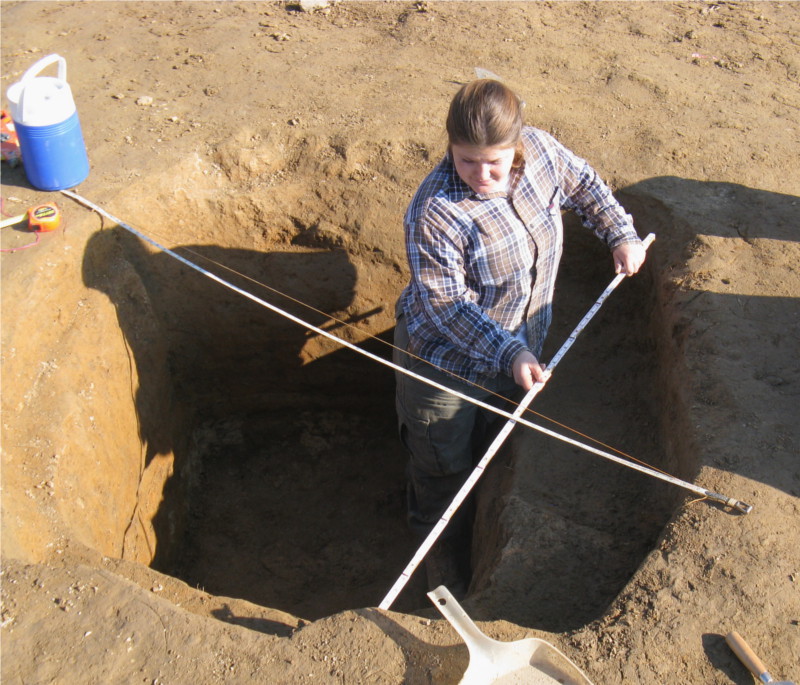
Back in the field today at our little eighteenth-century farm site in Delaware. We're working on the strange well shown above and below, which is very rectangular and filled with nearly sterile sand. Not sure how much deeper we're going to dig into this, with so little coming out.


The site is dotted with pits like the one being dug out in this picture. I think most of them are tree holes or rodent burrows related to a hedge row that ran across the site in the nineteenth century. At both this site and the last one we did in Delaware I have ended up thinking a lot about what happened to the site after it was abandoned. Here, a property line was established running across the site, at least two successive fences were built, trees grew up along the fence, and groundhogs made the hedge their home. Then at some point the hedge was grubbed out and the field plowed over. I think at least half of our pits features and post holes are related to that property line, not the eighteenth-century farm, but for many individual features it may be hard to tell.

Does Getting a Nuclear Weapon Change much for a Country?

Apropos of the alarmism about Iran getting a bomb, Stephen Walt asks what happened when other countries went nuclear:
Did British and French acquisition of nuclear weapons slow their decline as great powers? Not in the slightest. . . .

Did China's detonation of a bomb in 1964 suddenly make them a superpower? Hardly. China remained a minor actor on the world stage until it adopted market principles, and its rising global influence is due to three decades of economic growth, not a pile of nukes. . . .

The white government in South Africa eventually produced a handful of bombs, but nobody noticed and apartheid ended anyway.

What about India and Pakistan? India's "peaceful nuclear explosion" in 1974 didn't turn it into a global superpower, and its only real effect was to spur Pakistan -- which was already an avowed rival -- to get one too. And it's worth noting that there hasn't been a large-scale war between the two countries since, despite considerable grievances on both sides and occasional skirmishes and other provocations.
There is no reason to suppose that Iran's situation would change very much if it acquired the bomb, either, and therefore no reason to agonize about it. Let alone go to war.

The Dom Pedro Aquamarine

The Dom Pedro aquamarine, the largest one ever found, as been donated to the Smithsonian and is going on display near the Hope Diamond.

The stone weighs 10,363 carats, nearly five pounds, and is 14 inches (35 cm) tall. It was shaped by German gem carver Bernd Munsteiner. It was found in Brazil in the 1980s, and is named for Brazil's first emperor.

The stone before and after cutting.

Sunday, December 2, 2012

Soviet Modernism

Fascinating collection of pictures of some of the strangest red architecture. Above, the Fyodor Dostoevsky Theater in Novgorod. Below, the Druzhba Holiday Center in Yalta, Ukraine.


Kan Bahlam

Image of king Kan Bahlam, Snake Jaguar, on the wall of a Maya tomb at Palenque. The tomb's paintings depict nine ancestors of the tomb's occupant. Nine was a key sacred number for the Maya, and several other known tombs seem to have included invocations of nine ancestors. Many more pictures at National Geographic.

Today's Cathedral: Wells

In the thirteenth century, southwestern England became one of the most innovate centers in the development of the Gothic style, and the masterpiece of this movement is Wells Cathedral.

Construction of the cathedral began in about 1175, and it was planned from the first as a Gothic work. As with most of these cathedrals, construction took a long time, and the structure was enlarged and added to over the years. The famous west facade (top) was completed in about 1239.

The nave, with its inverted arch.

The ceiling of the choir.

The stairs to the chapter house.

The famous chapter house ceiling.

Capital in the nave. Even though much of the sculpture was damaged during the English Civil War, the cathedral still has a large collection of medieval pieces.

It also has much medieval stained glass.

The clock (1390).

A door in the undercroft. I love these elaborate medieval doors.

The ceiling of the Lady Chapel, 1326. The year 1326 was an interesting one in England, when civil war broke out and Edward II was overthrown by his wife and her lover. One of the fascinating things to me about the Middle Ages is that the nearly constant political instability did not interfere with the remarkable cultural production. Perhaps the building of churches slowed down during the times of worst violence, but it rarely stopped completely. This was partly because of the church, which had great wealth and was to some extent outside the political structure. The bishop was probably a partisan of either the king or the barons, but much of the cathedral's money was in he hands of the chapter house and the dean, and they went on with their building works regardless of what was happening in Westminster.


Adriaen de Vries

Adriaen de Vries (ca. 1545-1626) was a sculptor of the "mannerist" or early Baroque period. Born in the Netherlands, he trained in Italy and did much of his work in Prague, sculpting for Emperor Rudolf II. He entered Rudolf's service in 1593 and was his court sculptor from 1601 until the emperor's death in 1612. Above, Lazarus, 1615.


De Vries was a master of the complex technology of casting bronze sculptures, renowned in his own time as much for this alchemy as for his artistic vision. Above, Antiope and Theseus, ca. 1601.

Mercury and Cupid, 1596.


Bust of Emperor Rudolf II, 1609.


Rudolf II Introducing the Liberal Arts to Bohemia, 1609.

Rudolf was fond of complex allegories, and this seems to be one. It used to be known as Virtue Triumphant over Vice, but after much research in the obscure symbolic systems of Rudolf's court, it is now titled Empire Triumphant over Avarice. Rudolf was engaged in wars against the Turks for much of his reign, and one of his constant complaints was that the German princes and cities expected him to defend them but refused to send any money to help pay the cost. Hence this image, a sort of fantasy in which empire with her laurel wreath tramples ass-eared avarice under foot.

Vulcan's Forge, 1611.


Mercury and Psyche, 1593I find the fates of these works nearly as interesting as the works themselves. Many were looted from Prague after Swedish troops sacked the city during the Thirty Years War. Some ended up in Sweden, while others were scattered across Europe, sold by the officers who stole them. Later the kings of Sweden sold some of their own pieces to help fund their own wars. They were "treasures," a sort of portable, highly durable wealth and appropriate booty for war.

Man of Sorrow, ca. 1605.

Cain Killing Abel, 1622.

Saturday, December 1, 2012

Treasures of the Scanian War

In 1676 to 1679, the kings of Sweden and Denmark fought what we now call the Scanian War. Nothing remarkable about that, I suppose; fighting wars is what kings used to do. Scania is the southernmost part of Sweden, which belonged to Denmark and then was taken by Sweden in 1658. In 1676, as both sides were involved in the Europe-wide wars surrounding Louis XIV of France -- the Swedes were enemies of Louis' enemies the Prussians, so they joined on his side, whereupon their enemies the Danes and Norwegians (then sharing a king) joined the anti-French coalition -- the Danes tried to take Scania back. That's the Danish-Dutch invasion fleet on their way to Scania above, in a contemporary painting.

As you can see from this map, there were lots of wars around the Baltic in the whole early modern period; until 1712 the Swedes were mostly winning, but after that they mostly lost to the Russians.

Anyway, that was all by way of background to this discovery. Swedish archaeologists have pulled more than a thousand 17th-century silver coins out of a field in Scania.
With the help of metal detectors and spades, archaeologists in Helsingborg pulled up a total of 1,150 silver coins - what they consider to be a record haul for the area. . . . “There are 70 or so such treasures that were buried in SkÃ¥ne during the Scanian War. Most are not as big as this one. The usual interpretation is that it was rich farmers who buried them during the war, then died, and couldn’t dig them up again,” said archaeologist Kennet Stark, who was also on the scene.
Seventy treasures. Seventy family fortunes lost. Seventy households wrecked, scattered, and impoverished. From a war hardly anyone has heard of, that was not about much of anything in particular.

Castello Fenis

Today's castle is Castello Fenis in northern Italy's Valle d'Aosta. The first mention of the castle was in 1242. It was constructed by the Challant family, the Viscounts of Aosta.

The structure visible today was mainly built between 1320 and 1420.

The basic structure dates to the time of Viscount Aimone, who began construction of the pentagonal central block.


Much of the outer works were built by Bonifacio I, beginning in 1392.


Among the castle's most famous features are the frescoes in the chapel. These were also commissioned by Bonifacio I, and they were completed between 1414 and 1420 by
the studio of Giacomo Jaquerio.

According to the castle's web site, the fortunes of the Challant family declined after the death of Bonifacio I, and no major works were undertaken after his time. The family was finally forced to sell the castle in 1716 to pay their debts. The buyers were big-time farmers who transformed most of the castle into barns, stables, granaries, and so on, even the chapel. It was acquired by the Italian government in 1895 and the interior extensively restored.

Immigration and House Republicans

Now that numerous conservative ideologues have concluded that Republicans need to shore up their future by courting Hispanic immigrants, eyes turn to the House of Representatives to see what Republican legislators will actually do:
For the second time in three months, Republicans are pushing a bill that would create 55,000 additional green cards annually for foreign students who receive graduate degrees at U.S. universities in science, technology, engineering and math — so-called STEM graduates. On its own, that’s a fine idea, and a bipartisan one at that; as things stand, too many of these highly sought students are forced to leave the country upon graduation, to the detriment of U.S. competitiveness.

But the GOP measure, which was approved by the House of Representatives on Friday, comes at a cost: The 55,000 visas would be derived by eliminating a similar number of green cards disbursed by the so-called diversity lottery, a 20-year-old program that awards visas mainly to low-skilled Africans and Eastern Europeans. On top of having been a brilliant public diplomacy tool for the United States, the lottery has offered a lifeline for the sorts of immigrants who have energized this nation for decades by their pluck and drive. Democrats are willing to expand STEM visas, but many are rightly reluctant to sacrifice the lottery. So the bill is likely dead on arrival in the Senate. 
Sigh. Until House Republicans get out of their Braveheart mindset, shed their opposition to passing anything that makes Democrats look good, and work for compromise, nothing good will come out of Washington.

If House Republicans refuse to take any meaningful action on immigration, the winner will be the Democratic Party, which will solidify its hold on Hispanic and Asian voters. The loser will be the country as a whole, and especially the millions of immigrants and would-be immigrants whose lives will be left in limbo.