Wreck of a huge Ottoman vessel that sank around 1630 has been found in deep water off Cyprus. Above, Chinese porcelain bowls.
Anchor
Green-glazed jar that contained Indian peppercorns
Digital image of one of the six canons
One of twelve copper coffee pots recovered so far
Bowls from Yemen
Stone tobacco pipe depicting a man riding a camel
Friday, April 24, 2020
Skeletons in the Foundation
Archaeologists exploring the oldest foundations of Břeclav Castle in the Czech Republic found something interesting.
Three bodies, all obviously buried within the foundations when they were built in the 11th century. From the position of the skeletons the excavators thought they had been tied together. They were placed on top of the first layer of stones at the bottom of the wall, a careful placement that pretty much rules out an accident.
This habit of burying sacrificial victims in new building foundations was common around the world for thousands of years. But I wonder, how was it preserved in Moravia into the 11th century? The area had been Christian for at least 200 years, and the builder, Duke Bretislav I of Bohemia, was a champion of the church who had saints in his family. Who passed on this tradition, and how? And what else were they passing along?
And who were the victims? War captives? Criminals?
Weird and fascinating. Via The History Blog.
Three bodies, all obviously buried within the foundations when they were built in the 11th century. From the position of the skeletons the excavators thought they had been tied together. They were placed on top of the first layer of stones at the bottom of the wall, a careful placement that pretty much rules out an accident.
This habit of burying sacrificial victims in new building foundations was common around the world for thousands of years. But I wonder, how was it preserved in Moravia into the 11th century? The area had been Christian for at least 200 years, and the builder, Duke Bretislav I of Bohemia, was a champion of the church who had saints in his family. Who passed on this tradition, and how? And what else were they passing along?
And who were the victims? War captives? Criminals?
Weird and fascinating. Via The History Blog.
Links 24 April 2020
Robert Burns, Diana and her Nymphs, 1925
Life in small town Maryland
A design for a social distancing park
This article about hydroxychloroquine starts with a really interesting bit about the history of bone marrow transplants for cancer, something we spent billions on that turned out to do no good.
If you wonder what the deal is with Harry and Meghan and the royal family but haven't bothered to follow the tabloids, I recommend this New Yorker article by Rebecca Mead.
Marc Andressen essay, "It's Time to Build," starting from Covid-19 and moving on to our more systemic problems.
Video of baby humpback whales nursing
Why do the Amish spend so little on healthcare?
Thursday, April 23, 2020
Enthusiasts and Hardheads
Between the enthusiasts and the hardheads who dismiss them, I love the enthusiasts but stand with the hardheads.
– John Crowley
– John Crowley
Theodore Lukits
Theodore Lukits (1897-1992) was a Romanian-American painter who lived most of his life in Southern California.
He made most of his money doing glitzy portraits of socialites and Hollywood stars, like this one of Eleanor Merriam.
But these days people much prefer two other parts of his work. He got very interested in Hispanic America and mid many scenes like this one and portraits of dancers and musicians in Latin costume.
And he did many landscapes, some of them with a Japanese feel, which I find delightful.
He made most of his money doing glitzy portraits of socialites and Hollywood stars, like this one of Eleanor Merriam.
But these days people much prefer two other parts of his work. He got very interested in Hispanic America and mid many scenes like this one and portraits of dancers and musicians in Latin costume.
And he did many landscapes, some of them with a Japanese feel, which I find delightful.
Wednesday, April 22, 2020
Tyler Cowen Interviews John McWhorter
John McWhorter is a linguist and African American who briefly became a famous culture warrior for attacking the whole notion of Ebonics. When he sat down to be interviewed by Tyler Cowen, he obviously expected to be asked about his views on race politics, because that's all interviewers ever ask him about. But Tyler Cowen is a different sort of interviewer, interested in a world of things outside politics. The interview starts like this:
One more bit:
TYLER COWEN: Let’s start with linguistics. I’ve read that the Estonian language has 14 case endings, eight dialects, 117 subdialects, and the core population of speakers is only a bit over a million. Now, why is Estonian so complicated?They go on to discuss language in a wonderful way for twenty minutes or so, then move on to music, and only get to politics toward the end, and that part is also a lot more interesting than most American conversations about race politics. Highly recommended.
JOHN MCWHORTER: What a wonderful opening question.
[laughter]
MCWHORTER: It’s 16 cases actually, and the reason is that Estonia is like the size of New Jersey. It might be the size of Trenton. So, it’s a very small group of people, and very few people have ever had any reason — I can’t believe this is the first question — to learn Estonian as a second language. If you try, you fail.
As a result, it gets more and more complicated, more and more ingrown. Whereas, Finnish, which is a sister language to Estonian, is actually kind of easy. It’s easy Estonian. So Estonian is a small language that’s almost never learned by adults and therefore almost never screwed up. That is why it is so complicated.
One more bit:
COWEN: What is interesting about the language Saramaccan?
MCWHORTER: [laughs] This is delightful.
[laughter]
MCWHORTER: The sorts of things I’m usually asked — this is great. Saramaccan — okay, here’s what happens. Let’s say that you’re in South America. You’re up on the northern edge, and it’s 1660 something, and it is an English plantation colony. You bring in Africans to work there. They speak two languages. For whatever it’s worth, they’re called Fongbe and Kikongo. Some others, but they don’t really play much of a part. So you have slaves speaking those.
The English leave the place, and the Dutch come in. There’s a trade, and so New Amsterdam becomes New York. Suriname goes from the English to the Dutch. We here don’t care about the Suriname part, but that was the trade. Now the Dutch are running it. You’ve got English and Dutch. Then some Portuguese-Jewish slave owners come in from Brazil. That’s this whole other story of wandering Jews. They probably bring slaves with them.
So 350 years later, what is spoken by the slaves there who were lucky enough to escape into the rainforest and were never caught? That is what Saramaccan is. So they have their own language, and it’s been studied by many people, I am one of a great many. But it’s fascinating because it’s a mixture of all these languages. Then it’s got other stuff that it does all by itself and it’s tonal, so it’s absolutely fascinating.
Tuesday, April 21, 2020
Digital Museum Hopping: Edward Burne-Jones in Birmingham
The Birmingham Museum has among other things a wonderful collection of the Pre-Raphaelites. See, the museum was funded by industrialists and many of their works came from the collections of those industrialists, and nineteenth-century British industrialists loved the Pre-Raphaelites. It's the sort of thing that drives ideologically-minded artists crazy: the more they attack the elites of their time, the more those elites love them; the more they attack destructive technology, the more the makers of that technology pay for their works. Anyway the museum has a vast collection of stuff by Edward Burne-Jones, from famous paintings to bric-a-brac like drapery studies. Above, The Wizard, 1898.
Design for a tile done in 1861, when Burne-Jones was working for William Morris's shop.
Three sketches for a Triptych Burne-Jones never finished: Fame Overthrowing Fortune, Oblivion Conquering Fame, and Love Subduing Oblivion.
Cupid Finding Psyche
St. John the Evangelist, 1875
Quest for the Holy Grail Tapestries, Panel II, the Arming of the Knights, 1875
The Feast of Peleus, 1881
Self-portrait, 1895
And a portrait of Burne-Jones by George Frederic Watts, 1870
Design for a tile done in 1861, when Burne-Jones was working for William Morris's shop.
Three sketches for a Triptych Burne-Jones never finished: Fame Overthrowing Fortune, Oblivion Conquering Fame, and Love Subduing Oblivion.
Cupid Finding Psyche
St. John the Evangelist, 1875
Quest for the Holy Grail Tapestries, Panel II, the Arming of the Knights, 1875
The Feast of Peleus, 1881
Self-portrait, 1895
And a portrait of Burne-Jones by George Frederic Watts, 1870
Lock Downs, Herd Immunity, and Deaths
In the long run, the only way to control a highly contagious disease like Covid-19 is by establishing herd immunity, either via a vaccine or by letting the disease run through the population until some percentage are resistant. This percentage varies according to the disease, but for some diseases even 30% has a huge impact on the spread, especially if those are the most socially active people.
I am starting to see a lot of grumbling from people who say that with this disease, lockdowns will only increase the long-term death rate because they delay herd immunity.
The argument goes like this:
I have no idea if this is true. The sad toll of the disease in nursing homes shows one problem, which is that many of the old and sick are being cared for by younger, healthier people, and surely raising the infection rate among nursing home workers would end up killing lots of patients. I have a feeling that some of the people pushing to end lockdowns don't regard that as a bad thing, which bothers me.
Another point is that experiments with antiviral drugs are going on around the world, and remdesivir has already shown some promise, so delaying the disease might allow better therapies to be developed. That would also make the issue of hospital space more important, since we would have useful interventions to employ.
Anyway we have an experiment along these lines going in Sweden, where they have encouraged the vulnerable to self-isolate while letting the rest continue working. So we may end up finding out which approach saves more lives in the end.
As we re-open society it seems inevitable to me that vulnerable people will have to take extra measures to protect themselves. I see a lot in the news about the need for more testing and so on but I wonder if what we really need to put in place are measures to deliver vital supplies to elderly and immuno-compromised people, so they can stay safe while the disease spreads among healthier people going back to work.
I am starting to see a lot of grumbling from people who say that with this disease, lockdowns will only increase the long-term death rate because they delay herd immunity.
The argument goes like this:
- Covid-19 is far more dangerous to the old and sick than to the young and healthy; yes it does kill some young, healthy people, but not very many
- Short of a vaccine the best way to control the disease would be to expose millions of comparatively young, healthy people to it until half or so of the population is resistant, which would probably be enough to greatly slow its spread
- Lockdowns keep this from happening, because most of the people they keep home are comparatively young and healthy
- The effect is to lower the rate of infection but extend its lifetime; this flattening of the curve raises the overall death rate by keeping the disease at a pandemic level longer, so that more older, sicker people end up being exposed
I have no idea if this is true. The sad toll of the disease in nursing homes shows one problem, which is that many of the old and sick are being cared for by younger, healthier people, and surely raising the infection rate among nursing home workers would end up killing lots of patients. I have a feeling that some of the people pushing to end lockdowns don't regard that as a bad thing, which bothers me.
Another point is that experiments with antiviral drugs are going on around the world, and remdesivir has already shown some promise, so delaying the disease might allow better therapies to be developed. That would also make the issue of hospital space more important, since we would have useful interventions to employ.
Anyway we have an experiment along these lines going in Sweden, where they have encouraged the vulnerable to self-isolate while letting the rest continue working. So we may end up finding out which approach saves more lives in the end.
As we re-open society it seems inevitable to me that vulnerable people will have to take extra measures to protect themselves. I see a lot in the news about the need for more testing and so on but I wonder if what we really need to put in place are measures to deliver vital supplies to elderly and immuno-compromised people, so they can stay safe while the disease spreads among healthier people going back to work.
Monday, April 20, 2020
Sculptural Fragments from a Sanctuary in Roman Gaul
Beginning in 2014, archaeologists from INRAP excavated a Gallo-Roman sanctuary along the Oise River near Pont-Sainte-Maxence, now an outer suburb northeast of Paris. The found the remains of what they say was a monumental entrance, 70 m (230 feet) long. Love these fragments.
Below, a conjectural reconstruction of the gateway.
Sunday, April 19, 2020
The Scientist as Bureaucrat
Michael Specter on Dr. Anthony Fauci:
Fauci once explained to me that he has developed a method for dealing with political leaders in times of crisis: "I go to my favorite book of philosophy, The Godfather, and say 'It's nothing personal, it's strictly business.' . . . You just have a job to do. Even when somebody's acting ridiculous, you can't chide them for it. You've got to deal with them. Because if you don't deal with them, then you're out of the picture."
Since his days of advising Ronald Reagan and George H.W. Bush, Fauci has maintained a simple credo: "You stay completely apolitical and non-ideological, and you stick to what it is that you do. I'm a scientist and I'm a physician. And that's it." He learned the value of candor early. "Some wise person who used to be in the White House, in the Nixon administration, told me a very interesting dictum to live by, " he told me in 2016. "He said, 'When you go to the White House you should be prepared that that is the last time you will ever go.' . . . Everybody knows I'm going to tell them exactly what's the truth."No wonder Fauci seems unfazed by trying to advise Trump about Covid-19, I mean, that can't be any worse than trying to advise Ronald Reagan about AIDS.
American Indians Disappearing from the Culture
From John Smith's Discoverie of Virginia to around 1970, American Indians were central to Euro-American popular culture. Stories, visual art, advertising, songs – all of it was saturated with images of Native Americans. Until 1890 or so that was because Indians were central to American life. Defeating them, taking their land, and getting along with the survivors was a big part of our national project. But even during the war years the picture of Native Americans in Euro-American culture was not all negative; on the contrary there was from the 1600s on a romanticizing of "wild" Indians as noble, stoic, and wise. Wars against Indians were always opposed by a significant faction of whites, however ineffectual that opposition may have been. Conflict did not prevent Euro-Americans from taking over much of Native culture, from eating corn to smoking tobacco.
But from around 1890 Native Americans ceased to be major players in American politics, and Indian issues faded from the news. They remained, however, very large in our culture and especially in movies and television.
A Native boy growing up in the 1950s saw his ancestors on television almost every night. Maybe they were portrayed as savage barbarians, but they were certainly not pathetic; on the contrary they were badasses fighting hard for their land, and white people feared them. I remember a scene in which John Wayne points to a spear left behind by an Indian raid and says, "that's Comanche," at which everyone gets very quiet. From The Searchers to stories of the first Thanksgiving, Indians were huge in American popular culture.
Now, not so much. This is partly because we are just not as interested in the past as we once were, and partly because of white shame that makes it hard to portray cowboys driving their cattle across Indian land as heroes. And partly because of pressure from Native America leaders to get rid of offensive, stereotypical images.
This is on my mind because Land O' Lakes has decided to remove the Indian woman from their butter. This does not seem to have been because of any particular campaign by Native Americans, but because they want to feature some of their farmers in their product design to emphasize that they are a farmer-owned cooperative. But it has been celebrated by some Native leaders:
I do understand that in some cases nothing would be better than the offense offered by the culture, for example I think African Americans are right to fight minstrel show mockery of black people. But I think the situations of Native and African Americans are very different. The old stereotypes made African Americans laughable, while those of Native Americans made them violent and savage but on the other hand formidable and sometimes wise. There is in the old stereotypes of Indians much that is true – the Iroquois and the Lakota were very violent, and proud of it – and on the other hand much that matches the ways contemporary Native Americans want to be understood, especially in their spirituality and their attachment to the earth of their homes. It seems to me that there is much in the popular culture that Native leaders could work with in building a real understanding of their peoples. Plus there is the stark demographic fact that there are ten times as many African Americans as Native Americans, which makes them a lot harder to ignore.
So I wonder if the cause of Native American rights would really be helped by the disappearance of Indians from all sports team names, advertising, bad movies, corny tv shows, and so on. At least those things keep Indians in the public mind, and at their worst give Native leaders a chance to protest them and be heard.
The Land O' Lakes woman also raises another question: what bits of culture would meet the standards of Indian activists like Kevin Allis? It happens all the time that a big corporation will consult with some members of an ethnic group and hire people of that ethnicity and so on and still get accused stereotyping and cultural appropriation (like Disney with Moana). Because the Land O' Lakes image is not, it turns out, the random product of American advertising, but was created by a Native American artist who tried to make it specific to the Indian nations of Minnesota:
But from around 1890 Native Americans ceased to be major players in American politics, and Indian issues faded from the news. They remained, however, very large in our culture and especially in movies and television.
A Native boy growing up in the 1950s saw his ancestors on television almost every night. Maybe they were portrayed as savage barbarians, but they were certainly not pathetic; on the contrary they were badasses fighting hard for their land, and white people feared them. I remember a scene in which John Wayne points to a spear left behind by an Indian raid and says, "that's Comanche," at which everyone gets very quiet. From The Searchers to stories of the first Thanksgiving, Indians were huge in American popular culture.
Now, not so much. This is partly because we are just not as interested in the past as we once were, and partly because of white shame that makes it hard to portray cowboys driving their cattle across Indian land as heroes. And partly because of pressure from Native America leaders to get rid of offensive, stereotypical images.
This is on my mind because Land O' Lakes has decided to remove the Indian woman from their butter. This does not seem to have been because of any particular campaign by Native Americans, but because they want to feature some of their farmers in their product design to emphasize that they are a farmer-owned cooperative. But it has been celebrated by some Native leaders:
Kevin Allis, the chief executive of the National Congress of American Indians, a public education and advocacy group, said the organization saw it as a “positive sign,” adding, “We encourage all companies that peddle products displaying stereotypical Native ‘themed’ imagery to follow suit.”I wonder if this is wise. Because once we get rid of all the offensive, stereotypical images of Indians, we are not going to be left with sensitive, nuanced images of beauty and diversity. What's going to happen is that Indians will disappear. Or, I guess, that their prominence in the culture will fall until it matches their share in the population, which is around 1.5%.
“Americans need to learn the truth about the beauty and diversity of tribal nations, peoples and cultures today,” he said, “and discarding antiquated symbols like this are a step in the right direction.”
I do understand that in some cases nothing would be better than the offense offered by the culture, for example I think African Americans are right to fight minstrel show mockery of black people. But I think the situations of Native and African Americans are very different. The old stereotypes made African Americans laughable, while those of Native Americans made them violent and savage but on the other hand formidable and sometimes wise. There is in the old stereotypes of Indians much that is true – the Iroquois and the Lakota were very violent, and proud of it – and on the other hand much that matches the ways contemporary Native Americans want to be understood, especially in their spirituality and their attachment to the earth of their homes. It seems to me that there is much in the popular culture that Native leaders could work with in building a real understanding of their peoples. Plus there is the stark demographic fact that there are ten times as many African Americans as Native Americans, which makes them a lot harder to ignore.
So I wonder if the cause of Native American rights would really be helped by the disappearance of Indians from all sports team names, advertising, bad movies, corny tv shows, and so on. At least those things keep Indians in the public mind, and at their worst give Native leaders a chance to protest them and be heard.
The Land O' Lakes woman also raises another question: what bits of culture would meet the standards of Indian activists like Kevin Allis? It happens all the time that a big corporation will consult with some members of an ethnic group and hire people of that ethnicity and so on and still get accused stereotyping and cultural appropriation (like Disney with Moana). Because the Land O' Lakes image is not, it turns out, the random product of American advertising, but was created by a Native American artist who tried to make it specific to the Indian nations of Minnesota:
The original logo of the company’s “butter maiden” first appeared on Land O’Lakes packaging in 1928, created by Arthur C. Hanson, an artist who worked for a local advertising firm.
It was redone about 30 years later by Patrick DesJarlait, a Chippewa artist who died in 1972. As a Native American, he was a rarity in the illustration business at the time, his son Robert DesJarlait said in an interview on Friday.
“He redid her features and the dress she is wearing, a Plains-style dress with beaded panels,” said Mr. DesJarlait, a member of the Red Lake Ojibwe tribe in Minnesota. “He added floral designs for the Chippewa culture. It was basically a redesign. He gave her a clearer image. So he was modernizing her a bit.”
Though some groups have held up the illustration as an example of stereotyping, Mr. DesJarlait said, he didn’t see it that way. “She was never created as a stereotype,” he said.
Mr. DesJarlait said he believed that the company did not discard the imagery to get rid of a stereotype, but out of discomfort with representations of Native Americans of any kind.
“She just disappeared,” he said.
Saturday, April 18, 2020
A Walk Through Venice
We arrive in Venice by train and step out into the sunshine along the Grand Canal. Our view across the canal into the city is dominated by an eighteenth-century church, the Chiesa de San Simeon Piccolo.
We turn left along the canal for a short distance, passing the Chiesa Santa Maria degli Scalzi – don't be tempted to go inside, it's insanely over the top Baroque and we want to save ourselves for other, better churches so as not to get altarpiece fatigue –
until we reach the Ponte degli Scalzi, a footbridge across the canal, taking a moment to enjoy the view along the canal.
On the other side we proceed straight down the Calle Lunga, a narrow alleyway, and then turn left down the even narrower Calle Bergami S. Croce. This brings us to a narrow canal called the Rio Marin. We cross the canal on a small bridge and turn right down an embankment called the Fondamenta Garzotti.
We pass the sixteenth-century Palazzo Soranzo Capello, which these days houses the district superintendent of archaeology and historic buildings. Nice office space.
It also has a spiffy garden where I suppose the archaeologists lunch on nice days.
Continuing along the Rio Marin we cross the canal on another delightful bridge and turn right onto the Calle de l'Ogio
This brings us after a short distance to the Scuola Grande di San Giovanni Evangelista, founded as a confraternity in the 13th century and now an art museum.
Inside are many treasures, should you be in a museum mood.
From there it's just a short stroll to our first really famous monument, the Basilica di Santa Maria Gloriosa dei Frari. Perhaps it's not so spectacular on the outside, but on the inside –
This is a temple of art, and of artists. The most famous work is Titian's Assumption of the Virgin but there are so many
many, many
and tombs – Titian is buried here, along with many other Venetian grandees.
From the Basilica we turn down the Campo dei friari toward the ponte dei friari.
We cross the bridge over the Rio dei Friari and turn right on the embankment called the Fondamenta dei Friari – really the friars seem to have dominated this whole neighborhood.
Then left down the Rio Tera Caza, which I suppose must be a filled-in canal, then through a warren of narrow alleys to the Rio de San Polo
Which we cross on the Ponte San Polo
Into the Campo San Polo, one of Venice's largest squares
There is another famous church here, Chiesa Rettorale de San Polo,
full of paintings by Tiepolo and so on.
But we must scurry onward to the famous Ponte de Rialto, completed in 1591, and there cross the Grand Canal again.
Here we take a bit of a detour, turning left through the Campo San Bartolomeo
And crossing two more small canals to come to a little Venetian wonder, the Chiesa Santa Maria dei Miracoli, built in 1481-1489, a Renaissance masterpiece.
From there we walk south along the Rio della Fava (the Canal of the Bean), passing Santa Maria della Fava (St. Mary of the Bean – really)
and make our way down the Calle Flubera to the Calle Dei Fabbri, cross a small bridge where all the gondoliers will harass us and promise us the best, most wonderful tour of the city
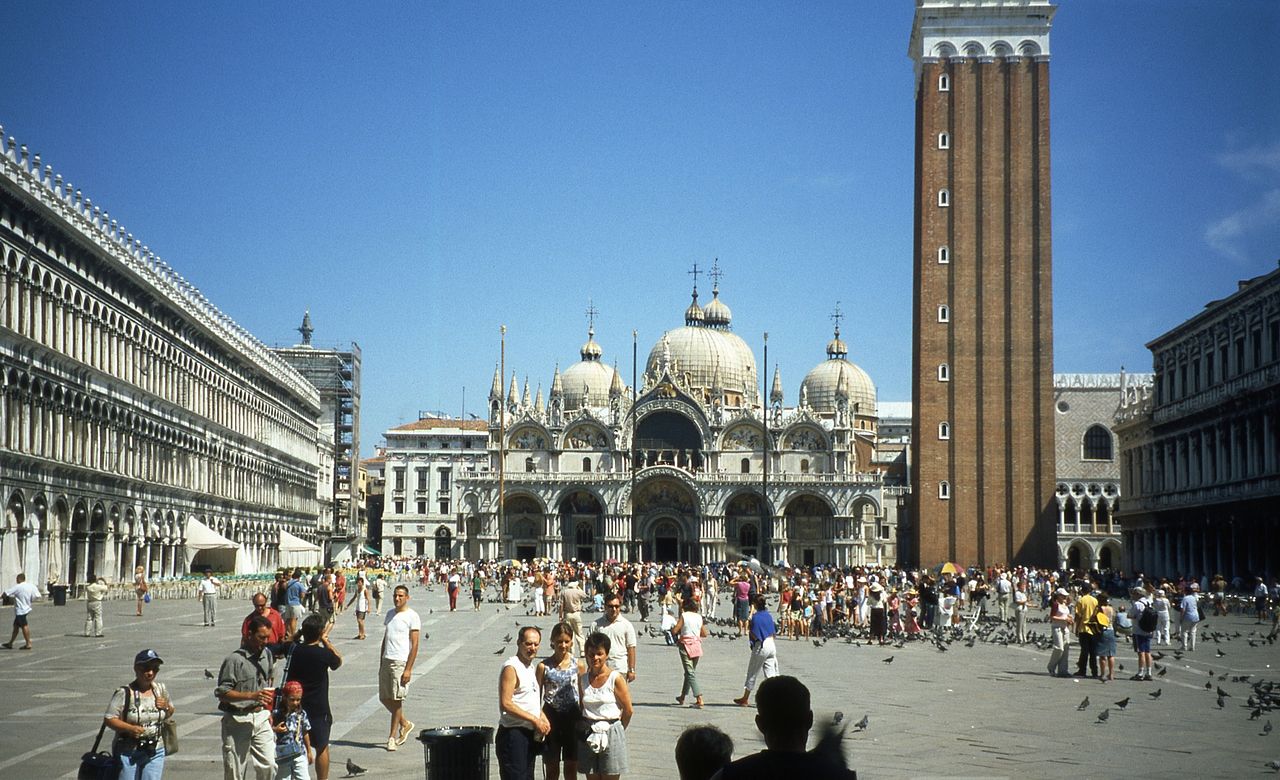
and into the heart of it all, the Piazza San Marco
Here we behold the wonders of the Doges' Palace
And the Basilica of St. Mark, built in the 11th century
When Venice was still in thrall to Byzantium.
Of course they loved Byzantium so much that in 1204 they sacked the city – maybe this was their way of announcing they had achieved adulthood and no longer needed a parent city to guide them – and brought home many treasures, most famously these four horses that became their symbol.
You are perhaps thinking by now that this must have been some hike, but the whole route laid out here is, according to Google, less than 4 miles (6 km). With a break for lunch, which we will of course take, it would be an easy day's stroll, so many wonders are packed into the little space of Venice.
We turn left along the canal for a short distance, passing the Chiesa Santa Maria degli Scalzi – don't be tempted to go inside, it's insanely over the top Baroque and we want to save ourselves for other, better churches so as not to get altarpiece fatigue –
until we reach the Ponte degli Scalzi, a footbridge across the canal, taking a moment to enjoy the view along the canal.
On the other side we proceed straight down the Calle Lunga, a narrow alleyway, and then turn left down the even narrower Calle Bergami S. Croce. This brings us to a narrow canal called the Rio Marin. We cross the canal on a small bridge and turn right down an embankment called the Fondamenta Garzotti.
We pass the sixteenth-century Palazzo Soranzo Capello, which these days houses the district superintendent of archaeology and historic buildings. Nice office space.
It also has a spiffy garden where I suppose the archaeologists lunch on nice days.
Continuing along the Rio Marin we cross the canal on another delightful bridge and turn right onto the Calle de l'Ogio
This brings us after a short distance to the Scuola Grande di San Giovanni Evangelista, founded as a confraternity in the 13th century and now an art museum.
Inside are many treasures, should you be in a museum mood.
From there it's just a short stroll to our first really famous monument, the Basilica di Santa Maria Gloriosa dei Frari. Perhaps it's not so spectacular on the outside, but on the inside –
This is a temple of art, and of artists. The most famous work is Titian's Assumption of the Virgin but there are so many
many, many
and tombs – Titian is buried here, along with many other Venetian grandees.
From the Basilica we turn down the Campo dei friari toward the ponte dei friari.
We cross the bridge over the Rio dei Friari and turn right on the embankment called the Fondamenta dei Friari – really the friars seem to have dominated this whole neighborhood.
Then left down the Rio Tera Caza, which I suppose must be a filled-in canal, then through a warren of narrow alleys to the Rio de San Polo
Which we cross on the Ponte San Polo
Into the Campo San Polo, one of Venice's largest squares
There is another famous church here, Chiesa Rettorale de San Polo,
full of paintings by Tiepolo and so on.
But we must scurry onward to the famous Ponte de Rialto, completed in 1591, and there cross the Grand Canal again.
Here we take a bit of a detour, turning left through the Campo San Bartolomeo
And crossing two more small canals to come to a little Venetian wonder, the Chiesa Santa Maria dei Miracoli, built in 1481-1489, a Renaissance masterpiece.
From there we walk south along the Rio della Fava (the Canal of the Bean), passing Santa Maria della Fava (St. Mary of the Bean – really)
Here we behold the wonders of the Doges' Palace
And the Basilica of St. Mark, built in the 11th century
When Venice was still in thrall to Byzantium.
Of course they loved Byzantium so much that in 1204 they sacked the city – maybe this was their way of announcing they had achieved adulthood and no longer needed a parent city to guide them – and brought home many treasures, most famously these four horses that became their symbol.
You are perhaps thinking by now that this must have been some hike, but the whole route laid out here is, according to Google, less than 4 miles (6 km). With a break for lunch, which we will of course take, it would be an easy day's stroll, so many wonders are packed into the little space of Venice.
Subscribe to:
Posts (Atom)