The trains to Washington weren't running, so I was stranded here. I really tried to work from home, but by 2:00 my restlessness took over. So I grabbed Ben, Clara, and Ben's friend Noah and took the sled to the high school. Above, the scene.
Ben and Noah contemplate the hill.
Clara climbs back up after the day's longest run.
Ben tries it backwards. Worked very well.
Clara clowns for the camera.
As they always used to, my puppies end up in a pile.
Monday, January 25, 2016
The Snake Witch of Gotland
This Viking Age stone from Gotland, Sweden, is generally called the Snake Witch Stone (Ormhäxan Stenen). What it really depicts is much disputed. One obvious guess would be Loki in his guise as mother of monsters (Fenrir Wolf, Hel the goddess of death, and Jormungandr the great serpent) . Snorri's account of this episode actually makes Loki the father of the monsters with a giantess named Angrboda as the mother, so this might also be Angrboda, if she was known in Sweden. But various "scholars" have produced all sorts of other guesses, from Odin in female guise (he did that) to the Aegean mother goddess to the Celtic god Cernunnos.
The image combines two ancient bits of iconography: the mistress of animals and the woman giving birth. (Like Artemis and Diana, the virgin huntress was also often the goddess of childbirth.) This stone therefore reaches back to the earliest depths of Eurasian myth, and symbolizes as well as anything the vast store of vision, song and story that lies behind or medieval legends. Even if the carver of the stone had some particular character like Angrboda in mind, his work touches the deep springs of our culture: the dreams of Paleolithic shamans, the cry of the sacrificer, the mutterings of priests atop mud-brick towers in Babylon far away.
Another depiction of the mother of monsters, a small relief now in the Swedish church at Väte, which I posted because it came up in researching the Ormhäxan Stenen and I can't remember ever seeing it before.
The image combines two ancient bits of iconography: the mistress of animals and the woman giving birth. (Like Artemis and Diana, the virgin huntress was also often the goddess of childbirth.) This stone therefore reaches back to the earliest depths of Eurasian myth, and symbolizes as well as anything the vast store of vision, song and story that lies behind or medieval legends. Even if the carver of the stone had some particular character like Angrboda in mind, his work touches the deep springs of our culture: the dreams of Paleolithic shamans, the cry of the sacrificer, the mutterings of priests atop mud-brick towers in Babylon far away.
Another depiction of the mother of monsters, a small relief now in the Swedish church at Väte, which I posted because it came up in researching the Ormhäxan Stenen and I can't remember ever seeing it before.
Trump is the Anti-Obama
David Axelrod explains the rise of Trump using a memo he wrote for Obama in 2006:
In late 2006, when Barack Obama was a first-term senator pondering a long-shot race for the presidency, he asked me to write a strategic memo exploring his prospects. My bullish analysis was predicated on several factors, but rooted in a theory I had developed over decades as a political writer and campaign consultant.So just as Obama succeeded in part because he was the opposite of Bush, Trump is succeeding in part because he is the opposite of Obama:
Here’s the gist. Open-seat presidential elections are shaped by perceptions of the style and personality of the outgoing incumbent. Voters rarely seek the replica of what they have. They almost always seek the remedy, the candidate who has the personal qualities the public finds lacking in the departing executive.
A young, energetic John F. Kennedy succeeded the grandfatherly, somnolent Dwight D. Eisenhower, promising “a new generation of leadership.” In a slight variation, a puritanical Jimmy Carter, offering “a government as good as its people,” defeated the unelected incumbent Gerald R. Ford, who bore the burden of the morally bankrupt Nixon era.
Even George H.W. Bush, running to succeed the popular and larger-than-life Ronald Reagan, subtly made a virtue of his own lack of charisma and edge.
Beyond specific issues, however, many Republicans view dimly the very qualities that played so well for Mr. Obama in 2008. Deliberation is seen as hesitancy; patience as weakness. His call for tolerance and passionate embrace of America’s growing diversity inflame many in the Republican base, who view with suspicion and anger the rapidly changing demographics of America. The president’s emphasis on diplomacy is viewed as appeasement.Certainly it seems to me that Republican primary voters are looking for the opposite of Obama. Whether that is true of the country as a whole remains to be seen.
So who among the Republicans is more the antithesis of Mr. Obama than the trash-talking, authoritarian, give-no-quarter Mr. Trump?
Sunday, January 24, 2016
Does the First Amendment Protect You from Mistakes?
Back in 2006, police detective Jeffrey Heffernan of Paterson, New Jersey, was seen carrying around a yard sign for a candidate in the mayoral election. The candidate of that sign lost, and after the election Heffernan was demoted to beat cop. He sued. A jury awarded him $105,000, but the judge vacated the verdict, and an appeals court agreed. After all, Heffernan hadn't actually been exercising his First Amendment rights. He was only mistakenly thought to be exercising his First Amendment rights, and the constitution doesn't say anything at all about that. The issue was argued in the Supreme Court this week:
Frost, Heffernan’s lawyer, gets off to a bumpy start this morning when Justice Anthony Kennedy asks him almost immediately how he would “define the right at issue in this case.” Frost tries to explain that there is a right to not be demoted for perceived political associations, but Roberts cuts him short: “Well, but the First Amendment talks about abridging freedom of speech, and I thought the case came to us on the proposition that he wasn't engaging in speech at all. That he was not engaging in association, he was not engaging in trying to convey a message, he was just picking up a sign for his mother.”We'll have to wait for the verdict, but right now it seems that there is no constitutionally protected right to engage in carrying a yard sign for your mother.
Justice Antonin Scalia tags in: “He was not expressing any First Amendment view whatever. I mean, he was fired for the wrong reason, but there’s no constitutional right not to be fired for the wrong reason.”
The Strange Case of Dr. Polidori
Amusing retelling by Carrie Frye of the famous tale of the Frankenstein summer, focusing on the character of Dr. Polidori. A sample:
If you have any interest in Mary Shelley’s Frankenstein or vampires or Romantic poets or, who knows, Swiss tourism, you’ve most likely read Polidori’s name. He’s a curio, Polly Dolly, most notable not for what he wrote but for being nearby when other people wrote things. It’s a strange afterlife; to think you’ve landed a leading role, and then there you are, on stage, sure, and with big names too, but fixed to a mark far upstage and over to the left, near the wings, in the half-dark where the spotlight doesn’t quite reach. “Poor Polidori.” That’s how Mary Shelley referred to him, writing years later. And he was. Here is how he creeps into letters, like this one written by Byron: “Dr. Polidori is not here, but at Diodati, left behind in hospital with a sprained ankle, which he acquired in tumbling from a wall—he can’t jump.” It was John Polidori’s misfortune to be comic without having a sense of humor, to wish to be a great writer but to be a terrible one, to be unusually bright but surrounded for one summer by people who were titanically brighter, and to have just enough of an awareness of all of this to make him perpetually uneasy. Also, he couldn’t jump. Poor Polidori.
One short story he wrote, though, remains important, a vampire story that was read across Europe when it came out and led the way to Dracula. But even that story was not all Polidori’s own. In a nice bit of literary vampiricism, he fed off a sketch by Byron to write it and the story was first published under Byron’s name (hence all the attention it got), so he’s instructive, too, as a reminder of all that writers and vampires have in common.
An aristocratic vampire bored by his immortality—we’re accustomed to that creature now. But this sort of vampire is relatively new. As Paul Barber describes in his wonderful book, Vampires, Burial, and Death, the vampires that populated European folklore for centuries were Slavic peasant and villager revenants, ordinary people rising from their graves bloated and ruddy, with long fingernails and grave dirt in their hair. Polidori based his story “The Vampyre” on a “Fragment” written a few years before by Byron. In each story, the vampire is rich, lordly, weighted down by dissatisfaction.
He is, in other words, a personage not so unlike Lord Byron. In Polidori’s story, the vampire, Lord Ruthven, has cold grey eyes. He is bored. It’s impossible to know what he’s thinking. He mixes in the highest society. He is well thought of, but, secretly, a predator eager to lead virtue astray. He and a young idealistic companion, Aubrey, set off on a tour by carriage of Europe. There is no mention of whether a monkey and a peacock are with them, but the rest of it sounds familiar. “The Vampyre” was first published, in 1819, in New Monthly Magazine as a story by Byron. It created an international stir. A play and then an opera were based on it, events that seem unlikely to have occurred if the story had gone into the world as the work of a London physician. It’s widely assumed that Polidori passed the story off as Byron’s in an intentional imposture, but the evidence there is murky. Just as possible is that, the manuscript having passed through several hands after Polidori wrote it, the details of its connection to Byron grew confused on the way to publication. (Byron, breezily waving it off: “… I scarcely think anyone who knows me would believe the thing in the Magazine to be mine, even if they saw it in my own hieroglyphics.” He might just as well have added: “He can’t jump either.”)
The Rediscovered Frescoes of Saint Méard de Drône
One day in the spring of 1999, a bit of white plaster flaked off the ceiling of the small church in Saint-Méard-de-Drône, France. It revealed a painted figure, perhaps an angel. A survey of the church by a firm of art restorers was then commissioned. By prying off tiny pieces of plaster in various locations the restorers discovered that most of the church had been painted, and that more than 300 square meters (3200 square feet) of the medieval frescoes seemed to survive underneath several layers of whitewash.
A program of fundraising and restoration then began, now reaching its conclusion. The frescoes date to the fourteenth century.
Those on the lower level were badly damaged by Calvinist iconoclasts, probably in 1562 after a massacre of Protestants at Wassy on March 1. It seems that the whole church was then whitewashed by a Protestant congregation, the sculptures removed and smashed or burned. The Protestants remained in charge of the church for only a short time, but the Catholics never tried to remove the whitewash or repaint the walls. Thus the attempted iconoclasm actually preserved much of the painting for us to rediscover in modern times.
The restorers have made digital restorations of some of the slashed lower panels, like this one of the scene of St. Bartholomew's martyrdom shown above. This is a standard scene known from many medieval examples. In fact this is true of all the frescoes at St. Méard, all of which are fourteenth-century commonplaces. This may make them less interesting as art but they are very valuable for social and religious history, showing that the images so well known from illuminated manuscripts were also used in church frescoes and other sorts of art that common people would see.
The Last Supper, another badly damaged scene.
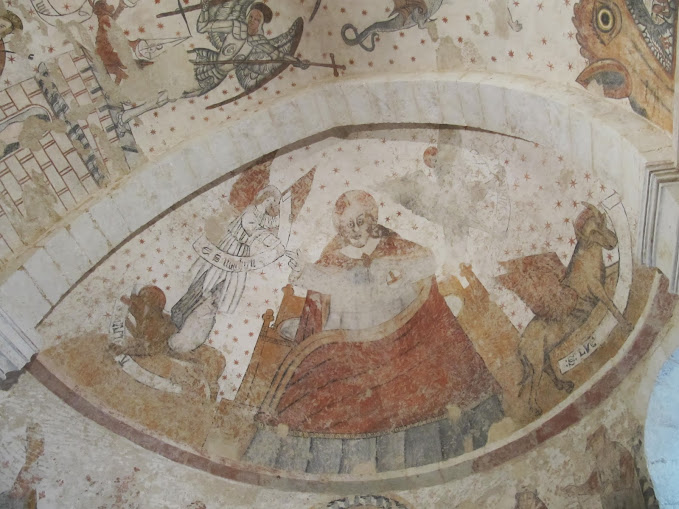
The paintings on the ceiling, beyond the reach of the enraged iconoclasts, are much better preserved. The main scene in the apse shows Christ in majesty, surrounded by the symbols of the four evangelists.
The Archangel Michael weighs souls.
The condemned are herded into the mouth of Hell.
And the saved are welcomed into paradise.
Angels and a dragon preside.
Opinions differ about this image, but it may be Christ entering Jerusalem.
I love discoveries like this. Sometimes it seems like the body of knowledge we have about the past is fixed, and everything that can be said about it has already been said. But really new wonders are uncovered all the time.
This photo and the one are below are by Juliana Lees, my favorite photographer of medieval monuments. Wikipedia has more.
A program of fundraising and restoration then began, now reaching its conclusion. The frescoes date to the fourteenth century.
Those on the lower level were badly damaged by Calvinist iconoclasts, probably in 1562 after a massacre of Protestants at Wassy on March 1. It seems that the whole church was then whitewashed by a Protestant congregation, the sculptures removed and smashed or burned. The Protestants remained in charge of the church for only a short time, but the Catholics never tried to remove the whitewash or repaint the walls. Thus the attempted iconoclasm actually preserved much of the painting for us to rediscover in modern times.
The restorers have made digital restorations of some of the slashed lower panels, like this one of the scene of St. Bartholomew's martyrdom shown above. This is a standard scene known from many medieval examples. In fact this is true of all the frescoes at St. Méard, all of which are fourteenth-century commonplaces. This may make them less interesting as art but they are very valuable for social and religious history, showing that the images so well known from illuminated manuscripts were also used in church frescoes and other sorts of art that common people would see.
The paintings on the ceiling, beyond the reach of the enraged iconoclasts, are much better preserved. The main scene in the apse shows Christ in majesty, surrounded by the symbols of the four evangelists.
The Archangel Michael weighs souls.
The condemned are herded into the mouth of Hell.
And the saved are welcomed into paradise.
Angels and a dragon preside.
Opinions differ about this image, but it may be Christ entering Jerusalem.
I love discoveries like this. Sometimes it seems like the body of knowledge we have about the past is fixed, and everything that can be said about it has already been said. But really new wonders are uncovered all the time.
This photo and the one are below are by Juliana Lees, my favorite photographer of medieval monuments. Wikipedia has more.
Saturday, January 23, 2016
The Weeping Rebels of Malheur
Matt Taibbi:
The Bundy militiamen are like a Black September version of an Iron John forest retreat: a bunch of weepy middle-aged guys who dressed up in crisply pressed outdoorswear and took over a bird sanctuary so they could play outlaw for a few days while they "worked on themselves."I've mostly been ignoring these buffoons, figuring that the sooner they disappear from the news the sooner they will disperse, allowing the FBI to arrest the leaders without violence. But Taibbi cracks me up.
They gathered around a bonfire (there really was a bonfire) and presumably engaged in Robert Bly-style mythopoetic healing, getting back to their manly roots by stroking their rifles, wearing camo undies, and complaining about all the wrongs done to them by women/the federal government/wild birds/whoever. . . .
There's no doubt that these people are dangerous, but their ridiculousness is a huge part of who they are. Incidentally, this is true of groups like the actual al-Qaeda, too, led as they are by men in beards and Rick-Perry-style "smart glasses" who play at being religious scholars and intellectuals when in fact they are the kind of people who are afraid of cartoons and lie awake at night wondering if it's permissible to play chess with a menstruating woman. Just because a person is dangerous does not mean he's not also absurd.
The King of Glass
Part I: The Royal Brother
The King of Glass was Charles VI, King of France from 1380 to 1422. We'll get to him in a minute. But first consider his brother, Louis, Duc D'Orleans, a notorious rake who was rumored to have a secret chamber in which he kept portraits of all the women he had seduced.
Part II: The Hermit
Thus it was that King Charles found himself, on a very hot day in August, 1392, leading an army to Brittany. As they rode through a forest near Le Mans,
Part III: The King of Glass
Sadly the king's recovery did not last. A year later, after a nasty accident in which four men of his court were burned to death (the famous bal des ardents) he fell into madness again. Over the course of his reign he suffered 35 such episodes, lasting from days to months:
The quotations come from Eric Jager, Blood Royal: a True Tale of Crime and Detection in Medieval Paris, 2104. I am reading this right now and enjoying it very much, so expect a review soon. Jager's other book, The Duel, is one of my favorite popular books on the Middle Ages.
The King of Glass was Charles VI, King of France from 1380 to 1422. We'll get to him in a minute. But first consider his brother, Louis, Duc D'Orleans, a notorious rake who was rumored to have a secret chamber in which he kept portraits of all the women he had seduced.
Around the beginning of the year 1392, Louis fell in love with a beautiful young girl and offered her a thousand gold crowns if she would sleep with him. But before he could consummate the affair his own wife, Valentina Visconti, learned of it. She summoned the girl and threatened her so severely that the terrified girl went into hiding. Louis, angered and mystified by her sudden disappearance, blamed a chamberlain he had confided in, Pierre de Craon, and had him banished from court. Craon in turn heard that Olivier de Clisson, the constable of France – the king's chief military officer – had been responsible for his disgrace. On the basis of this hearsay, he secretly returned to Paris, rented a house there, and staffed it with hired thugs. Late one night, he and his men tried to assassinate Clisson but succeeded only in wounding him. Craon fled to the court of the Duke of Brittany, who refused to give him up to the king. King Charles, outraged at the attack on his constable and at Brittany's protection of the culprit, raised an army to bring the rebellious duke to heel and Craon to justice.
Part II: The Hermit
Thus it was that King Charles found himself, on a very hot day in August, 1392, leading an army to Brittany. As they rode through a forest near Le Mans,
A man leaped out from behind some trees and into the king's path. Bareheaded and barefoot, he had a long, scraggly beard and wore a dirty white smock. Some said later that he was a leper or a madman. Seizing the bridle of the king's horse, he shouted: "King, ride no further! Turn back, for you are betrayed!"Later on the royal army emerged from the forest onto open ground, where they spread out because of the dust. With the king rode his brother Orleans.
As Charles glanced in alarm from this strange figure to the forest around him, the royal procession stopped in its tracks, the line of troops bunching up as the king's entourage blocked the way.
In seconds, the king's infuriated attendants leaped upon the man and began beating and kicking him to make him release the king's horse. Soon he let go. Eluding the king's men, he ran back into the woods, where he continued shouting as before: "Turn back, King! You are betrayed!"
The man kept this up for half an hour, then disappeared back into the forest shadows as mysteriously as he had appeared. During this time, no one interfered with him. The king rode on in silence, apparently brooding over the strange encounter but showing no sign of fright or hesitation about continuing.
Two royal pages rode behind Charles, one carrying his polished steel helmet and the other holding up the king's lance, which had a broad steel head. At some point, the second page dozed off in the saddle and accidentally dropped the lance, which fell and struck the helmet of the page in front of him.The king's uncle, the Duke of Burgundy, then noticed the affair and rode over, crying out
There was a loud clang, and Charles started in his saddle. As though spooked by the strange man in the forest and his warning, he spurred his horse forward, then drew his sword and wheeled around toward the two pages. His face was contorted; he seemed to recognize no one. Raising his sword over his head, he shouted wildly: "Attack! Attack the traitors!"
The young king was an excellent swordsman. The frightened pages reined their horses aside to escape his slashing blade, but a knight riding nearby was not so lucky; the king struck him dead in the saddle.
At this, fear and horror of the king fell over his entourage. "Everyone now fled from him as though from thunder and lightning."
Charles spied his brother nearby and suddenly made for him, brandishing his sword and yelling "Attack! Attack!"
Louis could hardly believe his eyes, for Charles had always shown him great afection. He spurred his horse and galloped off in a great fright . . .
"Disaster has overtaken us. The king's gone mad! After him, in God's name! Catch him!" And then, as if to urge Louis to safety: "Fly, nephew, fly! The king means to kill you!"The courtiers eventually surrounded the king and let him beat him sword on their shields until he was worn out, whereupon they wrestled him to the ground and hurried him back to Le Mans. He fell into something like a coma and remained unmoving for two days.
But on the third day of his mysterious illness, to everyone's astonishment, Charles stirred and opened his eyes. Recognizing those around him, he spoke calmly and rationally. Then rising from his bed, he humbly begged pardon from all those he had harmed during his fit. After confessing his sins to a priest, he heard Mass and received the Eucharist.
Part III: The King of Glass
Sadly the king's recovery did not last. A year later, after a nasty accident in which four men of his court were burned to death (the famous bal des ardents) he fell into madness again. Over the course of his reign he suffered 35 such episodes, lasting from days to months:
A strong, vigorous man, Charles loved to be outdoors and in the saddle, hunting or jousting. But during his spells he sat inside, keeping perfectly still for hours, claiming that he was made of glass and that any loud noise or sudden movement might shatter him into a thousand pieces. At other times he would shake and scream, shouting at invisible enemies and running so wildly through his palace that the doors had to be walled up to hide his antics his curious subjects and prevent him from escaping.Yet each time he would one day wake up lucid and apologetic and go on in a somewhat normal way.
In his made fits, Charles hurled objects, smashed furniture, and struck courtiers and servants. There are reports that he even hit the queen. He also refused to change his clothes or bathe, wearing his royal finery to rags until his body grew so foul and his presence so odious that his servants had to overpower him, cut him out of his filthy, tattered garments, and forcibly wash him.
The quotations come from Eric Jager, Blood Royal: a True Tale of Crime and Detection in Medieval Paris, 2104. I am reading this right now and enjoying it very much, so expect a review soon. Jager's other book, The Duel, is one of my favorite popular books on the Middle Ages.
The Letnitsa Teasure
To liven up a snowy day, how about another Thracian treasure? The Letnitsa Treasure was discovered in 1964 by Bulgarian shepherds digging the foundation for a new hut.
It consisted of 22 gold and silver-and-gilt appliqués that had been placed in a bronze cauldron, which was then buried with its mouth downward. It is generally assumed that most of the artifacts were decorations from saddles, bridles, or other horse furniture. The objects date to the middle of the 4th century BCE.
The largest is this lovely phiale (which remember just means a round ornament or shallow dish, but if you call it a "phiale" people will nod and think you know something).
Some of the images show battling animals in the style of the steppes. Thrace after all sat at the meeting place of three great ancient civilizations: the Greeks to the south, the Scythians to the northeast, and the Celts to the west, and all three influences appear in the objects from their treasures.
The Letnitsa treasure is well known only to those of us who enjoy the arcana of ancient religion. Some of the appliqués depict what are obviously religious or mythical scenes, notably the goddess or priestess with the three-headed snake (top) and this dragon lady. Sadly the pictures I have found of most of these leave a lot to be desired, but at least these give you the general idea. The snake woman at the top holds a mirror, which seems like a significant detail. Perhaps she is going to show the object its own reflection, like Perseus with Gorgon, or perhaps she is going to catch its soul and thereby get control of it, as in a widespread folk tale motif.
This famous appliqué is said by western historians to depict the hierogamy (sacred marriage) between the mother goddess and the king of Odryssia (the largest Thracian kingdom). Note the king's hair, drawn up into the top-knot that Greek writers always ascribed to Thracian horsemen. But some Bulgarian and other east European historians offer a slightly different interpretation. They say it represents the union of a character they call The Hero or The Son with The Daughter while the mother goddess looks on from the left.
The same difference of interpretation appears in discussions of the horsemen. Bulgarian scholars usually call this figure The Hero, and from what I can tell they believe that Thracian myths were focused on the deeds of this hero. One source I found calls him "the god of hunting, fertility, life and death, a protector and savior often depicted as a riding hunter," In these depictions the hero seems to have his mouth open, which to some scholars implies that he is shouting. Perhaps, they say, Thracian heroes were known for their loud voices or "great war cries" just like the those of the Iliad.
Notice the floating heads, some of humans and some of horses.
The general idea seems to be that these heads represent spiritual guidance being given to the hero. But by whom? Some think these are gods, which would explain why they are so large. Others think this is Orpheus, serving as divine messenger. At least one scholar thinks that these are the victims of sacrifice, speaking as they pass through the veil of death. After all one of the purposes of ancient sacrifice, and especially of horse sacrifice, was to obtain prophetic guidance. But you can certainly see that the Thracian hero had a lot of divine help as he went about his adventures. This is one theme of ancient myth that survived into the age of Arthurian knights, who were regularly corrected by wild hermits if they went astray during their journeys: "Galahad you great oaf, you were supposed to look for clues in that castle, not just romance the women!"
The rider or hero, hunting. I love these hints at half known, half imagined myths, especially when they gleam with gold from the earth.
It consisted of 22 gold and silver-and-gilt appliqués that had been placed in a bronze cauldron, which was then buried with its mouth downward. It is generally assumed that most of the artifacts were decorations from saddles, bridles, or other horse furniture. The objects date to the middle of the 4th century BCE.
The largest is this lovely phiale (which remember just means a round ornament or shallow dish, but if you call it a "phiale" people will nod and think you know something).
The Letnitsa treasure is well known only to those of us who enjoy the arcana of ancient religion. Some of the appliqués depict what are obviously religious or mythical scenes, notably the goddess or priestess with the three-headed snake (top) and this dragon lady. Sadly the pictures I have found of most of these leave a lot to be desired, but at least these give you the general idea. The snake woman at the top holds a mirror, which seems like a significant detail. Perhaps she is going to show the object its own reflection, like Perseus with Gorgon, or perhaps she is going to catch its soul and thereby get control of it, as in a widespread folk tale motif.
This famous appliqué is said by western historians to depict the hierogamy (sacred marriage) between the mother goddess and the king of Odryssia (the largest Thracian kingdom). Note the king's hair, drawn up into the top-knot that Greek writers always ascribed to Thracian horsemen. But some Bulgarian and other east European historians offer a slightly different interpretation. They say it represents the union of a character they call The Hero or The Son with The Daughter while the mother goddess looks on from the left.
The same difference of interpretation appears in discussions of the horsemen. Bulgarian scholars usually call this figure The Hero, and from what I can tell they believe that Thracian myths were focused on the deeds of this hero. One source I found calls him "the god of hunting, fertility, life and death, a protector and savior often depicted as a riding hunter," In these depictions the hero seems to have his mouth open, which to some scholars implies that he is shouting. Perhaps, they say, Thracian heroes were known for their loud voices or "great war cries" just like the those of the Iliad.
Notice the floating heads, some of humans and some of horses.
The general idea seems to be that these heads represent spiritual guidance being given to the hero. But by whom? Some think these are gods, which would explain why they are so large. Others think this is Orpheus, serving as divine messenger. At least one scholar thinks that these are the victims of sacrifice, speaking as they pass through the veil of death. After all one of the purposes of ancient sacrifice, and especially of horse sacrifice, was to obtain prophetic guidance. But you can certainly see that the Thracian hero had a lot of divine help as he went about his adventures. This is one theme of ancient myth that survived into the age of Arthurian knights, who were regularly corrected by wild hermits if they went astray during their journeys: "Galahad you great oaf, you were supposed to look for clues in that castle, not just romance the women!"
The rider or hero, hunting. I love these hints at half known, half imagined myths, especially when they gleam with gold from the earth.
Friday, January 22, 2016
The Majority Doesn't Agree with You
Paul Krugman:
Nor is there any evidence that a sufficiently loud or skillful bully pulpit could do more than nudge the national mood a fraction of a point. Bernie Sanders is always saying that if we could just get the billionaires out of politics, "the people" would rise up and demand change. But the most important grass-roots movement in recent American politics has been the Tea Party. Sanders has plenty of fans among the poor, but so does Sarah Palin.
Politically, we are a divided country, and always have been. Fantasies of radical change --"realignment," "revolution," "real conservatism" -- are just that. Forget them.
The good news is that change is still possible, but it has to be achieved one painfully ground-out little victory at a time.
Still, there are some currents in our political life that do run through both parties. And one of them is the persistent delusion that a hidden majority of American voters either supports or can be persuaded to support radical policies, if only the right person were to make the case with sufficient fervor.There is simply no evidence that a majority of Americans supports any radial change in the system.
You see this on the right among hard-line conservatives, who insist that only the cowardice of Republican leaders has prevented the rollback of every progressive program instituted in the past couple of generations. Actually, you also see a version of this tendency among genteel, country-club-type Republicans, who continue to imagine that they represent the party’s mainstream even as polls show that almost two-thirds of likely primary voters support Mr. Trump, Mr. Cruz or Ben Carson.
Meanwhile, on the left there is always a contingent of idealistic voters eager to believe that a sufficiently high-minded leader can conjure up the better angels of America’s nature and persuade the broad public to support a radical overhaul of our institutions. In 2008 that contingent rallied behind Mr. Obama; now they’re backing Mr. Sanders, who has adopted such a purist stance that the other day he dismissed Planned Parenthood (which has endorsed Hillary Clinton) as part of the “establishment.”
But as Mr. Obama himself found out as soon as he took office, transformational rhetoric isn’t how change happens. That’s not to say that he’s a failure. On the contrary, he’s been an extremely consequential president, doing more to advance the progressive agenda than anyone since L.B.J. Yet his achievements have depended at every stage on accepting half loaves as being better than none.
Nor is there any evidence that a sufficiently loud or skillful bully pulpit could do more than nudge the national mood a fraction of a point. Bernie Sanders is always saying that if we could just get the billionaires out of politics, "the people" would rise up and demand change. But the most important grass-roots movement in recent American politics has been the Tea Party. Sanders has plenty of fans among the poor, but so does Sarah Palin.
Politically, we are a divided country, and always have been. Fantasies of radical change --"realignment," "revolution," "real conservatism" -- are just that. Forget them.
The good news is that change is still possible, but it has to be achieved one painfully ground-out little victory at a time.
Sylvaine and Ghyslaine Staelens
Sylvaine and Ghyslaine Staelens are two self-taught French artists, born 1960 and 1968. In 1996 they moved to an old house in a rural part of the Auvergne. There they explore the countryside around ancient volcanoes and find the materials for their figures.
They have recently been promoted by the Cavin-Morris Gallery in New York, experts in outsider art.
These are all recent works, from 2014 and 2015. The riders are all called "Cavaliers," and most of the others are just called "Personages."
Le Chasseur, 2014.
Totem, 2015.
Personnage Totem, 2015.
And one more Personnage. I think these are quite cool.
They have recently been promoted by the Cavin-Morris Gallery in New York, experts in outsider art.
These are all recent works, from 2014 and 2015. The riders are all called "Cavaliers," and most of the others are just called "Personages."
Le Chasseur, 2014.
Totem, 2015.
Personnage Totem, 2015.
And one more Personnage. I think these are quite cool.
Subscribe to:
Posts (Atom)