Monday, August 24, 2015

St. Mary's Basilica, Krakow

The Church of Our Lady Assumed into Heaven, alias St. Mary's Church, is Krakow's most famous medieval monument. The first church on this spot was destroyed during the Mongol conquest of Poland, in 1241. The church is most famous in Poland for a bit of trumpet music:
On every hour, a trumpet signal—called the Hejnał mariacki—is played from the top of the taller of St. Mary's two towers. The plaintive tune breaks off in mid-stream, to commemorate the famous 13th century trumpeter, who was shot in the throat while sounding the alarm before the Mongol attack on the city.
Construction of the current church began in 1290, but no sooner was it complete than Casimir the Great rebuilt it, raising the roof, elongating the windows, and making many other changes. That was between 1355 and 1365, and the basic structure of the church dates to that period.The towers and the side chapels were built mainly in the fifteenth century, although the taller tower was not completed until the 17th century.

But anyway the outside of the church is very fine but not especially remarkable.

The most striking thing about the church is the interior, which was completely remodeled in the 18th century.


Baroque designers did not understand the concept of "too much."

The other famous thing about the church is the altarpiece, carved between 1477 and 1489 by Veit Stoss.


It shows nine scenes from the Virgin's career; above, the Annunciation, and the Three Kings.

The Dormition. (Mary "falls asleep" before being taken bodily into heaven.)

The coronation. In 1941 the Altar was dismantled and shipped to Germany by perfidious Nazis. It was recovered in 1946 in Bavaria, hidden in the basement of Nuremberg Castle, which had been heavily bombed. It was shipped back to Poland and restored, and was re-installed in 1955.

An amazing and fascinating place.

Science Fiction and the Chinese Government

Neil Gaiman:
I was in China in 2007, and it was the first ever state-sponsored, Party-approved science-fiction convention. They brought in some people from the west and I was one of them, and I was talking to a number of the older science-fiction writers in China, who told me about how science fiction was not just looked down on, but seen as suspicious and counter-revolutionary, because you could write a story set in a giant ant colony in the future, when people were becoming ants, but nobody was quite sure: was this really a commentary on the state? As such, it was very, very dodgy.

I took aside one of the Party organisers, and said, "OK. Why are you now in 2007 endorsing a science-fiction convention?" And his reply was that the Party had been concerned that while China historically has been a culture of magical and radical invention, right now, they weren’t inventing things. They were making things incredibly well but they weren’t inventing. And they’d gone to America and interviewed the people at Google and Apple and Microsoft, and talked to the inventors, and discovered that in each case, when young, they’d read science fiction. That was why the Chinese had decided that they were going to officially now approve of science fiction and fantasy.
Part of a really interesting conversation with Kazuo Ishiguro about genre fiction.

Carbon Dioxide and the End of the Last Ice Age

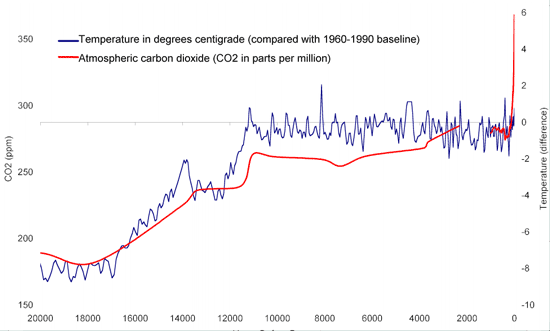
At the end of the last Ice Age, the level of Carbon Dioxide in the atmosphere soared. As the CO2 level rose, so did the temperature. Behold how closely the two lines track each other in the graph above.

Or in this one.

So you might say that the rising level of CO2 obviously caused the rising temperature, the retreat of the glaciers, and the origins of the modern climate. That's what this new study concludes, after making the most detailed comparison yet between temperature and CO2 levels:
A team of scientists led by Jeremy Shakun of Boston College re-examined the ages of more than 1,100 previously studied glacial boulders by measuring a particular isotope -- Beryllium-10 -- produced by exposure to cosmic rays.

They compared their findings, the most accurate so far, to the timing of the rise of carbon dioxide in the atmosphere, data gleaned from ice bubbles trapped in ice cores.

The results were unequivocal.

"The only factor that explains glaciers melting all around the world in unison during the end of the Ice Age is the rise in greenhouse gases," said Shakun.
Well, maybe. But what caused the rise in the carbon dioxide level? Where did all that carbon come from?
Scientists are still not sure what triggered the gradual release of CO2 into the atmosphere starting 19,000 years ago, or exactly where it came from.

"It's fair to say that the reason CO2 went up and down over the Ice Ages is one of the biggest palaeoclimate mysteries out there," Shakun said by email.

The most likely scenario, according to co-author Peter Clark of Oregon State University is that huge quantities of carbon bubbled up from the sea. "The carbon was likely released because of changes in the ocean and its circulation that were triggered by changes in the Earth's orbit around the Sun," he wrote in an email exchange.
So does that mean the real cause of the rise in temperature was  "changes in the Earth's orbit around the Sun"?

What these authors would probably say -- it's what most climate scientists say, anyway -- is that whatever caused the rise in carbon dioxide at the end of the Ice Age, the rise in carbon dioxide was the mechanism by which the planet was warmed. So the current rise in CO2 -- from 280 ppm over most of the past 12,000 years to about 400 ppm now -- is cause for alarm.

Climate scientists spout a lot of nonsense these days, but the reason they spout nonsense is that they are really freaked out by the red spike at the far right of that top graph. Until 1940 or so, temperature and CO2 tracked each other pretty closely. Since then, the CO2 concentration has soared, and temperature has not. When scientists try to model the climate, their equations keep telling them that those two curves must eventually come back into sync. That is, sooner or later the temperature must rise to match the rising level of CO2, because the two curves have always been so closely aligned in the past.

If you are a skeptic, you might say that we know no such thing. We only know that whatever global processed drove climate change in the past worked that way. Burning coal is something new in history, so maybe it will work out in a completely different way. And it might. But that seems to me like a risky bet that we would be fools to take.

Sunday, August 23, 2015

RIP Svetlana Boym

Svetlana Boym was a Russian-American scholar of literature, memory, and the experience of being in immigrant. Her most famous book was The Future of Nostalgia, 2001. In it,
Dr. Boym grappled with two essential questions: Can a past that has slipped out of reach be reclaimed by means of nostalgia? Should it ever be?

She identified two types of nostalgia, one salubrious, the other far less so. The first, which she called reflective nostalgia, centers, she wrote, on “longing and loss, the imperfect process of remembrance.”

That condition — a constant companion of the émigré — acknowledges that the past can never truly be reconstructed. In consequence, she argued, it fosters empathy and a bittersweet consolation.

In the other type of nostalgia, Dr. Boym said, lies danger. This type, which she called restorative nostalgia, seeks to resuscitate the past as rigorously as possible.

“This kind of nostalgia,” Dr. Boym wrote, “characterizes national and nationalist revivals all over the world, which engage in the anti-modern mythmaking of history by means of a return to national symbols and myths.”

She added: “Restorative nostalgia manifests itself in total reconstructions of monuments of the past, while reflective nostalgia lingers on ruins, the patina of time and history, in the dreams of another place and another time.”
I like my past ruined, and safely past. People who obsess over history for reasons of contemporary politics creep me out.

A Mural Created in 3 Minutes

Watch my old friend Liz LaManche create a mural for one of her clients in a 3-minute time lapse. More at her web site.

Mars One is not Feasible

On August 13 there was a debate over the feasibility of the Mars One mission between Mars One executives and two MIT students, Sydney Do and Andrew Owens, who took the position that the Mars One plan can't work. According to Tech Insider, the students won easily:
The final moments of the debate made it pretty clear who won: the MIT students.

They circled back to the point that the Mars One mission is fundamentally unsustainable because the cost grows as the number of people living on Mars increases. Both parties agreed a critical step is to figure out a way to efficiently build things and grow food on Mars.

But the most pressing problem is that everything about Mars One's plan is still preliminary and needs further research and development.

"The topic of this debate is 'Is Mars One feasible?'" Do said. "But these projects are very complex. It's a house of cards, if any of them them don't work, then the whole thing fails."

"If you're still developing concepts, then you don't really have a plan," he added.

It seems safe to conclude that in its current state, the Mars One plan is not feasible.
Love that graphic Do and Owens came up with. It compares the hardware of the Apollo mission and its actual cost in 2012 dollars with what Mars One says they can get for $6 billion. Ha ha.

Artists in the Digital Age

Steven Johnson takes a look at the economics of art in the digital age, which many people predicted would lead to an artistic apocalypse. He starts with the incomes of artists:
The closest data set we have to a bird’s-eye view of the culture industry can be found in the Occupational Employment Statistics, an enormous compendium of data assembled by the Labor Department that provides employment and income estimates. Broken down by general sector and by specific professions, the O.E.S. lets you see both the forest and the trees: You can track employment data for the Farming, Fishing and Forestry Occupations (Group 45-0000), or you can zoom in all the way to the Fallers (Group 45-4021) who are actually cutting down the trees. The best approximation of the creative-class group as a whole is Group 27-0000, or Arts, Design, Entertainment, Sports and Media Occupations. It’s a broader definition than we’re looking for — I think we can all agree that professional athletes are doing just fine, thank you very much — but it gives us a place to start.

The first thing that jumps out at you, looking at Group 27-0000, is how stable it has been over the past decade and a half. In 1999, the national economy supported 1.5 million jobs in that category; by 2014, the number had grown to nearly 1.8 million. This means the creative class modestly outperformed the rest of the economy, making up 1.2 percent of the job market in 2001 compared with 1.3 percent in 2014. Annual income for Group 27-0000 grew by 40 percent, slightly more than the O.E.S. average of 38 percent. . . .
OES data doesn't track self-employed people, so for that you have to use a different statistical set, the Economic Census:
If anything, the numbers from the self-­employed world are even more promising. From 2002 to 2012, the number of businesses that identify as or employ ‘‘independent artists, writers and performers’’ (which also includes some athletes) grew by almost 40 percent, while the total revenue generated by this group grew by 60 percent, far exceeding the rate of inflation.
So far as we can tell from the employment and income statistics, artists are doing ok. Johnson's overall conclusion:
Why have the more pessimistic predictions not come to pass? One incontrovertible reason is that — contrary to the justifiable fears of a decade ago — people will still pay for creative works. The Napsterization of culture turned out to be less of a threat to prices than it initially appeared. Consumers spend less for recorded music, but more for live. Most American households pay for television content, a revenue stream that for all practical purposes didn’t exist 40 years ago. Average movie-­ticket prices continue to rise. For interesting reasons, book piracy hasn’t taken off the way it did with music. And a whole new creative industry — video games — has arisen to become as lucrative as Hollywood. American households in 2013 spent 4.9 percent of their income on entertainment, the exact same percentage they spent in 2000.
This doesn't mean there haven't been casualties. The music industry has been hit hard, with many jobs lost; revenue from sales of recorded music has fallen by 75%. But if you ask me, the record companies brought that on themselves by forcing people to pay $18 for a cd with one decent song. After a decade of pressure from fans who just wanted to buy that one song, they brought ought cd singles that sold for $8. People felt robbed, and responded accordingly. I worry a little that similar feelings about cable companies might lead to a similar reaction, and it is the high price of cable that has ultimately supported the great creativity of TV in recent years. So cable companies need to get their act together.

That, it seems to be, is the real underlying point. Entertainment monopolies have been smashed, so if you want to make it in the arts, you have to deliver what people want to pay for. So far, that is working out fine for artists and great for the rest of us.

Saturday, August 22, 2015

The Garden in Late Summer

Some recent pictures of the garden in its late summer messy stage. The light is harsh because I have to take these in the early morning while the morning glories are open.


A Great, Bipartisan Idea in College Financing

One of the sad things about the college financing mess in America is that thousands of poor students who could go to college practically free don't know this. To find out how much financial aid you qualify for, you have to complete the dreaded FAFSA form, which is a major pain. Yet the IRS already has most of the information on the FAFSA, and supplying it again is really rather pointless. Now a bipartisan bill has been introduced into the Senate that would cut the FAFSA to two questions. And there is an even better idea out there, a plan to put a box you could check on your 1040 form directing the IRS to supply all your tax information to the financial aid bureaucrats. Wouldn't that be lovely?

Friday, August 21, 2015

Carroll Creek Park, Frederick, Maryland

I was in Frederick, Maryland today for a meeting. I arrived early, so I took a quick walk through the downtown, where I was startled to discover the wonderful plantings in Carroll Creek Park.

Frederick was founded along the banks of Carroll Creek back in the 1740s, but the creek has always been a mixed blessing for the town. It provided fresh water and power for mills, but it regularly flooded, inundating the downtown.

After terrible floods in 1972 and 1976 Frederick hit a real low point, with much of the downtown vacant. Local officials decided that they could never really bring the town back without bringing the creek under control. So they hired some engineers to carry out a study and develop a long-range plan.

The plan that eventually emerged had two parts. The first was to turn Baker Park, upstream from the town, into a sort of emergency holding basin, reconfiguring the landscape so the stream would flood the park instead of the town.

The second was gigantic underground concrete conduits along the route of the stream. That of course involved digging a huge ditch through the center of town along the creek. (Page from the Master Plan, which you can read here.)

Once the conduits were in place, the stream was directed through this canal over top of them, and a park was built along the canal. Just this year, as a sort of final touch, the canal has been planted with a beautiful array of lotuses and water lilies.


None of this has come cheap -- $24 million just for construction, and I'm sure millions more for engineering and planning. But it has worked spectacularly. Frederick is booming, with more than $150 million in private investment for new stores and offices just in the area that lines the park.

This is, I think, a model of how imaginative thinking can help reinvigorate a town. Projects like this make me wish I were a planner; I would love to design things like this. But notice how long it took; people began pushing for a solution after the 1976 flood, but the plan was not finished until 1991 and construction on the main phase is only now being completed. More work is planned farther downstream. These things take time, money, and decades of concerted effort.

The result has been an economic turnaroud, and a wonderful amenity for the people of Frederick.

And the ducks.


Unnecessary Surgery for Early Stage Breast Cancer

The latest:
As many as 60,000 American women each year are told they have a very early stage of breast cancer — Stage 0, as it is commonly known — a possible precursor to what could be a deadly tumor. And almost every one of the women has either a lumpectomy or a mastectomy, and often a double mastectomy, removing a healthy breast as well.

Yet it now appears that treatment may make no difference in their outcomes. Patients with this condition had close to the same likelihood of dying of breast cancer as women in the general population, and the few who died did so despite treatment, not for lack of it, researchers reported Thursday in JAMA Oncology.
Cancer diagnosis and treatment have reached, it seems to me, a very bad stage. Doctors are capable of detecting tiny tumors long before they cause symptoms, but can't tell which ones are potentially dangerous. By the time we are fifty, all humans have cancer somewhere in our bodies, but most of us die of something else before those cancers become dangerous. Removing every tiny node of rogue cells is a waste of time and also dangerous-- all surgery is dangerous, something we often forget.

Instead of learning to scan for ever smaller lumps, we should put our efforts into genetic testing that might reveal which tumors are potentially life-threatening. That way we could ignore the harmless ones, saving billions of dollars and untold worry.

Laurel Thatcher Ulrich, "The Age of Homespun"

Laurel Thatcher Ulrich is one of the greatest living historians, a master at bringing back the ordinary lives of the American past. She is the author of two amazing books. The first is A Midwife’s Tale: The Life of Martha Ballard based on her diary, 1785–1812 (1990), which is the richest and most compelling life of any ordinary person I have ever read. It achieved the rare feat of winning both the mainstream Pulitzer Prize and a raft of academic prizes in women's and social history. The second is The Age of Homespun (2001), which I have just finished reading. What I love about Ulrich's work is that she offers general insights into the past without making generalizations. She never says that "women" did this or "Indians" did that; she tells us about particular women and particular Indians and their families and neighbors and friends until a profound understanding arises from the mass of details.


The Age of Homespun is an unusual work of history, structured around an imaginary museum display containing ten objects. All of them were made by ordinary New Englanders between 1650 and 1850. All but one (the chest above) were made by women, and the chest bears a woman's name and was passed down through several generations of women. Three were made by Indians, the rest by Europeans. Starting out from an examination of each object, Ulrich explores who made it, and why, and how the maker learned her skills, and how the work was related to the maker's household economy and the broader economy of New England, and how it was passed down through the family, and why it ultimately came to be preserved in the collection of some museum or historical society. We meet all kinds of women, from poor cottagers on the margins to governors' wives. Some of the book is not very exciting -- although much is more interesting than a book about homespun cloth and hand-made baskets has any right to be -- but as a whole it is a revelation. From a kaleidoscopic array of sources Ulrich has assembled a crystal-clear window into the past lives of ordinary women, through which I gaze in wonder.

Ulrich has spent her working life among the women of old New England, and she writes about them as if she had known all of them and watched them grow up from girlhood. Her main source is their their diaries and letters, and those of their male relatives. To these wonderful documents she adds court records, business papers, newspaper stories and advertisements, sermons, speeches, and more. She does amazing things with the objects themselves, for in her hands they tell stories: tales of techniques transmitted from mother to daughter, or across oceans, or across the barrier dividing Indians from Europeans; tales of gift exchanges and marriage rites; tales of inheritance and memory. I never knew there was so much to learn from a bit of weaving or embroidery.

The importance of these objects for women's history is great. Ulrich has nothing to say about women being silenced or excluded. Her women do speak, not just in their diaries but with their needles and looms; they drive the economy with their efforts; they show off their skills; they interact directly with other women, neither hidden behind their husbands nor cut off from the cash economy. They earn their own money and win prizes in their own names. Their best work is beautiful, and they know it. They could not vote, but they did participate in politics, for example through patriotic spinning contests; the embargo politics of the Revolution and the War of 1812 would hardly have been possible without the home manufactures of women. Of course Ulrich understands how grueling this work could be, and all the pressure women were put under to be models of virtuous productivity. But there is no denying the joy some women took in their work, and the pride they felt in beautifully made cloth.

If you check out books and web sites devoted to debunking myths about the American past, you will often encounter the "myth" of homespun. But it was no myth; in the eighteenth century American women did spin, weave, knit and sew a huge amount of clothing and bed linen. In the nineteenth century first the spinning and then the weaving were taken over by machines, but women did not stop working with cloth. They simply shifted to other forms, such as quilting, embroidery, knitting, and the sewing of ever more elaborate clothes. Working with cloth was a major part of life for millions of women, and through the lens of their work Ulrich shows us much about them, their dreams, their struggles, and their place in the world of early America.

Thursday, August 20, 2015

Frank Gehry, Foundation Louis Vuitton

I think this looks pretty much like other Frank Gehry buildings, but on the other hand it doesn't look like anybody else's buildings. So you have to grant the man that he has established a strong personal style.

It's in the the Bois de Boulogne outside Paris, a pleasant setting.


The Foundation Louis Vuitton is one of the few private art museums in France, a product of the new era of billionaires rather than the old Colbertisme.


These interior shots seem cold and sterile to me.

But when you see the sort of art the thing was designed to display, you have to admit that only a cold, sterile building would do. That' s Spectrum XVIII by America painter Ellsworth Kelly.


I don't know what these are, and I don't care.

But Gehry can't be held responsible for the decline of our civilization, so I guess I will concede that he did his job well.