Saturday, September 24, 2011

"Closure" is Hooey

Is there any evidence that executing murderers brings "closure" to the victims' families?

No.

Dahlia Lithwick:
To the extent the data on the needs of victims suggest anything, it says there is no magical solution, no one-size-fits-all mechanism to afford closure to the victims and survivors of violent crime.
She cites a study by law professor Lynne Henderson:
Looking carefully at the existing psychological data on the needs of victims, Henderson discovered a wide array of victim responses to tragedy, responses that differ from victim to victim and that change significantly over a victim's lifetime. "In light of the existing psychological evidence," Henderson concludes, "common assumptions about crime victims—that they are all 'outraged' and want revenge and tougher law enforcement … fail to address the experience and real needs of past victims."
The government really played up the "closure" angle in the trial and execution of Timothy McVay, allowing victims' families to watch McVay's death via closed-circuit tv. Those who opposed his execution were shrugged off:
The survivors of the Oklahoma City bombings who didn't want to see Timothy McVeigh executed were not permitted to offer victim-impact statements at his sentencing. As Bruce Shapiro pointed out in this 1997 essay in Salon, the terror trial that made "victim closure" a national buzzword was structured such that "any victim or relative who wanted to play a part in the sentencing phase of the trial first had to pass a death-penalty loyalty test."
There is a voice for sanity here, an organization of people who have become death penalty opponents after executions they sought did nothing to bring peace to their lives. They call themselves "Murder Victims' Families for Human Rights." They have just issued a report arguing that executions only create more victims:
Murder Victims’ Families for Human Rights released a report entitled “Creating More Victims: How Executions Hurt the Families Left Behind.” Families of the executed are victims, too, according to the new report, which draws upon the stories of three dozen family members of inmates executed in the United States and demonstrates that their experiences and traumatic symptoms resemble those of many others who have suffered a violent loss. “I don’t think people understand what executions do to the families of the person being executed,” says Billie Jean Mayberry, one of the family members featured in the report. Mayberry’s brother, Robert Coe, was executed in Tennessee in 2000. “To us, our brother was murdered right in front of our eyes. It changed all of our lives.”
There was an amusing moment in one of my family gatherings a few years back, when my conservative father and I started to argue about the death penalty and the whole room immediately emptied. But it turned out we had a lot of common ground, because we both think that if the state is going to execute people it should be for a state purpose, not because of some psychological crap about helping the victims' relatives.

Fast Neutrinos and Time Travel

The big science news this week comes from Italy, where a very careful experiment called OPERA seemed to show that neutrinos travel a little bit faster than light. Nobody can find a flaw in the experiment, and it confirms a less certain finding from an American experiment done back in 2007. Still, not everyone is convinced:
Many experiments have looked for particles traveling faster than light speed in the past and have come up empty-handed. Most troubling for OPERA is a separate analysis of a pulse of neutrinos from a nearby supernova known as 1987a. If the speeds seen by OPERA were achievable by all neutrinos, then the pulse from the supernova would have shown up years earlier than the exploding star's flash of light; instead, they arrived within hours of each other.
So the result may be wrong. If it is correct, then there is something wrong with Einstein's theory of special relativity. If there is something wrong with special relativity, there is a big hole in all of our physics, because special relativity is, in our models, the bookkeeping by which the universe make sure that effects follow causes, and that the laws of science are the same for everyone. If it does not hold, there may be ways in which those laws can be very different for some observers in some situations -- a very big can of worms.

A lot of the secondary news about this story focused on time travel. This is because in Einstein's model, the closer you are traveling to the speed of light, the slower time passes for you. If you could travel exactly the speed of light, the equations imply, time for you would be frozen. Some people think this means that if you traveled faster than light, you would be traveling backward in time.

But this is, as my wife says, "just math." At the speed of light the equations break down and generate zero or infinite results, so one shouldn't place too much confidence in them. And the whole business of particles traveling back in time is a purely mathematical construct. If you graph the relationship between a particle's speed and the passage of time, it approaches closer and closer to an axial line representing the speed of light. (Imagine the old x/y plane from high school algebra.) Mathematically, this curve also has a negative version on the other side of the axis, and this mirror image might (might) represent particles traveling faster than light. But since nobody has, until now (maybe), seen a particle traveling faster than light, it would be dangerous to assume that they obey laws we understand. Remember that the backward in time business is not Einstein's own interpretation of special relativity; he thought special relativity made faster than light travel impossible. So any predictions special relativity makes about things traveling faster than light should not be taken too seriously.

And yet one more caveat: neutrinos are weird little things that interact very weakly with other matter -- trillions of them pass through your body every second -- so even if they can sometimes travel faster than light, other kinds of matter (like us) still may not be able to.

Friday, September 23, 2011

And then the Sunset

This was the view as Clara and I left her first gymnastics class this evening.

And a few minutes later.

The Rainbow

Over Catonsville this evening, our reward after a week of rain.

Tamerlane?

This sculpture of the Tatar conqueror Timur or Tamerlane was made to the specifications of Russian archaeologists, who opened Timur's tomb in 1941 and made a cast of the skull.

I know nothing about the technique used to recreate this face from the skull, but I have seen some good results done by police artists using unfancy technology, so I imagine this is not too far off.

I also have no idea why Soviet archaeologists were opening the tombs of 14th-century conquerors in 1941. Trying to increase support for the war effort among Turks and Uzbeks?

At Least It's Different

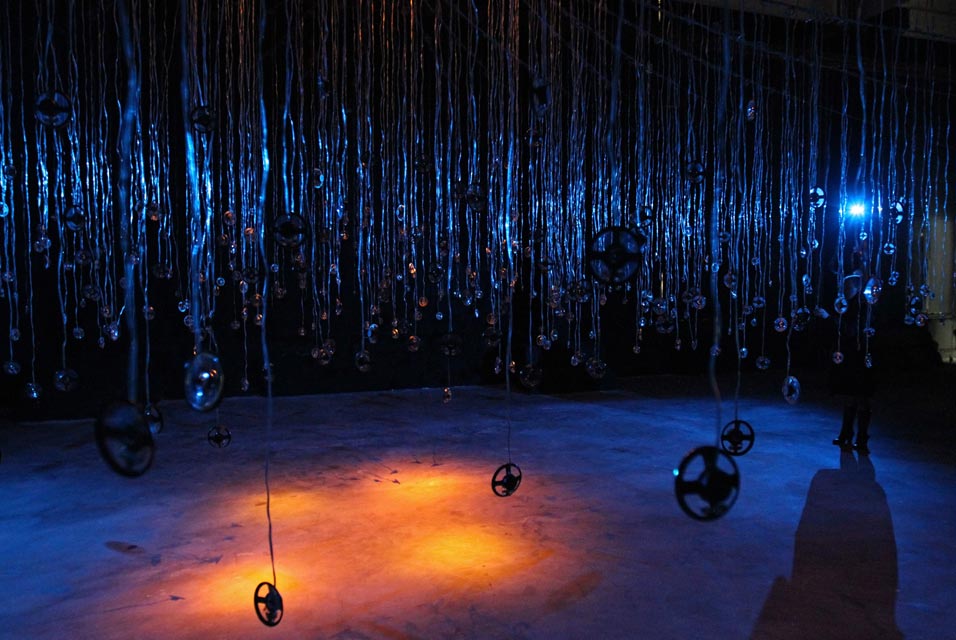
Stahiweg, an installation by German artist Christoph Schlingensief at the 4th Moscow biennale of contemporary art. I was going to start my comments on this piece, "At least it doesn't look like every other _____ you've ever seen," but I couldn't think of what would go in the blank.

Soon everybody will have a biennale, I guess. Below are two more works at the Moscow biennale, first Witness 2000 by
Susan Hiller and then Houndingdown by Indian artist T.V. Santhosh.

Thursday, September 22, 2011

Pakistan's Double Game

Today on the Af-Pak front:

The top U.S. military officer on Thursday accused Pakistan’s military intelligence agency of directing the operations of the group blamed for last week’s attack on the U.S. embassy in Kabul, warning that the time has come for Islamabad to stop supporting terrorists.

“The Haqqani network acts as a virtual arm of Pakistan’s Inter-Services Intelligence agency,” Adm. Mike Mullen, chairman of the Joint Chiefs of Staff, told the Senate Armed Services Committee. He said the agency was implementing Pakistani government policy in its support of the group, which has also been blamed for numerous other deadly attacks on U.S. troops in Afghanistan.

“The support of terrorism is part of their national strategy. That’s got to fundamentally shift,” Mullen said. “By exporting violence, they have eroded their internal security and their position in the region. They have undermined their international credibility and threatened their economic well-being.”

Mullen’s warning — the bluntest yet from any senior U.S. official — was echoed by Defense Secretary Leon Panetta, who repeated his own warning first delivered Tuesday that the United States would act unilaterally to stop the attacks if Pakistan does not crack down on the group, which is based in the lawless tribal areas near the Afghan border.

Our Afghan strategy is founded on something we have never had, Pakistani cooperation. Their double, triple game ensures that no government not strongly allied to Islamabad can ever govern Afghanistan peacefully. Unfortunately for everyone, that means nobody will govern Afghanistan peacefully for a long time to come.

Another Meltdown, Anyone?

All of the Republican Presidential candidates have come out against the Dodd-Frank financial regulation bill. I am sure the bill has problems, but none of the candidates has offered any concrete suggestions for improving it. They just keep saying that we should deregulate the banks and then let them fail next time they get themselves into trouble.

This is crazy, but enough Americans share this particular madness that taking this stand will probably not hurt the Republican nominee.

It grows on you

I started out in life not likin' anything, but then it grew on me. Maybe that'll happen to you.

--A waitress in Gainesboro, Tennessee to William Least Heat Moon

The Bones of Basque Whalers

Canadian archaeologists have found the skeletons of more than 100 European men buried in Labrador's Red Bay in the decades around AD 1600. They say the bones are the remains of Basque whalers, who came to Labrador hunting right and bowhead whales.

Whaling was a dangerous business. At this one whaling station, more than 100 men were buried who never made it back home. Surely that is more than one a year for the duration of this whale fishery, and even more must have been lost at sea.

Wade Graham's California Garden

Times profile of Wade Graham, Los Angeles-based landscape architect who plants Bearss lime trees because the fruit “makes the best vodka tonic you’ve ever had in the world” and is
the type of gardener who plants a thicket of privacy shrubs around the perimeter of the property. “Americans, in general, want to see inside you,” he said. “We want people to have no skin but just, like, Plexiglas. We want to know about their private lives and stuff. I don’t want to know about anyone’s private life.”

Graham considers gardening a form of self-expression:
We ask our gardens “to speak for us,” Mr. Graham writes in a book introduction, “often assigning them certain lines in the play that we write about ourselves.”
This tropical California fantasia is not at all my sort of garden, but then I am nothing like Wade Graham. I share his belief that a garden should be a personal thing that expresses something about the creator. Which is why mine is an overgrown mess full of the most traditional European flowers.

Zekiah Fort!

Ok, so you may never have heard of Zekiah Fort, but it has merited at least a sentence in every one of the dozens of "historical background" sections I have written for projects in Maryland. Now, after 80 years of searching, it has been found:

The fort was established in 1680 by Gov. Charles Calvert, the third Lord Baltimore, for the protection of the Piscataway people and other Maryland Indian groups that were the targets of raids by "foreign" Susquehannock and Seneca warriors from the north.

Five weeks of digging this spring and summer, led by St. Mary's College of Maryland anthropologist Julia King, have turned up Indian pottery mixed with glass trade beads, arrowheads fashioned from English brass, gun parts and a silver belt hanger for an English sword.

The artifacts, the hilltop position, a nearby spring and rich soils to support an Indian settlement of 90 to 300 people - it all signaled that the search was over.

"I have no doubt this is the site of Zekiah Fort," King said. A formal announcement was planned for Thursday.

Anne Arundel County archaeologist Al Luckenbach, who visited the site with his crew to assist in the dig, said there's little doubt about the discovery.

"I think she's found it," he said. "The location is nothing but defensive. It's hidden; it's away from the water where we normally find (Indian) sites; it's away from the road (Route 5, once an Indian trail), back in the interior there, sitting on top of this hill. ... The only reason for being here is if you're trying to hide."

Wednesday, September 21, 2011

Alexandre Benois, Watercolors

Watercolors by Alexandre Benois (1870-1960), a Russian artist who spent much of his adult life in France. He is probably best known today as a stage designer for theater and ballet, but I love these watercolors. Above, an Italian courtyard.

Versailles, 1905.

The Venetian Garden at Versailles, 1910.

Grand cascade at the Peterhof, 1918.

Birthplace of Maurice Ravel, 1914.

Entrance to a house in Lugano.

Lake Primel, Brittany (or so Google translated from the Russian), 1910.

Orthanc in London

Renzo Piano's new skyscraper, known as "The Shard," is rising above London. When finished it will be the tallest building in the European Union. And look so much like Peter Jackson's Orthanc that I have to wonder if this is some sort of homage or satire.

Below, the Shard this month.

Counting the Dead from the Civil War

J. David Hacker has an interesting column in the Times on using demographic methods to estimate the number of men killed in the Civil War. The number has been disputed since the war ended, since the numbers listed in the official records obviously missed many casualties:
Even as Civil War history has gone through several cycles of revision, one thing has remained fixed: the number of dead. Since about 1900, historians and the general public have assumed that 618,222 men died on both sides. That number is probably a significant undercount, however. New estimates, based on Census data, indicate that the death toll was approximately 750,000, and may have been as high as 850,000.
The new estimates rely on creating a profile of the population, based on age and sex, and then showing how many men were "missing" in 1870. If the new estimates are right, about 1 in 10 American men died as a result of the war.

Rick Perry and the Boy Scouts

Justin Elliott finds the key to Rick Perry's politics in a book -- not Fed Up, his 2010 political manifesto, but his 2008 love offering to the Boy Scouts:

Where Fed Up was a feat of opportunism, an attempt to pander to the newly-founded Tea Party, his earlier book was both a true labor of love (he received no advance and donated all proceeds to the Scouts’ legal defense fund) and a stirring call to protect the integrity of the nation’s traditions. For the Perry of On My Honor: Why the American Values of the Boy Scouts Are Worth Fighting For “culture war” is no mere euphemism: He not only thinks of military siege as an apt metaphor for the state of American culture—he’d like to enlist Boy Scouts as his preferred ground troops.

In that way, On My Honor’s odd mix of autobiography and polemic underscores what truly animates Perry—and, needless to say, it isn’t tax policy. His real political passion is the protection of traditional American institutions against elitist attacks. It’s no accident that even though Perry’s campaign is supposed to be founded on his economic record as governor of Texas, he’s been having trouble staying on message.

In making his book-length indictment, Perry paints with a startlingly wide brush. “Student campus unrest, rejection of authority, the ‘self-esteem’ movement, moral relativism, and the demands of secularists all gradually fused into a series of attacks on American institutions,” he writes in the book. We learn that he disdains “secular humanism,” the “self-esteem movement,” and youth sports leagues that don't keep score. For good measure, he compares homosexuality to alcoholism, and supports corporal punishment of children.

It is amazing to me how many people's politics are all about things that have almost nothing to do with the government. Rick Perry loves the Boy Scouts and hates hippies. Fine, that's his business. But it becomes our business when people whose main interests are cultural gravitate to politics and rather thoughtlessly take positions they identify as "conservative" on other issues, especially taxation and foreign policy. If what you really want is to preserve small town American life, then you should not be opposed to the regulation of business, because it is mainly unregulated capitalism that is remaking the country. Small town values are under attack, not from liberals, but from capitalism. Yes, there are a few hot button issues (abortion and acceptance of homosexuality are the main ones) where the government is heavily involved in Perry's concerns. But by and large Perry's agenda is apolitical. I think the confusion of the nostalgic moral crusade with pro-business, anti-tax policies is a huge corrupting factor in American politics, leading many people to vote for things they don't really support.

The End of Don't Ask, Don't Tell

As the Post put it, the Pentagon is eager to "declare victory and move on." And that is exactly what they should do. They have a job to do and should get on with it. Working out the implications of this freedom is now up to soldiers and sailors themselves. Some will make a hash of it. Most will do ok. That's life.

It is worth pausing to note that another gross injustice has been removed from American life.

Police Misconduct and Troy Davis

Yesterday the Georgia parole board refused the clemency request of Troy Davis, facing execution for the killing of a Savannah police officer. His case is a catalog of error and abuse:

The grievous errors in the Davis case were numerous, and many arose out of eyewitness identification. The Savannah police contaminated the memories of four witnesses by re-enacting the crime with them present so that their individual perceptions were turned into a group one. The police showed some of the witnesses Mr. Davis’s photograph even before the lineup. His lineup picture was set apart by a different background. The lineup was also administered by a police officer involved in the investigation, increasing the potential for influencing the witnesses. . . .
Under proper practices, no one should know who the suspect is, including the officer administering a lineup. Each witness should view the lineup separately, and the witnesses should not confer about the crime. . . .

Seven of nine witnesses against Mr. Davis recanted after trial. Six said the police threatened them if they did not identify Mr. Davis. The man who first told the police that Mr. Davis was the shooter later confessed to the crime. There are other reasons to doubt Mr. Davis’s guilt: There was no physical evidence linking him to the crime introduced at trial, and new ballistics evidence broke the link between him and a previous shooting that provided the motive for his conviction.

The thing is, this sort of behavior by police departments is actually routine, and we only hear about it in these death row cases. Thousands of men are in jail now and will be for decades after even clumsier investigations and trials. I suppose most Americans don't care because the police almost always pick out low-life guys with dubious backgrounds for this kind of treatment, most of whom may well be guilty of something. But to me these case show a very troubling indifference to justice in America.

Tuesday, September 20, 2011

Broch o' Gurness, Orkney

A view up the avenue leading to the broch of Gurness in the Orkney Islands.

A Drizzly Morning in Delaware

Working this morning at a site in the yard of a 1970s house in Delaware. Most of it is actually in a paddock that held horses until yesterday, hence the fences. The site includes both a prehistoric camp -- there's a little stream in those trees in the back -- and a historic farm that may go back to 1739. So far, though, we're mostly finding stuff from the 1800s.

Wes, from my crew, digging carefully into a feature that looked good on top but turned out to be a groundhog burrow.

View of the site from an impressive goldenrod thicket.

And some more flowers.

Pictish Chieftains and Roman Civilization

Scottish archaeologists working near Strathearn, in the lowlands north of Edinburgh, have uncovered the remains of a Pictish broch dating to the 1st to 2nd centuries AD. Brochs were the homes of chieftains, each centered on a massive stone tower. This large site was probably home to one of the most important families in Scotland.

Among the finds is an artifact obtained by trade with the Romans. What could this object be? An ornamented helmet, perhaps? An elaborate bronze lamp? A jeweled necklace?

A saucepan. Of all the things to ship from southern Gaul to Britain, and then carry overland across the border of Roman rule to a barbarian chieftain's stone tower on a hilltop at the edge of the civilized world. What does it mean?

Evil Cannibals Step out of the Cartoon

Nothing says "evil cannibals" like human skulls on stakes. But did anyone ever actually put human skulls on stakes? Yes! Here, from an 8,000-year-old Mesolithic site in Sweden, are two human skulls mounted on stakes. Fragments of nine other skulls were also found at the site. So now you can include skulls mounted on stakes in your anime/fantasy novel/adventure movie without fear of being called inaccurately sensationalistic.

Harnessing Nerd Brainpower

AP:

Online gamers have achieved a feat beyond the realm of Second Life or Dungeons and Dragons: they have deciphered the structure of an enzyme of an AIDS-like virus that had thwarted scientists for a decade. . . .

Figuring out the structure of proteins is vital for understanding the causes of many diseases and developing drugs to block them. But a microscope gives only a flat image of what to the outsider looks like a plate of one-dimensional scrunched-up spaghetti. Pharmacologists, though, need a 3-D picture that "unfolds" the molecule and rotates it in order to reveal potential targets for drugs.

This is where Foldit comes in.

Developed in 2008 by the University of Washington, it is a fun-for-purpose video game in which gamers, divided into competing groups, compete to unfold chains of amino acids -- the building blocks of proteins -- using a set of online tools. To the astonishment of the scientists, the gamers produced an accurate model of the enzyme in just three weeks.

Cracking the enzyme "provides new insights for the design of antiretroviral drugs," says the study, referring to the lifeline medication against the human immunodeficiency virus (HIV).

It is believed to be the first time that gamers have resolved a long-standing scientific problem.

"We wanted to see if human intuition could succeed where automated methods had failed," Firas Khatib of the university's biochemistry lab said in a press release. "The ingenuity of game players is a formidable force that, if properly directed, can be used to solve a wide range of scientific problems."

The mental energy of the world's online gamers is enormous, and if more ways could be found to use it, all sorts of things might be accomplished.

Monday, September 19, 2011

The Lovers of Valdaro

This Neolithic double burial was uncovered in Italy back in 2007, on the outskirts of Mantua. Both the man (left) and the woman (right) were aged 18 to 20 when they died, around 4000 BC. This is a deliberate burial, so they were buried in this embrace. The discovery got a lot of play in the Italian press at the time, and reporters called them "stone age Romeo and Juliet" before settling on the "Lovers of Valdaro" as their title. The grave was removed from the ground as one piece and has just gone on display in Mantua.

Tomas Saraceno

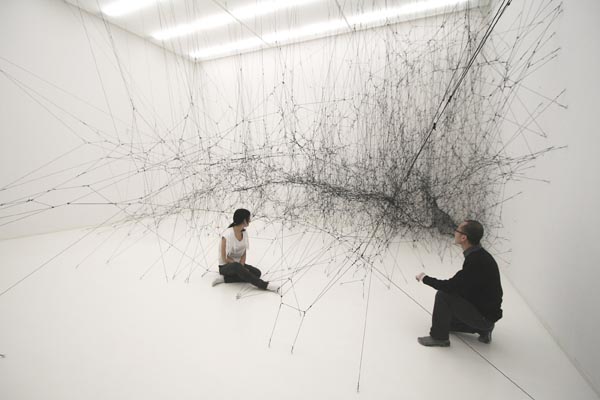
Argentine artist Tomas Saraceno is one of the most interesting contemporary artists working in the field of big "installations." I like his work because it combines high intellectual and conceptual content with a striking visual impact; you can look at these and say "wow, that's cool" without giving any thought to what they are about. Or, you can try to understand their connection to the history of the universe and what all.

Above, part of his "14 Billions" installation, 2010, which "uses the imagery and structure of spider webs to map the origin and structure of the universe."

Flying Garden.

Sunny Day, 2006.

Cloudy House, 2009

More Samarkand

I love the way the ancient patterns of the city show up in the clothes of the modern residents and the pottery for sale to tourists.

Making Police Lineups Better

Criminologists are finding ways to reduce the troubling incidence of false identifications in police lineups. The most important step is making the procedure "double blind," that is, making sure the people conducting the lineup are not part of the case and don't know which guy is the suspect. When the lineup is conducted by the arresting officers, they send clues that have been shown to influence the witness toward the guy they already suspect. Another technique is "sequential" lineups, that is, presenting the witness with a series of photographs of possible suspects one after another, rather than all at once. A new study finds that this reduces the rate of false identifications from 18 percent to 12 percent.

And that's good, but 12 percent is still a troublingly high figure for false identificationss. At least with the double blind system in place, the false ids are probably pretty random, and therefore don't have very important consequences for the wrongly identified man.

Sunday, September 18, 2011

Lucasfilm Sandcrawler

The new Lucasfilm office in Singapore.

Child Beauty Pageants

Would somebody tell me why, in a society so paranoid about child abuse that you can be sent to jail for having a cartoon picture of a naked child on your computer, we tolerate this? I am not much into banning things myself, but if I were going to ban anything I think it might be beauty pageants for young children. Ick.

Planting Tulips

Clara helping me plant tulips in the herb garden, today. These are the bulbs I gave Lisa for her birthday, and I planted them where she will see them the most. I took the opportunity to dig up most of the oregano that had taken over the western half of the herb garden and pull lots of other weeds. It felt good to get this taken care of. And now I will just have to buy lots of new herbs to fill up the space.