Saturday, November 5, 2011

The Medieval Churches at Banganarti, Sudan

Scholars have been investigating a group of medieval churches at Banganarti in modern Sudan, on the Nile between the third and fourth cataracts. The sanctuary was a center of healing and pilgrimage dedicated to Raphael, the angel who became in medieval Christianity the patron saint of the blind. Above is a reconstruction of how the Upper Church looked in AD 1100.

Fresco of Saint Damian.

Portrait of a Nubian ruler named King David.

One of the many inscriptions found at the site is in Catalan, written by a man 2000 miles from home. It says, "when Benesec came to pay homage to Raphael."

The man in this sketch is identified as Deif Ali, Arabic for "Ali the Guest." He was probably a Muslim. Since he is depicted as blind, he probably came to pray to Raphael for help with his infirmity.
In the lower church, built around AD 600, are amazing frescoes done in a style more western than Byzantine, suggesting further connections to Europe. These are damned souls in hell.

Hard Work and Moneymaking

Matt Yglesias responds to the same Will Wilkinson column that inspired my post below:
But if I look at America today, what I see undermining any meaningful notion of work ethic is a kind of run-amok ethic of moneymaking. The old Calvinist idea about money, as I understood it, was that hard work, discipline, and prudence were moral virtues. They were also things that are more likely than not to lead to personal prosperity. So prosperity shouldn’t be stigmatized as ignoble, it should be rather seen as something likely to flow from virtuous behavior. But this equation assumes that morally speaking what matters is the hard work, the discipline, and the prudence. Cutting corners, lying, cheating, or stealing to make a quick buck doesn’t fit the bill. Earning a multi-million dollar salary to deliver below-average performance as the CEO of a firm and then take a multi-million dollar golden parachute when you get sacked doesn’t fit the bill. Spending your days and nights dreaming up smart regulatory arbitrage schemes doesn’t fit the bill. In terms of what it says about your personal virtue, if you’re going to earn your keep identifying and exploiting previously unknown loopholes in the legal framework, you may as well just go out and break the law.

Starlings


I love these videos. Starling flocks don't have leaders, they just respond to the birds around them, so these amazing patterns emerge from thousands of individual acting on their own.

The Mechanical Galleon

Perusing the British Museum's History of the World in 100 Objects, I was struck by the inspired choice of this charming toy.

The galleon was made by Hans Schlottheim (1544 - 1625) who produced many mechanical automata for the princes who collected such things:
This mechanical galleon is in fact an elaborate, automated clock. Its mechanism no longer works but originally it would have played music, fired its cannons and trundled across the table at imperial banquets. Clocks like this were important status symbols in the courts of Europe in the 1500s and this clock is based on the great European ships that sailed the oceans during this period.
The figures on the deck are the Holy Roman Emperor and the Seven Electors, the Dukes and Bishops who chose the emperor. When the galleon was made the Holy Roman Emperor was the Hapsburg Rudolf II, and the galleon was an allusion to the Spanish treasure fleets that enriched the Hapsburg family.

The mechanical galleon is an inspired choice because it combines two of the key technologies of the Renaissance: sailing ships and the mechanical clock. It was the ships that made the age of world empires possible, that united the old world with the new, and that launched the modern economy. The caravels, fluyts, galleons and barques were not the first ocean-going ships nor even necessarily the best of their time, but they were good enough and they could be built at reasonable cost, so in their thousands they made Europe the center of a newly united world. It is hard to see how the modern world could have come about without the ships and the skill and daring of the men who sailed them across the stormy oceans.

The effects of the mechanical clock are more subtle but equally profound. These clocks changed our understanding of time and therefore the way we work and live. They created a class of craftsmen who made mechanical objects for a living, and who could then turn their skills to making everything from improved guns to mechanical looms. They launched a fad for ingenuity and invention that, as much as anything else, defines the modern age: other cultures have mostly been satisfied to do things in the old way, but we are constantly looking for some way to do better, or just for some entertaining novelty.

Ours is the global age, the mechanical age, the age of change for its own sake, and this object wonderfully represents all of those things.

Hard Work vs. Luck

Will Wilkinson has an interesting post about the very different ways conservatives and liberals think about wealth and poverty. He summarizes:
Liberals tend to explain both poverty and wealth in terms of luck and the influence of social forces while conservatives tend to explain poverty and wealth in terms of effort and individual initiative.
Absolutely true; my liberal take on the social origins of wealth is here. And this is why, as Wilkinson notes, libertarians usually end up allied with conservatives in American politics, despite their very different personalities:
As long as they stick to complaining about handouts for poor people sitting on their asses and praising rich people working hard to make civilization possible, libertarians and conservatives get along fine.
I would like to insert a few caveats here. My main objection to the conservative notion that wealth comes from hard work is at the top of the pyramid, not the bottom. Think about this: do corporate executives work harder than janitors or coal miners? I submit that they do not. Or, do corporate executives work harder today than they did in 1955, when their salaries were much, much lower? No, they do not. Does anything about the way people work explain the increasing inequality in America, that is, the ever growing ratio between the salaries of CEOs and the wages of factory workers? No, not at all. Inequality is growing because the rich have gotten more shameless and more clever about exploiting their positions to enrich themselves, along with (possibly) some effects of globalization. This insight explains why I support much higher taxes on the very rich, and why I get furious whenever I see people with money congratulating themselves on how hard they work to earn it.

On the other hand I agree that at the bottom income has a lot to do with personal choice and failings. Consider the people you know who are poor, or who have fallen far below the standards of living of their parents, and you will surely see that most of them have serious problems: drugs, alcohol, divorce, poor mental health. Or else they chose to give up middle class life for a shack in the mountains somewhere. I believe that in America reasonably healthy people with normal intelligence can make a decent living if they put their minds to it.

But I still think that the conservative/libertarian critique of the "welfare state" is off base. First, in America we actually spend little money supporting healthy poor people. Conservatives seem to imagine that we spend hundreds of billions supporting lazy layabouts who ought to get off their buts and get a job. We do not. The only "welfare" program in America that spends real money is Medicaid, which pays for health care, and most of that goes to people who are really sick, or else to children. There are certainly some slackers collecting Social Security disability payments, but only the hardest core libertarians think we should abandon that program altogether, and as long as it exists some people will exploit it.

I generally accept the notion that people are poor in America because of something that is wrong with them, not some flaw in capitalism. But that something is often not their fault -- the best predictor of poverty in America is mental illness, and I think we should absolutely be taking care of people with medical problems. And even where people have genuinely screwed up -- and this is the key point -- what are we going to do about it? Many conservatives think that the existence of miserable poverty is good and important, because it motivates people to work hard. If there is no penalty for failing to get up and go to work in the morning, the argument goes, more and more people will opt out of work and society as a whole will get lazier and less productive. Liberals think that if you give people the help they need, a lot fewer of them will end up poor.

Consider a 22-year-old single mother who had a child at 16 and dropped out of high school and generally screwed up her life but now wants to get back on track. I suppose the conservative attitude would be to say, "great, work hard, we're pulling for you." A liberal asks what we as a society can do to help her and her child. What does she need? Child care? Free GED classes? drug treatment? Help finding a job? What if she want to become, say, a medical tech of some kind. A liberal wants to provide her with free or at least very cheap classes at the local community college. Is that some kind of disreputable handout that cheats the people whose taxes pay for it, or is it how we create a world in which everyone really has a chance to rise or fall by his own efforts?

My biggest complaint about conservative economics is the element of bad faith. It is simply not true that low tax, low regulation societies have more social mobility; more poor people rise into the middle class in Denmark and Sweden than here. It is not true that low taxes on the rich help to create a more dynamic economy in which poor people can get ahead more easily. It is not true that governments fail at everything they attempt, or that they are inherently less efficient than private firms. When conservatives spout these lies, I hear the desperate self-justification of greedy people who just hate paying taxes because they don't give a damn about anyone else. To create a society with real equality of opportunity -- something conservatives claim to believe in -- actually takes massive government intervention, not lower taxes on millionaires. A society in which everyone actually has the same chance to succeed or fail by his own efforts has never yet existed, and we still have a long way to go to create one.

Ikenaga Yasunari

Contemporary Japanese artist who seems to paint only women and cats. Or maybe, women's faces surrounded by Japanese fabrics. Above, Emiko. Below, top to bottom, Manami, Mai, and Sachiko. More at the artist's web site.

Friday, November 4, 2011

Archaeology on the Shenandoah River

I visited an archaeological site yesterday along the Shenandoah River in Virginia that some of my colleagues are excavating for a bridge replacement. The site is stratified, with major components in the Late Woodland (ca. 900 to 1300 AD) and Early Woodland (ca. 1350 to 800 BC) periods, separated by a nice sterile zone. There are complications with the stratigraphy and the dating, but I think the excavators will be able to sort everything out and get some good results.

Cleaning up a hearth in the Early Woodland layers. This and numerous other features produced datable charcoal, so the site should produce a good suite of dates.

Nice view from the site, and it was a gorgeous day.

Winchester's Young George Washington

I was in Winchester, Virginia yesterday, and I admired their statue of George Washington as a young man, by Malcolm Harlow. I mean, the guy wasn't born old. Harlow, the sculptor, is better known as one of the main stone carvers at the National Cathedral.

Young Men Living with their Parents

According to the Census Bureau, 19% of men aged 25 to 34 are currently living with their parents, up from 14% before the recession.

I have three sons. I think that means the chance that all three will be living elsewhere when the youngest hits 25 is 53% (0.81*0.81*0.81), so the odds of a quiet retirement are still (barely) in my favor.

Of course, I also have two daughters, and the Census Bureau says that 10% of women aged 25 to 34 are living with their parents. So my chance of having an empty nest is really only 0.81*0.81*0.81*0.90*0.90, or 43%.

Boris the Torturer

Glenn Carle reviews the new memoir by FBI Agent Ali Soufan:
The third theme of The Black Banners is the most disturbing, poignant and effective section of the book: Soufan's growing disgust at how the interrogation methods developed and imposed on the intelligence community by the Bush Administration undermine our principles, break our laws, and do not work-indeed, how they actually hinder our intelligence work. Soufan and his colleagues in the FBI had been successfully interrogating terrorists for years before the sudden introduction of "enhanced interrogation techniques"-"torture" is the word a layman would use. We see convincing, devastating proof in his detailed descriptions of how, in case after case (e.g., Jamal Al-Fadl, Abu Jandal, Abu Zubaydah, Khaled bin Rasheed and on and on) he and his colleagues successfully interrogated al-Qaeda members by "establish[ing] rapport" with them, by talking about religion, or family, by sharing a taste for sweets, or by laughing with them, if necessary, rather than by intimidating and physically abusing a detainee. He describes his and his colleagues' consternation when confronted with the snake oil salesmen who peddled and imposed "enhanced interrogation techniques"-a pseudo-expert the CIA brought in to oversee interrogations, whom Soufan gives the appropriately menacing and foolish sobriquet "Boris"-who had never conducted an interrogation, knew nothing about terrorism, and who knew nothing about intelligence work. "Why is this necessary" Soufan asked when first confronted with such measures as sensory deprivation, overload, or humiliation, "given that Abu Zubydah is cooperating?" As "Boris" tinkered with ever-increasingly harsh, and ever-ineffective, ways to break detainees, Soufan and his colleagues tried to oppose them, but as was the case with everyone involved in the interrogation program (myself included,) failed. Soufan and the FBI formally ceased any involvement in the case. "I can no longer remain here. Either I leave or I'll arrest [Boris]." It is telling that, to my knowledge, four individuals with first-hand experience in interrogations during the "War on Terror," have spoken out about enhanced interrogation methods: two Air Force officers (Steve Kleinman and another officer writing under the pseudonym Matthew Alexander), an FBI officer (Soufan), and a CIA officer (myself). All of us, independently, make the same points: interrogation must be based on rapport; enhanced interrogation methods are ineffective, counterproductive, immoral, illegal, and unnecessary, and they had nothing to do with obtaining much, if any, information not otherwise obtainable. It is only apologists for the Bush Administration, or Bush Administration policymakers themselves, who assert that "enhanced interrogation techniques" are legal, or work. Soufan is devastating about these methods: "The person or persons running the program were not sane....the interrogation was stepping over the line from borderline torture. Way over the line." "In FBI headquarters, the situation was clear....What Boris was doing was un-American and ineffective."

Is Iraq Lost?

Krauthammer has a savage go at Obama today, blaming him for "losing Iraq." After all the successes of the Bush years, Kratuhammer tells us,
Obama was left with but a single task: Negotiate a new status-of-forces agreement (SOFA) to reinforce these gains and create a strategic partnership with the Arab world’s only democracy.
He blew it. Negotiations, such as they were, finally collapsed last month. There is no agreement, no partnership. As of Dec. 31, the U.S. military presence in Iraq will be liquidated. . . .

Three years, two abject failures. The first was the administration’s inability, at the height of American post-surge power, to broker a centrist nationalist coalition governed by the major blocs — one predominantly Shiite (Maliki’s), one predominantly Sunni (Ayad Allawi’s), one Kurdish — that among them won a large majority (69 percent) of seats in the 2010 election.

Vice President Biden was given the job. He failed utterly. The government ended up effectively being run by a narrow sectarian coalition where the balance of power is held by the relatively small (12 percent) Iranian-client Sadr faction.

I find this baffling. How on earth were Obama and Biden supposed to force Iraqi politicians who mistrust each other -- maybe hate is a better word -- to form a coalition government? More to the point, is it really any of our business how elected Iraqi politicians manage their affairs? Iraq is, as Krauthammer reminds us, a democracy, which means (or ought to) that Iraqi leaders are answerable to their constituents, not US interests.

The second failure was the SOFA itself. U.S. commanders recommended nearly 20,000 troops, considerably fewer than our 28,500 in Korea, 40,000 in Japan and 54,000 in Germany.
But, see, the Iraqis don't want us there. Really don't want us there. And one of the big reasons they don't want us there is all the Iraqis we killed during the fabulously successful Bush administration. We acted like conquerors, like occupiers, and as a result we are hated. And since Iraq is now a democracy, something Krauthammer seems proud of, the will of the vast majority prevailed and we are going to leave. Isn't that what is supposed to happen?

I also dispute that Iraq was really in such great shape when Bush left office. Many US officers and diplomats thought then and still think that renewed civil war was all but inevitable. Bombs go off every week, killing dozens or hundreds.

Personally I think Iraq is likely to muddle through as a semi-democracy, with a high level of violence but not open war. And I think the presence or absence of 20,000 US troops would not have much impact on the matter; any added stability they might provide to the government would be balanced by the anger they create among Sadrites and other nationalists, besides spreading the sense that the government represents the US rather than Iraqis. So I think our leaving Iraq, in a way that does not look like a retreat, is the best possible outcome.

If Iraq was ever "won," it has not been "lost," and now the matter is in the hands of Iraqis, where it belongs.

Roman Portus

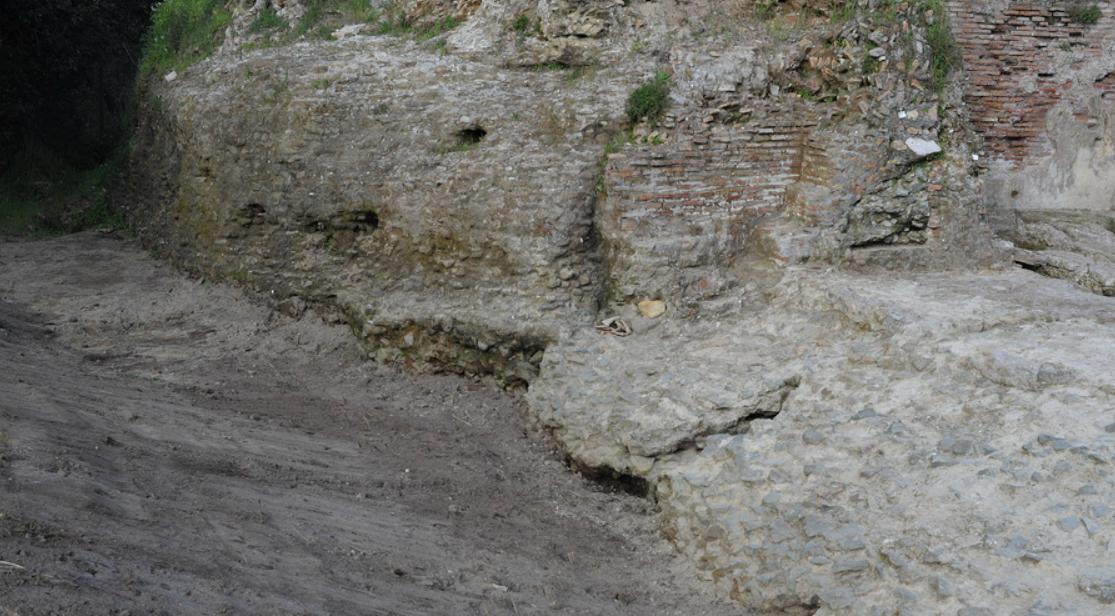
If you have ever read any ancient history, you may have encountered the statement that Ostia, at the mouth of the Tiber, was the port of Rome. Not entirely true. Ostia was a terrible port, and the Tiber is really bad for shipping, so before the end of the Republican period it had become very difficult to bring in enough grain through Ostia to feed the city's immense population. This was the sort of problem the Romans were good at solving, so they went to work providing their city with an alternative port. The hexagonal pond near Rome's airport, above, more than 1600 feet (500 meters) across, is the most dramatic surviving remnant of the alternative port built by the emperors to feed their city. This was called simply Portus.

The work was begun under emperor Claudius and the port was opened by Nero, along with a new road connecting the port to Rome. Then Emperor Trajan improved and expanded the harbor by having the huge hexagonal basin excavated, and a canal built connecting it to the Tiber. From that time until the fall of the western Empire, most of Rome's shipping went by this route. The complex included immense granaries and other warehouses, administrative buildings, a large garrison, and a huge palace.

Archaeologists are investigating Portus in a long-term, multinational project headed by Simon Keays of the University of Southampton. The remains are so immense that uncovering more than a tiny fraction of them using traditional archaeological methods would be impossible. So the project emphasizes remote sensing, especially ground-penetrating radar, some digging with machines, and had digging in a few selected spots.

One of the recent discoveries was an immense building along the north side of the Trajanic harbor, 475 feet (145 meters) long, that the investigators think was a drydock for building or repairing ships.

The outer harbor sported a lighthouse built as a smaller copy of the famous one at Alexandria. The Portus project has many cgi renderings of the port and its buildings on their web site.

When you wonder why medieval and early modern Europeans were so entranced by the ancients and had such respect for even stupid ideas that they found in ancient books, you have to remember that they lived, literally, amidst the ruins of Rome. After Rome fell, no European government could have undertaken a project this big until the late 1700s -- and this was just one of hundreds of such works built by the Romans, from Hadrian's Wall to the Egyptian desert. Many people who lived side by side with the relics of Roman might felt keenly the inferiority of their own power to shape the world, and that bred reverence for classical civilization.

New Frontiers and Human Evolution

A new computer study of the Charlevoix Saguenay Lac-Saint-Jean region in Quebec suggests that the first European pioneers in an area had a great impact on the make-up of the later population, leaving many more modern descendants than those who came later. Women on the Quebec frontier had 15 percent more children overall and 20 percent more children who married and had children than those who remained in more settled areas, and this impact persisted long enough to have an effect that lasted until modern times. Even today, most of the genes in the population were carried by people in the first generation of settlement. The study covered all the people who married in the district between 1686 and 1960, more than one million in all.

As the authors note, this might have major implications for human evolution. Mass movements into new, frontier zones have happened many times in human history. If those in the first wave gained a selective advantage (as this study shows was true in Quebec), this would have led to the spread of genes influencing things like boldness, restlessness, and curiosity that led people to move to the frontier.

Wednesday, November 2, 2011

Writing and the High-Wire Clown

It interested me particularly that in the circus there was one wistful clown who climbed the high wire after the experts were done, and scared himself and us with his uproariously funny, incredibly maladroit moves up there. Slipping and sliding about, losing his hat, his floppy shoes, and holding on to the wire for dear life, he was actually doing stunts far more difficult than any that had gone on before.

This was confirmed, invariably, as he doffed his clown garments one by one and emerged from the woeful little potbellied misfit as the star who headlined the high-wire act. In his tights and glistening bare torso he pulled off his bulbous nose and stood spotlighted on the platform with one arm raised to receive our wildest applause for having led us through our laughter, our fear, to simple awe.

I took profound instruction from this hoary circus routine. It was not merely that I, the sniffler with the red nose, would someday in my good time reveal myself to be a superman among men. There was art in the thing, the power of illusion, the mightier power of the reality behind it. What was first true was then false, a man was born from himself. All the problems of my own being were not the truth of me.

I knew. In my own eyes I was a man no matter what daily evidence was thrown in my face to the contrary. But that there were ways to dramatize this to an unsuspecting world was the keenness of my understanding. You didn't have to broadcast everything you knew all at once, but could reveal it suspense-fully, and make them first cry out in fear, and make them laugh, and, above all, make them applaud, when they finally saw what an achievement had been yours by taking on so well and accurately the comic being of a little kid.
--E.L. Doctorow, World's Fair

Hyenas Deserve More Respect

Lions are wimps by comparison:
Two hyenas escaped from a South African wildlife park Wednesday by chewing through an electric fence during a power outage, but were recaptured within half an hour, the park said. "The power went off... and the hyenas -- who will chew through wire and even iron bars -- managed to escape," said Earl Smith, general manager of the Lion Park, located just outside Johannesburg. "The hyenas always try to escape if there is a long power failure. The lions don't try to escape," he told the [South African Press Association].

The Greek Government Punts

Greece faces a miserable choice: either stay in the Euro and accept the terms dictated by France and Germany, offering a 50% cut in Greek debt in exchange for even more draconian cuts in government spending than the ones that have already driven Greeks to violent protests, followed by (mostly likely) a decade of economic stagnation, or, leave the Euro and default on their debts, which would trigger a terrible financial and economic crisis and then nobody knows what. So the government, knowing it would face intense criticism no matter what it did, has called a referendum and asked the voters to decide. That way the government can say, as things get awful (as they will), "we are only doing what the voters insisted."

The Wages of Sexual Harassment

Herman Cain gets accused of sexual harassment, sends out email to potential supporters complaining about mistreatment by the liberal media, and raises $400,000 in campaign contributions.

It is hard to overestimate the degree to which many American conservatives hate the big newspapers and the network news.

Ai Weiwei

Ai Weiwei may be China's most famous dissident -- in fact he may be the only Chinese dissident many westerners can name, especially western art lovers. He is certainly China's most famous artist. He is famous both for his inventive installations, films, and photographs and the long game of chicken he has played with the Chinese authorities. For years he danced along the limits of what was acceptable, goading the government and sometimes frankly daring them to arrest him. And arrest him they have, most seriously this past April, when he was seized at the Hong Kong airport and disappeared for 81 days. He was released after making a deal that (it is reported) included a promise to stay off Twitter. He is back on Twitter now, releasing frequent sarcastic remarks about corruption and stupidity in official China. (A recent example: "In the battle between creating evil laws and creating good laws, speaking out is golden and silence is death.") The secret to Ai's long-term survival must be that he, like Soviet writers in old times, actually has many fans in the party elite. Nationalist Chinese enjoy having an artist who can draw big crowds to museums in London, Paris and Tokyo, and they surely respect Ai's courage and cleverness.

Ai is back in the news today because Chinese authorities say he owes $2.4 million in back taxes, which he says is ridiculous, and are threatening to jail him (again) if he does not pay. It will do much to sum up my attitude toward Ai to say that I bet he is guilty on this charge. You can't glance at an art magazine or web site these days without seeing news about the opening of another Ai exhibit somewhere in the world. He is a gigantic star of the international art world, and such people earn millions a year. Can it really be that Ai, given his contempt for the Chinese government and his love of tweaking them in any way he can, is really paying all the taxes he owes on his foreign income? (The images above are from "Studies in Perspective," a series of photographs showing Ai holding up his middle finger to the top symbolic monuments of a dozen countries.)

I guess I don't really know about the tax issue, so I won't say any more about that. But Ai Weiwei is a strange character and the adoration heaped on him by western art fans has dubious origins. Ai is a real rebel who takes actual risks with his creations, and that gives him a cachet that phoney rebels in New York or Berlin have trouble matching. Who cares if Ai's art is any good? My personal thought is that he has churned out so much diverse stuff so fast that it is hard to get a handle on what is serious and what is not, or even how much he personally contributed. Ai is a notorious jokester whose production company is called Beijing Fake Cultural Development Ltd., and he seems to laugh off questions about his standing as an artist. Is a work like his pile of 100 million porcelain sunflower seeds, which museum goers were invited to walk on, humorous or serious? One critic said they symbolized China's downtrodden masses, but that is just a guess; I can't find the quotation, but once when he was asked about this work Ai said he was just hoping that someone would mistake the seeds for real and break a tooth on one. (A pile of a few thousand of these seeds recently sold at auction for $600,000.) His fans say this is a necessary part of his political struggle, allowing him to disavow many of his rebellious gestures and statements, but surely it is also a major part of his character.

Here, via Wikipedia, is a good example of Ai's jokey artistic rebellion:


The caption(草泥马挡中央, "grass mud horse covering the middle") to Ai's self-portrait sounds almost the same in Chinese as 肏你妈党中央, "Fuck your mother, the Communist party central committee".
Ok, that's funny, and it's a good dig at the Chinese authorities, but in what sense is it art?

Which brings me to the real question: Does "art" exist as a category anyway? Ai's biggest assets in his career are his battle with the Chinese authorities, his gift for getting attention, and his sense of humor. Do the images and objects Ai creates as part of his struggle matter at all, except as gestures of rebellion? By admiring Ai's works, are people doing anything other than expressing solidarity with his political struggle and admiration for his character? Is there such a thing as Ai Weiwei's art, separate from his life and politics?

Here is one of Ai's most famous works, three images from a short film titled "Dropping a Han Dynasty Urn." Nothing like the smashing of a 2,000-year-old relic to get a little attention; and how does this differentiate Ai from a Chinese government that smashed millions of historical objects? Or is that the point? Beats me.

This is my favorite Ai work, Zodiac Animals, which has been displayed all over the world. I find it interesting that none of the descriptions of this work explain where these heads came from; did Ai sculpt them? Are they casts of traditional Chinese images? Three-dimensional renderings of drawings by Ai, traditional Chinese images, or drawings by someone else? Nobody seems to know, and it doesn't seem to matter. By displaying them together with his name on them, Ai has made this his work.

I am on Ai Weiwei's side in his battle with the Chinese government, which (I think) is being quite stupid by taking Ai so seriously. If they just ignored him, his relevance would fade. (He is much more famous since he was arrested than he ever was before.) But he is able to goad them in ways they can't resist responding to. It is important to remember, though, that he is going out of his way to goad them. I got no sense of oppression in China. So far as I could tell, most Chinese people rarely think about the government one way or the other, except in very local matters. Ai is seeking out a battle with the government, and I suspect he is doing so for reasons of vanity as much as anything else. Perhaps it is necessary that someone challenge the Chinese system before it will reform, since, as I said, most Chinese people don't seem interested. But rebels have complex motives, among which a desire to thrust themselves forward is often prominent. Ai wants to make waves, and he is.

I think the most positive way to see Ai Weiwei would be to imagine him as a Trickster, a mythic figure laughing and joking his way toward profound change. Perhaps there is much truth in this. But perhaps also he is a vain self-promoting climber who constantly mocks both the Chinese authorities who struggle to keep him down and the western art lovers who eat up his rebellious creations. It seems to me that this is ever the way with the most important people. Simple goodness never leads to greatness, and monstrous vanity is often part of the complex of qualities that does. I admire Ai Weiwei, and like some of his work. But I am suspicious of the way he has goaded the Chinese government into helping make him an international art star, and very dubious about the motives of westerners who hail him as a great artist.

Tuesday, November 1, 2011

Salewa Headquarters, Cino Zucchi Architects

This is certainly striking. New headquarters for manufacturer of outdoor gear, in Bolzano, Italy. By Cino Zucchi Architetti.

The architects say:
The new Salewa Headquarters, one of the most prominent manufacturers in Bolzano, is situated in an exceptional location adjacent to the Bolzano highway suggesting a “landscape” building, in formal dialog with the surrounding steep cliffs. As well as housing new work spaces and an indoor climbing gym, the building aims to provide a space for interaction and communication between the company and its network of suppliers, partners and clients. The new headquarters represents a point of convergence between different elements of everyday life: from physical, social and communicative dimensions to work styles and leisure. The Salewa headquarter is formed by a series of multifaceted slabs and towers, including a 50 metre-high structure which when built will be the tallest building in the city.
My only criticism is that I would have thought an outdoor company might have gone for a greener building, at least one well served by public transportation instead of alongside a highway. But I don't know that I have ever seen a cooler-looking office building.


They're Baaaack

The vultures that spend the winter right down the road from me, that is. Sorry about the lousy picture but trust me, those are turkey vultures.

The Golden Temple

Diwali at the Golden Temple in Amritsar, India.

High Speed Rail in California

The new estimate for the cost of building California's high speed rail system is $98 billion, up from the original estimate of $65 billion. No surprise there; the costs of big projects always rise over their history, especially when they involve new technology.

Even if the cost rises to $200 billion, I still say it is a better way of spending our money than the trillion dollar war in Iraq. Or than new highways.

You know, they used to have a brightly colored, easy to read map, but they ditched it in favor of this soothing blue and green thing. Some consultant probably told them that hot colors only added to the anger of opponents, or something.

The Gothic Tour of Italy

Nina Burleigh in the Times:
“Italy was the Gothic writers’ favorite background,” wrote Massimiliano Demata, a professor at the University of Bari, who has made a study of the form. The country’s baroque portas, ruined castles, eerie reliquaries and catacombs were a gateway to the uncanny, possessing, as he put it, “a labyrinthine and claustrophobic architecture that was the novels’ perfect physical and psychological setting.” Today, these same books can serve as unconventional guidebooks for tourists who tire of the sun and want to explore the country’s macabre past. . . .
Above, The Lower Church of Santa Maria delle Anime dell Purgatorio.