
Showing posts with label land use. Show all posts
Showing posts with label land use. Show all posts
Friday, May 15, 2026

Saturday, December 27, 2025
Derek Thomapson and Ezra Klein, "Abundance"
Well, that was a fun Christmas gift.
Abundance (2025) is a hymn to the high-tech, eco-friendly future we can have if only we adopt the authors' political prescriptions. It begins by describing this future, in which we zoom around in electric, self-driving cars and supersonic airplanes, eating factory-grown meat and vegetables grown hydroponically in nearby towers, drinking desalinated seawater and treating all possible diseases and addictions with drone-delivered meds manufactured in low-earth orbit. Improved food production allows us to rewild vast areas that are now farms or ranches, while desalination allows us to let rivers run free. Because of AI and other technologies, most people enjoy all this while working only a few days a week. Sounds great!
The authors state their thesis at the beginning: "scarcity is a choice." Actually, though, they devote just as much attention to a separate thesis: that there is no conflict between economic growth and preserving the environment. In fact, they argue, in order to protect the environment we need a lot more economic growth. We need green energy, a vastly expanded electrial grid, and billions of new, electrically-powered machines. The biggest threat to a green future, in their view, is anti-growth politics.
Most of the book is an analysis what we need to do to get this transformation. The discussion is interesting, but it is mostly at what I would call a middle level. For example, DT and EK spend a lot of time on the troubles with NEPA, and this discussion is valuable. NEPA was passed in an era of air and water pollution that was nightmarish by out standards, when the actions needed to clean up the planet seemed pretty straightforward. But in our world,
these well-meaning laws to protect nature in the twentieth century now block the clean energy projects neeeded in the twenty-first. Laws meant to ensure that government considers the condequences of its actions have made it too difficult for government to act consequentially. (5)
The problem with NEPA is not really the law as written. As I have written here before, the texts reads as pretty reasonable and sensible. The problem is that it gives people a way to file lawsuits against any project they oppose. This is an almost uniquely Americn problem; nowhere else in the world do citizens file nearly as many lawsuits against their own government. As the authors note, the result is that decisions that in most of the world are made by bureaucrats end up being made by judges. So NEPA, an instrument designed to protect the environment, has ended up hamstringing the government. One reason Republicans have never tried to repeal it is that it gives their own supporters a way to fight Democratic priorities:
Over the ourse of the twentieth century, America developed a right that fought the government and a left that hobbled it.
One way to think about our highly bureaucratic, schlerotic system is to look at what we can do when we cast all the rules and limits aside. DT and EK talk up Governor Shapiro's rapid restoration of I-95 through Philadelphia after a damaging fire, which was all done as an "emergency," without any environmental review or competitive bidding. They also tout the Operation Warp Speed program to develop Covid-19 vaccines.
DT and EK devote a whole chapter to housing supply, and that is the main way their arguments have entered the discourse. I have already written about this part of the issue, so I won't belabor it again. But I think that saying "less zoning, more housing" is no kind of solultion; the successful French and British new urbanist projects I have written about here emerged from careful planning, not just changing the zoning laws.
Abundance also covers the "crisis" in scientific funding, which I have written about extensively (here, here, here). They make the usual complaints and recommendations that I consider shallow, e.g., that we don't fund enough younger scientists, when insiders will tell you that the last thing we want to do is to make young, highly productive scientists into grant recipients, which forces them to be mainly administrators. They complain at length about the refusal of grant-making bodies to fund mRNA research, but 1) this is wrong, tons of mRNA research was funded, and 2) sure, some great projects don't get funded because scientific funding is a human endeavor and therefore imperfect. It is points like this that always make me suspicious of grand, far-reaching plans; if you make a hundred points and are wrong about one of the few I know anything about, what does that say about the rest of your points?
Ok, fine, I don't know anyone who doesn't think the US is over-bureaucratized, lawsuit ridden, and too slow to do important things.
But I am interested in a deeper level of thinking about these problems: why do Americans want to hamstring their government?
Because we do not trust our government. And to me that is another way of saying that we do not trust each other.
That, to me, is the real issue: we have no vision of the future that a majority of Americans share. For my whole life I have watched our government hatch schemes for making the country better, and then watched the people rise up against them. I was born too late for the great era of America doing things, which stretched from the 1840s to the 1960s: railroads, telegraph lines, power stations and electric lines, skyscrapers, pipelines, dams, roads, a vast array of new factories. Whole new cities. The Moon landings. I was born into the reaction against all of that. Baltimore was in the forefront of fighting the Interstate Highway System, and eventually succeeded in keeping I-70 and I-83 out of downtown. The same thing happened in Washington and many other places, and much of the system as imagined was never built. Then came the environmental movement, which I think was a great thing but often took the form of attacking the infrastructure we had just built. The expansion of nuclear power was shut down.
Then we had school busing, which turned a nation already on edge over desegration into a lava lake of resentment against "social engineering." Lately we have had rage against "gentrification."
Plus we have had two generations of architects determined to force modernism down our throats, even though a large majority hates it. I think it would be much easier to build things if architects hadn't forgotten how to make them attractive.
Here's a parable: in the 1930s, New Deal Progressives expelled people they considered materially and spiritually impoverished from thousands of places in America to create the TVA and many of our National Parks. In the 1980s both the parks and the TVA launched programs to record the memories of those who had been expelled, resulting in a great trove of oral history, and now they have dozens of exhibits devoted to the lives of those who were expelled. In working on this I have met people who are still mad about the expulsion of their ancestors, 75 years later, and do not in any way think that the creation of the National Park system, or the electrification of the Tennessee basin justifies what was done to their families.
I don't think DT and EK's vision will fail because of bureaucracy or NEPA or lawsuits; it will fail because the nation is not united behind their vision. Everything they propose is controversial. I think lab-grown meat would be great, but tens of millions of Americans would fight any attempt to end ranching, quite likely with guns. A shift from surface agriculture, some of it still done by family farms, to corporate-owned hydroponics towers would also be widely opposed. (Imagine all the ways the organic, anti-GM crowd will find to worry about hydroponics towers.) We already see bitter opposition to the phasing out of coal mining, complete with accusations of cultural genocide, and if anybody moves against oil drilling that would be even worse.
Everybody involved in firefighting or forest management says we need to do more controlled burns across the West, but every plan to do so is fought like hell by the residents. In a democracy, who has the right to tell them they are wrong?
So, yeah, it's stupid that we hold up solar farms for NEPA review, and stupid that Trump's crew thinks wind farms are a woke conspiracy. But this is a democracy, and it is very, very hard to do anything that 50 million people oppose, especially when those opponents include the neighbors.
One of my children asked me if solving our housing problems would be harder or easier than getting to the Moon, and I said getting to the Moon is much easier. There's nobody in the way who has to be moved.
At an even deeper level, I am not at all sure that humans would cope very well with no longer having to work to stay alive. Even though I am something of a rationalist, the sort of ultra-clean, hydroponics towers, desalinated seawater, all electric future they imagine makes my skin crawl. And without a future that a majority of people can get excited about, big changes will not happen.
Thursday, July 10, 2025
Daniel Burnham's Plan for Manila


The Treasury, One of the Burnham Period Buildings
In 1900, understanding that the situation in the Philippines was critical, McKinley sent one of the best Americans to become the first Governor General: future president William Howard Taft. Taft got along famously with Filipino elite, even though he pursued a policy of land reform that led to the dismemberment of several large estates. After all, that elite very much wanted to join the modern, industrializing world, and they appreciated that Taft wanted to help them make that happen.
Taft decided that one of the things the Philippines needed to become a proper modern country was a new capital city on the grand scale. So he got Teddy Roosevelt to send a team of architects led by Daniel Burnham to devise a new plan for Manila.

Burnham, the lead architect of the Chicago Worlds Fair and a generally famous character, fell in love with Manila. He wrote,
Possessing the bay of Naples, the winding river of Paris, and the canals of Venice, Manila has before it an opportunity unique in history of modern times, the opportunity to create a unified city equal to the greatest of the Western world with the unparalleled and priceless addition of a tropical setting,These days Burnham is probably most famous for writing: "Make no little plans. They have no magic to stir men's blood and probably themselves will not be realized. Make big plans." His plan for Manila very much put this axiom into action, since he planned on a grand scale. The plan is at the top of the post; this is the best-quality image I could find, but I think it is good enough for you to see that Burnam was thinking big. Less than half of that area had been built on by 1900, so he imagined a huge expansion of the city, with long, straight, diagonal boulevards to tie the metropolis together.

Above is a detail from the plan showing the new monumental core Burnham imagined for reclaimed marshland next to the old walled city. Since this was a colony, the core was to include government buildings but also the city's top hotel and the clubs where American military men and other officials hung out. (Perhaps this was a nod to Taft, one of history's great clubmen.) Burnham specified that the old city walls should be left in place, due to their historical interest, but the mosquito-infested moat should be filled and the land used for a new road.

Part of the model Burnham's team made of the new city
For a bunch of reasons, most of Burnham's plan was never realized. It was too expensive, too grand, and involved seizing a lot of private land. But he and the team of architects he left behind to pursue the rebuilding did leave a major legacy in Manila.
(On the other hand, the plan that Burnham also devised for Baguio, a hilltop resort that was to become the colonial "summer capital," was much more completely realized, mostly because a lot of it was on vacant land.)


I find all of this fascinating. The weird fact of the democratic, revolutionary US taking over old Spanish colonies is intriguing in itself, as are the political struggles that followed over the next 40 years. For example, I've been trying to find out why nobody imagined that the Philippines might ever become part of the US, as was imagined from the beginning for Hawaii, but haven't found anything; it seems everyone just assumed from 1899 on that the destiny of the Philippines was independence. Same for Cuba vs. Puerto Rico, I guess.
And then there is the fascination of the assignment Burnham's team was handed: turn an aging colonial city into the capital of a new, modern nation. In our era many people have a reflexive dislike of top-down urban planning, especially when carried out by a colonial regime: but if Manila had been left to grow "naturally" it would not have many of the amenities that make it a lovely city. Burnham knew, as city planners had known since the time of the ancient Egyptians, that some things need to be laid out in advance, and some space needs to be set aside for public purposes before people cover it with houses.
Neither Taft nor Burnham was a strong advocate for colonialism. Both found themselves thrust into an ambivalent position: running someone else's country, and planning its capital. Both threw themselves into the job and emerged with their reputations greatly enhanced.
Thursday, March 20, 2025
The Abundance Agenda
Ezra Klein, Matt Yglesias, and some other moderate Democrats I follow have lately been touting something they call the "abundance agenda," which is the title of a forthcoming book from Klein and Derek Thompson. In this podcast, Klein lays out the basic argument. He starts out by asking why people are moving by the millions from Blue states to Red ones; the overwhelming answer people give is that housing is more affordable.
There is a policy failure haunting blue States: it has become too hard to build and too expensive to live in the places where Democrats govern. Our politics is split right now between a left that defends government even when it doesn't work and a right that wants to destroy government even when it is working. What we need is a political party that actually makes government work. Democrats can be that party. They should be that party. But it requires them to confront what they have done to make government fail.Klein then spends a few minutes on California's high speed rail disaster, noting that environmental review began in 2012 and is still not finished. Plus:
California has the worst housing problem in the country. In 2022 the state had 12% of the country's population, but it had 30% of the country's homeless population and 50% of its unsheltered homeless population. Has this unfathomable failure led to California building more homes than it was building a decade ago? No, it hasn't. . . .
In the last few decades Democrats took a wrong turn they became the party that believes in government, that defends government, not the party that forces government to work.
I refuse to accept that this is our choice, a Democratic party that will not make government work and a Republican party that wants to make government fail. What those two parties have created over decades is scarcity, scarcity of homes, of good infrastructure, of clean energy, of public goods.
I want to put myself down as being for this, in principle. But that is the problem; a lot of people will support this agenda in the abstract, but they will rebel when their own special interests are attacked.
I fully support reforming the NEPA process, even if it means less work for people like me; in fact I regularly agitate against doing archaeology in some situations. But there are things I very much want to preserve – historic buildings and neighborhoods, battlefields, archaeological sites where the record of the deep past is well preserved.
Let's think for a bit about housing in California. Sure, in the abstract I'm all for building more, but where? Fire experts have been warning for a century about the danger of building in the canyons above Los Angeles, but they were deemed annoying destractors from the abundance agenda and building went ahead. Water experts warned for decades about over-building in Phoenix, but they were ignored and now the Rio Grande dries up every winter and Phoenix has had to curtail development.
Where does Klein stand on building on barrier islands? on wetlands? on battlefields? in western forests?
Back when it was much easier to build stuff in the US, we constructed the Interstate highways system. Most people I know are glad we did. But building highways into urban areas did a lot of damage, and many cities are now trying to find money to demolish old highways they wish had never been built. In fact those highways did a lot to create the anti-building coalition in America.
The devil is in the details, as usual.
Monday, February 19, 2024
Developers Building Tiny House Communities


Tuesday, January 30, 2024
Transforming Brooklyn


This was done with the cooperation of the borough authorities, who approved all of this, including the use of old, dodgey warehouses as music venues. The government also helped stage a long series of street music festivals that solidified Williamsburg's status as an art mecca. In my experience no neighborhood is ever transformed without both private initiative – from both nonprofits and businesses – and a lot of input from government. The presence of all these Bohemians drew restaurants, and by 1994 the Times food critics had noted the arrival of Williamsburg as a dining destination.
Williamsburg hosted breweries for a century, but by 1990 they had all closed, part of the gradual takover of American beer by a few enormous companies. But then we got the craft beer revival, and in 1996 Rudy Guiliani served as brewmaster for the opening of the new Brooklyn Brewery. (Honestly Rudy was a pretty good mayor before he went crazy.) But the city modified its zoning laws to allow most of the old factory district to be converted to residential space.
Things really took off during the Bloomberg administration, 2002 to 2013. Bloomberg's people rezoned 37% of NYC and did everything they could think of to promote housing construction, which was built in NYC faster than in any older city in the country. This included 175,000 units deemed "affordable." Bloomberg also pushed the construction of the new commerical district in downtown Brooklyn, which was soon covered with high-rise buildings. During Bloomberg's time in office more than 10,000 new apartments and condomiums were built in the new downtown, and more than 4,500 in Williamsburg. From 1950 to 1980 Brooklyn lost 500,000 inhabitants, or 18.5% of its population; it has now regained all of those people and probably passed the 1950 level last year. Since the average household is smaller, that means many more units.


It's a story many American cities have seen over and over: neighborhoods get run down and dangerous, which drives rents very low, which pulls in people like rave promoters and artists who need big loft spaces, which draws in hipster bars and restaurants, which draws in yuppies, which drives up housing prives and eventually drives out the music venues and the hipster bars.
But I don't think there is any realistic alternative to this. The world doesn't stand still. Yes, there is something weird about the repeated, rapid transformation of neighborhoods by capitalism and the quest for cool, but what really kills cities is for things to stay as they are. Living beings are always changing.
Tuesday, January 23, 2024
"Disillusioned" by Suburbia
There's a review in the NY Times today of a book called "Disillusioned: Five Families and the Unraveling of America’s Suburbs," by Benjamin Herold. This book makes an argument I think is important, if not enitrely correct. From this review, and other places I have encountered this argument, I will summarize it like this:
Beginning in the 1910s, white Americans began to move in large numbers to the suburbs. To house the growing population and provide everyone with the trappings of a modern life – house, yard, neighborhood – millions of new houses were built. Many of them were built cheaply, and the infrastructure to serve them was also often shoddy: sewers, electrical systems, gas lines, streets. Especially from the late 1940s to the mid 1960s, America built millions of crappy suburban houses served by leaky sewer lines and inch-thick sidewalks.
Also, while before WW II most suburbs were built around streetcar or commuter rail lines, after WW II they became entirely car-centric, and many of them closed old public transit lines or refused new ones to keep out undesirables. They also zoned out most economic activity, especially anything industrial.
The result is what Herold calls a "time bomb." All of those shoddily built houses are decaying, as are the water lines, sewer lines, streets, and so on built in such a hurry, while the tax revenue needed to pay for upgrades falls. For jurisdictions funded mainly by property taxes, it is simply not sustainable to rely on a tax base that consists of moderately-priced houses; the people who live in them cost the county or city more than they pay in taxes. You need some amount of commercial, industrial, or high-end housing to balance the budget, or big apartment buildings. The problem is worsened by white folks leaving older suburbs to move even farther out in search of whiter schools and bigger lawns.
And there is some truth to this. But.
Right now we have a very different sort of construction regime in America. Now, housing developers have to pay up front for good sewers and streets and even new schools and other amenities; to get approval for a big housing development in Haymarket, Virginia, the developer agreed to pay for a new high school and a new commuter rail station. They have to pay for stormwater management systems to reduce flooding, mitigation measures for wetlands they destroy, and on and on. As a result, new housing developments are more sustainable in a lot of ways, especially fiscally, but we have a severe shortage of affordable housing. Say what you want about the Levittown model, it provided affordable housing for millions of families. A big part of why many Americans feel like their standard of living has declined is that our housing costs so much more.
Also, it is not true in general that older, inner-ring suburbs are declining. I should know, I live in one that is booming, with new housing being wedged into every available space and the price of existing homes up about a hundred percent in 25 years. In places like South San Francisco, little Levittown-style houses are going for big bucks to tech workers who enlarge or upgrade them, even though the taxes have to be high to upgrade the crumbling infrastructure.
Herold makes much of the racial side to this, with minority folks driving whites ever farther into the suburbs. This has happened in many places. But right now the reverse is just as likely, with richer white folks buying poor people out of gentrifying inner ring suburbs, forcing minority people to move farther out and endure monstrous commutes. In Maryland we have the interesting case of Prince George's County on the east side of DC, where the black folks moving in are richer than the white folks who are leaving for outer exurbia, so we have gentrification and white flight at the same time.
Part of the point of Herold's book is to say that the American Dream of circa 1965 was an illusion, propped up by unsustainable tax subsidies and shoddy infrastructure, defended by racial exclusion policies and anyway not affordable to many people. Fine. But I don't really get the point of writing about five hard-luck families in five different hard-luck suburbs. Everybody knows that not everyone in America is thriving; everybody knows that some communities are "troubled." I'm sure the massive development of the 1948-1973 period could have been done better. But it simply is not true that most older suburbs are decaying; their status depends on the overall economic health of their regions, and also sometimes on little details like where school district lines are drawn.
There just isn't enough money in the world to make life great for everyone. Compromises have to be made. In Europe, housing for their booming post-war populations was largely provided via government-constructed concrete apartment blocks. But they, it turns out, were also shoddy and also now need to be replaced or restored (at great expense). Many apartment blocks that were perfectly decent places to live in 1965 have now become decaying, crime-ridden hell holes. This suggests that the suburban model was not the root of the problem.
No system works all the time, for everyone. As long as our society is founded, in a very deep way, on individual effort and achievement – or, if you prefer, on a rigged competition played out across a massively tilted playing field – it will continue to generate unequal outcomes. What we do for those at the bottom is a deep and hard problem that this critique of suburbia does not touch.
Tuesday, December 5, 2023
The Transformation of Le Plessis-Robinson


To me the political angle is actually the least interesting. I wrote here last summer about a new urban project in England that was entirely socialist, and I also thought that was great. To me what matters is: paying attention to what people want, which is overwhelmingly not concrete boxes; caring about beauty as a value it itself; being pragmatic about funding and planning; and thinking in the long term. We can make our world better if we put our minds to it, and we will reap the benefits of that in many ways.
Sunday, July 16, 2023
Policies Can Change
For a long time it seemed that exclusionary zoning in the American suburbs was just a fact of life. Suburbanites, people said, were so committed to defending their property values that nothing could ever be done to increase density and create more housing. But as Ezra Klein reports, that turned out not to be true:
Berkeley, Calif., was the first locality to mandate single-family zoning. In 2021, the Berkeley City Council voted to end single-family zoning, as the liberals who call it home came to see that it was a tool of exclusion. California followed suit, passing a bill that functionally outlawed single-family zoning across the entire state. In San Francisco, Mayor London Breed recently proposed reforms to the way housing is built in the city that delighted even the most hardened of YIMBYs. In Los Angeles, voters raised taxes on themselves to address homelessness and Mayor Karen Bass and the City Council just exempted affordable housing from a lengthy step in the planning process.
Statewide, Gov. Gavin Newsom has now signed more pro-housing bills than I can reasonably describe here, and he just passed a package of permitting and procurement reforms over the initial protests of environmental groups. And it’s not just California: Oregon and Maine also outlawed single-family zoning, and Connecticut and Massachusetts have taken steps in the same direction.
This is happening in the way major political changes usually happen, because a broad range of interest groups have pushed it for decades: young people afraid they could never afford a home, businesses worried about worker shortages, advocates for the homeless, property developers, immigrants, anti-racists, socialists who just like apartment buildings. Note that this list includes groups that lean toward both parties. It probably helps that the spread of homelessness has created an atmosphere of crisis in some places, like Los Angeles and the Bay Area.
Whenever you think that something just can't change, glance at history and ask yourself what has not changed over the past 200 years. The list is not long, and I don't think anything about land use is on it.
Sunday, July 9, 2023
New Urbanism on Goldsmith Street


They took inspiration from the city’s Golden Triangle, a desirable neighbourhood of Victorian terraced houses. This provided a useful lesson on density: planning rules would usually require at least 21 metres between facing homes, to prevent overlooking, but these popular historic terraces were just 14 metres apart. The architects used the precedent to argue that this new neighbourhood could be just as humanely scaled, while fitting in more homes.
The result, one critic said, is "dense without being oppressive."


Tireless work by the architects has kept the standard of workmanship up to a very high level. Social tenants get impressively high specification interiors – in both the end-of-terrace flats and the central terrace houses. Passivhaus detailing has nicely accommodated the mechanical ventilation Heat Recovery (MVHR) units in the interiors, and the services intakes have been intelligently controlled. Each dwelling has a range of providers’ services pre-wired, so that they can be connected on demand, without the need for a service providers’ to come in later and drill through vital vapour barrier lines.

Tuesday, February 21, 2023
In Seoul, a Freeway became a Riverside Park


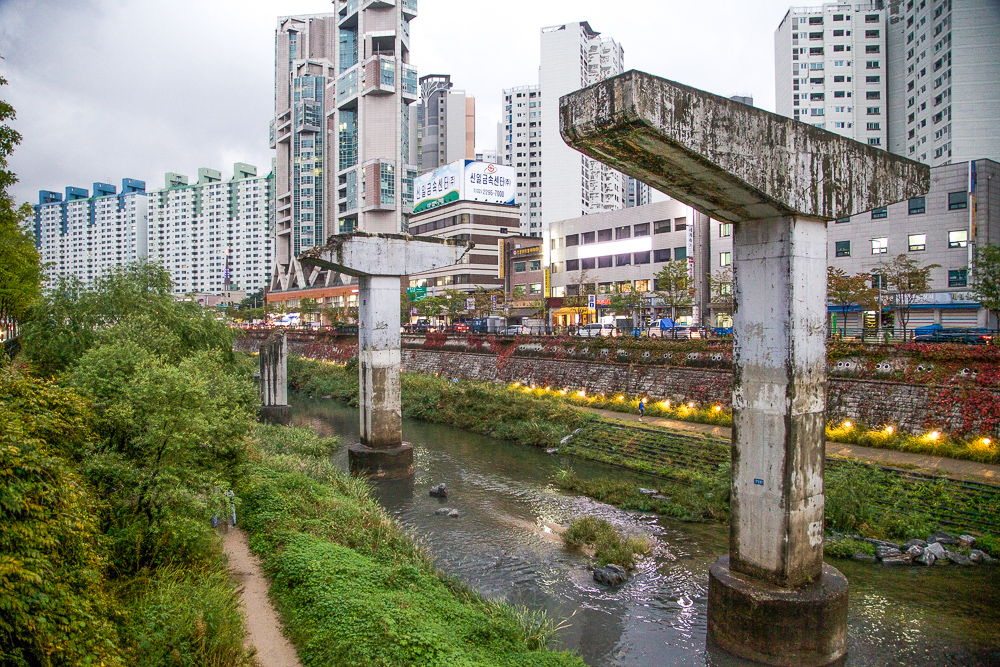
Projects like this remind us that the world does not have to keep getting uglier. It was expensive, but South Korea is rich, and can afford it. New businesses have sprouted up all along the stream, helped to pay the city back for the expense, and it has also helped the city to attract new residents.
Subscribe to:
Posts (Atom)

