Friday, June 5, 2015

Grinling Gibbons

Grinling Gibbons (1648 – 1721) was born in Holland to British parents, and is thus sometimes called a Dutch-British artist; educated largely in the Netherlands, he spent his working life in England.

His spectacular wood carvings decorate Windsor Castle, Hampton Court Palace, St. Paul's Cathedral and other London churches, Petworth House and other country houses, Trinity College Oxford and Trinity College Cambridge. Above, from Hampton Court, is a fairly typical example of his work -- he loved garlands of fruit and flowers.

This is one of his most famous pieces, the Modena Panel, created as a memento mori for Charles II and now in Italy.

St. James Church, Piccadilly.

The Stoning of St. Stephen. This is a big file, worth clicking on.

Hampton Court display wall. Much of his work was done as frames or settings for paintings, mirrors and so on, and such is Gibbons' fame that his work now often much overshadows the things it was supposed to set off.

The Valley of Dry Bones, detail.

The Crucifixion, an early work he made to impress prospective patrons. Another big file.

The choir stalls in St. Paul's Cathedral, London, Gibbons' biggest project.

Lace bow, now in the Victoria and Albert.

King David.


Stems, leaves and even violin strings carved from lime wood.

Wonderful things. And how can you not love a man named Grinling Gibbons?

Politics and the University of Wisconsin

Like a lot of conservatives, Wisconsin governor Scott Walker sees university faculties as his enemies. In fact this is largely true -- professors are overwhelmingly liberal or leftist, and many of them see spreading their political views as a mission more important than scholarship. But while most conservative politicians have been content to nibble away at university funding and otherwise ignore the professors, Scott Walker is taking the fight to his foes. His new budget removes tenure protections from state law and orders the Board of Regents -- 16 of the 18 regents are appointed by the governor -- to come up with a new system. He says that the point is to put university governance in the hands of the regents rather than the legislature, and that he has no idea what the board will propose. As one Republican state senator explained:
We are directing the Board of Regents to develop a policy, just as there is in so many states. It’s just a matter of recognizing the ability for chancellors and campuses to administer and manage their operations.
Don't believe it. If I know Scott Walker, he has already made it clear to the board members he appoints what they will have to do to keep their jobs, and that is remove all obstacles to reforming the university along the lines of an economic engine and career nursery.

Because, see, conservatives have a problem with universities, which is that although they are bastions of leftism they are also economically and socially vital. They prepare the people of the state for lucrative careers, and their research drives technological change. Plus their football and basketball teams have huge followings of voters. So every conservative governor wonders, how can I keep the things about universities I want while restraining or getting rid of leftists who use their state-sponsored jobs to attack me? Walker's approach has two parts, limiting tenure and limiting the control of professors over what and how they teach:
Along with tenure, “shared governance” has been a central feature of academic life in universities generally, giving faculty members the primary responsibility for decisions about matters like curriculum, choice of subject matter, instructional methods, faculty status and research. Under the proposed changes in Wisconsin, faculty members would still advise leaders on academic and educational activities, and on personnel matters, but that advice would be “subordinate” to the powers of the board, president and chancellors.
In China the government calls this “seizing control of the lectern.”

American professors need to wake up. The cozy arrangements they have long enjoyed -- tenure, limited teaching loads, salaries protected from the free market, freedom to teach what and how they want -- are disappearing. So far this has largely happened by increased hiring of adjuncts, and the shrinking number of tenured professorships have remained plum jobs. That is going to change, too. Except at a handful of wealthy private schools, professors are going to lose autonomy, earn less, and be subject to rigorous goal-oriented management focused on how many students they train and how much funding they bring in. Departments that don't measure up are already disappearing, and this is going to accelerate.

All of these changes are happening because the professors have lost the support of the voters. Well, actually they may never have had the support of the voters, but they had the support of a big swathe of the elite, including many conservative politicians. That is changing. Your populist, Tea Party-allied Republican sees nothing good in English or Anthropology departments, and doesn't see why he should vote money to support them. Even most Democratic voters don't care, so they pay no political price for whacking away at academia.

Over the long term, the conditions and pay of professors are going to decline until there are no longer people willing to take the jobs. That's how the free market works for people who lack political and institutional power. If professors want the university as they know it to survive, they need to convince the voters that it is worth paying for, and that their work is vital to university life.

Thursday, June 4, 2015

Today's Quantum Weirdness

To carry out the experiment, the ANU team initially trapped a collection of helium atoms in a Bose-Einstein condensate (a medium in which a dilute gas is cooled to temperatures very close to absolute zero), and then forcibly ejected them from their containment until there was only a single atom left behind.

This remaining atom was then released to pass through a pair of counter-propagating laser beams (that is, beams moving in opposite directions), which created a pattern to act as a crossroads for the atom in the same way that a solid diffusion grating would act to scatter light.

After this, another laser-generated grating was randomly added and used to recombine the routes offered to the atom. This second grating then indiscriminately produced either constructive or destructive interference as if the atom had journeyed on both paths. Conversely, when the second light grating was not randomly added, no interference would be introduced, and the atom would behave as if it had followed only one path.

However, and this is the really weird part, the arbitrary number generated to determine if the grating was added or not was only generated after the atom had passed through the crossroads. But, when the atom was measured at the end of its path – before the random number was generated – it already displayed the wave or particle characteristics applied by the grating after it had completed its journey.

According to Truscott, this means that if one chooses to believe that the atom really did take a particular path or paths, then one also has to accept that a future measurement is affecting the atom's past.

"The atoms did not travel from A to B. It was only when they were measured at the end of the journey that their wave-like or particle-like behavior was brought into existence," said Truscott. "It proves that measurement is everything. At the quantum level, reality does not exist if you are not looking at it.”

Karolin Klüppel: Mädchenland

Karolin Klüppel, a German photographer, went to Mawlynnong in far eastern India to document the girls of the matrilineal Khasi people. Among the Khasi it is the youngest girl who inherits the family property, and children take their mother's names.


Klüppel found, I guess, what she was looking for. She wrote:
In the Khasi culture, women and girls have a special standing in the society and, of course, this exceptional role ‘produces’ a great self-confidence. I did not want to do a classical documentary on their culture, but tried to capture this outstanding role somehow. I decided to make a portrait series of the girls because I was so impressed by their self-assured appearance and thought this must be how matriliny becomes visible.

I will offer no opinion as to how true that is, but anyway the Khasi are a fascinating people and their part of India is gorgeous, famous for its living bridges and other jungle wonders. The girls in Klüppel's portraits do radiate confidence. I have read that in recent years the matriarchy of the Khasi has been reinforced by the economic patterns of rural India, in which many men leave home to find work and women increasingly dominate the home even in traditionally patriarchal places. Among the Khasi the traditionally weak ties of men to the house have encouraged even more such departures. So in a sense this is a Kingdom of Girls, as Klüppel titled her photographs -- they will stay, inherit these homes, marry itinerant men and raise children in a world dominated by women.

I was fascinated by this piece of furniture, which looks like it came from an American antique shop. Did that style of punched tin screen originate in India, and spread from there to Britain and thence to America?

A Grand Mansion and a Sale of Paintings in Ireland

This is Russborough House, built in the mid 1700s, one of the grandest mansions put up by Ireland's Protestant ruling class back in the day. Its last private owner was Sir Alfred Beit of the diamond mining fortune. In 1974 Beit was famously tied up in his library by armed IRA soldiers who called him a capitalist pig and stole 19 of his paintings. That time the paintings were recovered, but Beit was rattled. He gave away most of his art and set up the house as a private foundation, open to the public.

Now this is all in the news because the foundation wants to sell nine paintings to raise money. This is the best, Portrait of a Bearded Man by Peter Paul Rubens. The plan has led to an outcry from Irish art lovers, especially leftist art lovers who hold it as a principle that no work of art accessible to the public should ever disappear into private hands.

But if the house is to remain open, the money has to come from somewhere, and Ireland is just not a rich enough country to pay for keeping up all of its heritage with public funds. The real jewels of Beit's art collection (Goyas, Vermeers, others by Rubens) are safely in the Irish National Gallery, which has the resources to protect them from theft and decay. I feel the same way about this as I do about many other incidents involving museum collections: you can't save everything. Decisions have to be made about what can preserved for the public and what needs to be let go, and these days museum fanatics are, I think, pressing way too hard to keep every scrap of art and history. As a result many thousands of artifacts are locked up in museum basements when they could be the centerpieces of private collections. If the Russborough House keeps all of its paintings but then goes bankrupt and has to close, who has gained?

Wednesday, June 3, 2015

City Museum, St. Louis; Now That's a Playground

Created by sculptor Bob Cassilly The City Museum is a repurposed shoe factory that now features one of the world's most spectacular playgrounds.


Among other things, it has a 10-story spiral slide:


And an enchanted cave.

Why aren't there more such places in the world?


Do We Live in an Anti-Human Society?

Sebastien Junger thinks so many American soldiers suffer from post-traumatic stress not because of what they endured in war, but because of what they come back to:
Any discussion of PTSD and its associated sense of alienation in society must address the fact that many soldiers find themselves missing the war after it’s over. That troubling fact can be found in written accounts from war after war, country after country, century after century. Awkward as it is to say, part of the trauma of war seems to be giving it up. . . .

What all these people seem to miss isn’t danger or loss, per se, but the closeness and cooperation that danger and loss often engender. Humans evolved to survive in extremely harsh environments, and our capacity for cooperation and sharing clearly helped us do that. Structurally, a band of hunter-gatherers and a platoon in combat are almost exactly the same: in each case, the group numbers between 30 and 50 individuals, they sleep in a common area, they conduct patrols, they are completely reliant on one another for support, comfort, and defense, and they share a group identity that most would risk their lives for. Personal interest is subsumed into group interest because personal survival is not possible without group survival. From an evolutionary perspective, it’s not at all surprising that many soldiers respond to combat in positive ways and miss it when it’s gone. . . .

There are obvious psychological stresses on a person in a group, but there may be even greater stresses on a person in isolation. Most higher primates, including humans, are intensely social, and there are few examples of individuals surviving outside of a group. A modern soldier returning from combat goes from the kind of close-knit situation that humans evolved for into a society where most people work outside the home, children are educated by strangers, families are isolated from wider communities, personal gain almost completely eclipses collective good, and people sleep alone or with a partner. Even if he or she is in a family, that is not the same as belonging to a large, self-sufficient group that shares and experiences almost everything collectively. Whatever the technological advances of modern society—and they’re nearly miraculous—the individual lifestyles that those technologies spawn may be deeply brutalizing to the human spirit.

“You’ll have to be prepared to say that we are not a good society—that we are an anti-human society,” anthropologist Sharon Abramowitz warned when I tried this theory out on her. Abramowitz was in Ivory Coast during the start of the civil war there in 2002 and experienced, firsthand, the extremely close bonds created by hardship and danger. “We are not good to each other. Our tribalism is about an extremely narrow group of people: our children, our spouse, maybe our parents. Our society is alienating, technical, cold, and mystifying. Our fundamental desire, as human beings, is to be close to others, and our society does not allow for that.”
I absolutely agree that we suffer from loneliness and atomization. The thing is, people in close-knit societies suffer from that, too -- we have trouble living apart but drive each other crazy when we are together. I suspect that our modern way of living is too isolated, and that more togetherness would be better for us. But it is an interesting fact that as soon as people have the material resources to put some space between themselves and their neighbors, they do so.

Tuesday, June 2, 2015

The Strange World of Russian Government Trolls

Bizarre, fascinating story by Adrian Chen in the Times about the massive Russian government operation to troll the internet:
By working every day to spread Kremlin propaganda, the paid trolls have made it impossible for the normal Internet user to separate truth from fiction.

“The point is to spoil it, to create the atmosphere of hate, to make it so stinky that normal people won’t want to touch it,” Volkov said, when we met in the office of Navalny’s Anti-Corruption Foundation. “You have to remember the Internet population of Russia is just over 50 percent. The rest are yet to join, and when they join it’s very important what is their first impression.” The Internet still remains the one medium where the opposition can reliably get its message out. But their message is now surrounded by so much garbage from trolls that readers can become resistant before the message even gets to them. During the protests, a favorite tactic of the opposition was making anti-Putin hashtags trend on Twitter. Today, waves of trolls and bots regularly promote pro-Putin hashtags. What once was an exhilarating act of popular defiance now feels empty. “It kind of discredited the idea of political hashtags,” says Ilya Klishin, the web editor for the independent television station TV Rain who, in 2011, created the Facebook page for the antigovernment protests.

Russia’s information war might be thought of as the biggest trolling operation in history, and its target is nothing less than the utility of the Internet as a democratic space. In the midst of such a war, the Runet (as the Russian Internet is often called) can be an unpleasant place for anyone caught in the crossfire.
I would like to assure my readers that I actually exist and am not a troll created by the Kremlin, the Internet Research Agency, the CIA, the NSA, MI-5, or the Bavarian Illuminati.

Medieval Treasure Bindings

The most valuable medieval books were bound in bindings that were themselves great treasures. This is the T’oros Roslin Gospels, an Armenian manuscript from 1262.

Gospel cover from the monastery of St. Gall in Germany, c. 760-790.

The Codex Aureus (golden book) of St. Emer, c. 870.

The Lindau Gospels, also dated to c. 870.

Gospel book of Otto III, 10th century.

Spanish gospel cover, 11th century, incorporating a Byzantine ivory icon of the 10th century.

Mondsee Gospels, German, 12th century.

Sion Gospel, German, c. 1140-1150.

Pericopes of Henry II, 12th c.

German gospel cover, c. 1200.

This unusual book comes from monastery of Pawłoskan in Cilicia, and bears the date of 1193.

In the thirteenth century the enamel artists of Limoges made many book covers.

And one Gothic masterpiece, from Austria, c. 1260.

The Five No's and the Seven Unmentionables

The Chinese government, nervous about the energies released by reform, seems to be turning toward authoritarianism. Lately they have been cracking down on critical voices and especially on foreign influences, mixing Marxism and nationalism with grim ideological rigor. Former president Hu Jintao launched this move to limit change with his famous "Five No's":
No to multiparty politics; no to diversification of [the party's] guiding thought; no to the separation of powers; no to a federal model; and no to privatization.
New president Xi Jinping has extended the argument, partly through historical revisionism. He has attacked critics of Mao, said that accounts of the early 60s famine are exaggerated, and denounced any division of recent Chinese history into pre- and post-reform periods. (This last item is sometimes coupled with a defense of communism's accomplishments into the "theory of the two cannot-negates.")

Now Xi has gone Hu two better by extending the Five No's into the Seven Unmentionables. This first came up in the context of university reform; to keep universities from become centers of dissent, Xi announced a program to "seize control of the lectern" from wayward professors. Lists of the "seven unmentionables" vary -- I suspect translation issues -- but a typical version includes:
  • "universal norms" 
  • "civil society" 
  • freedom of the press
  • "civil liberties"
  • "privileged capitalist class"
  • the party's historical errors
  • the independence of the judiciary.
The determination to keep out dangerous foreign ideas seems clear.

On the other hand the party has continued its assault on corruption, and they have launched high-profile prosecutions of several party officials. I suspect, though, that they will find the same thing Mikhail Gorbachev found, that the only way to really rein in corruption is to encourage a freedom of the press and a habit of confronting officials that are hard to reconcile with authoritarian rule. Since I do not expect any major change in Chinese politics, I think that means China is stuck with entrenched corruption for the foreseeable future. The Chinese have certainly survived worse problems.

I think any notion that democracy is "inevitable" in China is silly. The current regime has overseen one of the most spectacular periods of economic growth in human history; it has restored China's status as a great power; it has encouraged the resurgence of genuinely popular Chinese traditions; it has kept a lid on terrorism; it has avoided large-scale ethnic violence like that in Burma and India; and it has avoided the terrible class conflict between peasants and the urban middle class that has ruined democracy in Thailand. All in all in is a pretty good record. So far as I can tell, most Chinese people appreciate this, and they are not much interested in trading their stability for the unknown seas of democracy. Yes, there are major problems in China and issues that people worry about -- corruption, pollution, lack of clear property rights, continued poverty -- but they can look to India and see that democracy has no obvious solutions to these problems.

On a lighter note, I am sorely tempted to come up with a list of Seven Unmentionables for my children.

Monday, June 1, 2015

What a Palimpsest Looks Like

A palimpsest is an ancient manuscript in which one text has been erased and then written over with another text. Some of our most famous ancient texts survived only in this way, including works by Archimedes, Cicero, Seneca, and Plautus, the oldest surviving textbook of Roman Law, and the oldest version of the Gospels in Syriac. But what, you have perhaps wondered, does a palimpsest actually look like? And how hard are they to read?

One palimpsest discovered in fairly recent times is a work by the ancient Greek doctor Galen, written over with a set of Syriac hymns. Scholars have been working on this for years, mapping out the text character by character and trying to fit it back together. Detailed photographs of the whole thing are online, at the Digital Galen Palimpsest. You can see from these that the older writing is quite faint and not at all easy to ready, which is why reading one of these texts takes thousands of person-hours of labor.

The Headscarf in America

The Supreme Court ruled today that Abercrombie & Fitch violated Samantha Elauf's religious freedom when they refused to hire her for wearing a headscarf to her interview. At the time, it seems, a headscarf violated their dress code, which they call their "Look Policy." They actually changed this policy years ago and paid compensation to three people they discriminated against, but it's still nice to see the Supreme Court affirming religious freedom by an 8-1 vote.

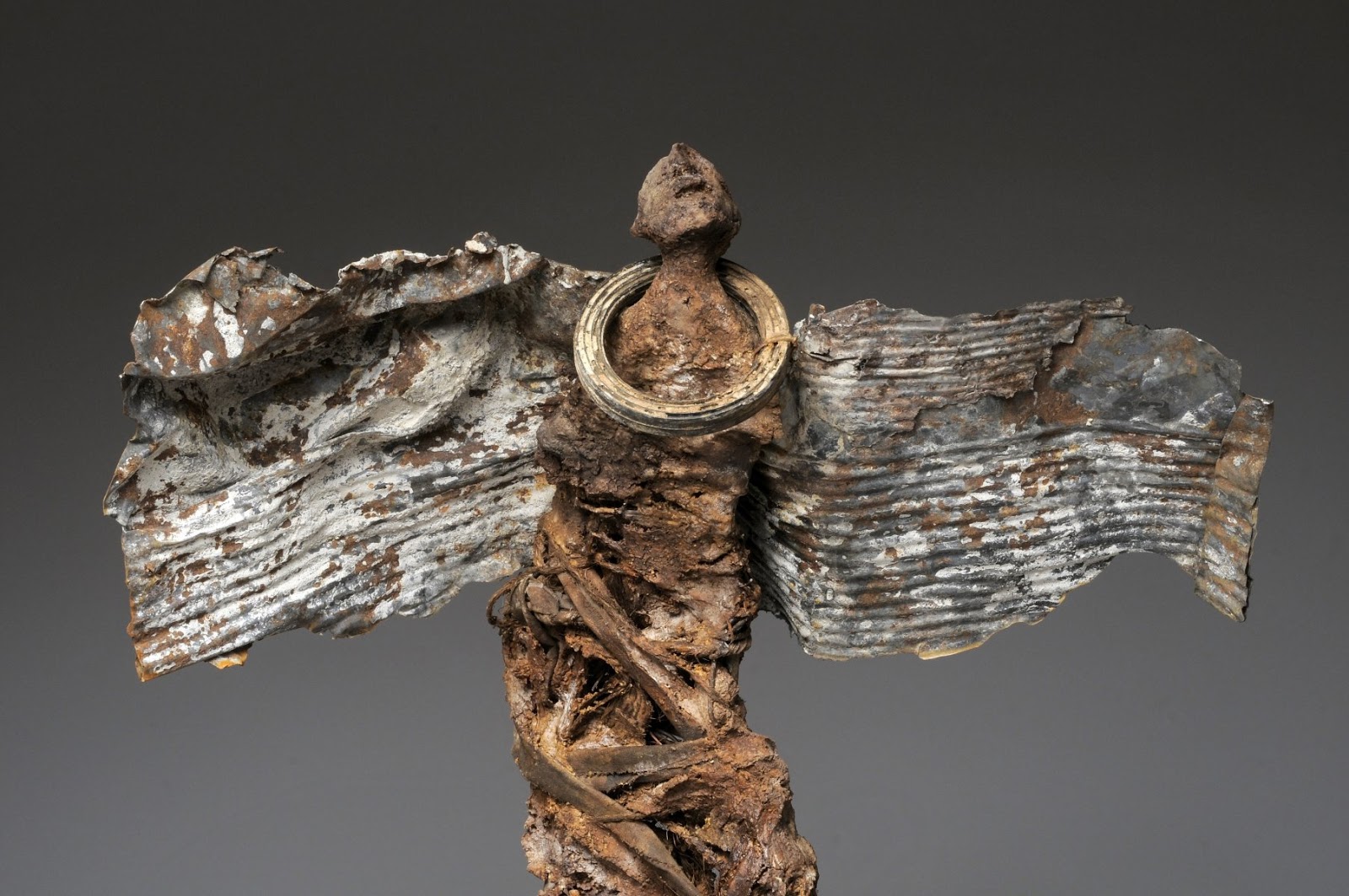
Marc Perez: Sculpture


Marc Perez is a French painter and sculptor, born in Tunis in 1955. I found the sculpture above -- Bust, 2007 -- on the Tumblr of the Cavin-Morris Gallery, and I had to find out more about him.

He has a large web site with many images of his work, none with titles or dates. And also lots of pretentious French art criticism. This is from the artist himself:
ller au delà de soi, comme pour se perdre de vue, comme pour sauter l’obstacle de la sincérité… Nous sommes tous prisonniers de notre histoire, de nos idées, sans doute nous faut-il raconter cette prison, mais plus encore, ne nous faut-il pas nous aventurer au delà, au delà de nous- même, ne serait- ce que d’un pas?…
Which might mean something like:
Art must go beyond itself, as much to lose sight as to jump the obstacle of sincerity ... We are all prisoners of our history, of our ideas, perhaps we need to expound this prison, but even more , must we not venture beyond ourselves, if only one step ?
One critic says:
Marc Perez is a warlord (chef de guerre). He throws a shadow army, innumerable and ever exhausted, constantly renewed, strengthened and multiplied on each canvas, drawing supports from wild paper or burnt canvas. Faceless eyes arise, or faces with eyes erased, partial beings gagged, bound, mutilated, advancing irresistibly onward with such strength that you know you cannot make them return. Powerful and castrated. Without arms, without an identifiable face. . . . A primitive horde, unstoppable, advances from within us to face us. They do not speak, they are.

Marc Perez carves. This formless magma of ill-being (mal-être) and the unspeakable gives rise to incisively brushed, brutal forms, fundamental. Freed of anecdote and illustration. Life is not simple and quiet. It is rough and unfinished, in gestation. It is in this life that Marc Perez carves his half-dead uncontrollables.

Marc Perez is a warlord. . . . He exists against the real, that is to say, he produces reality. The painter is beyond imagination, it seems. He paints to exist, in two senses: to be and understand.
Of course that is just my translation, and I suppose there is a slim chance that the original is clearer. But I doubt it. The thing is, despite the mad prose it makes as much sense as art criticism ever does.


I see what he means about the half-dead army. And I think these are cool.


An Interesting Compliment from 1737

Here's a fun way to compliment a lady, endorsed by the Wits Cabinet: Or, a Companion for Young Men and Ladies:
Your Voice is such a one, that should the Holy Churchmen use it, it would without the Addition of more Exorcisms, disinchant Houses, and tie up the Night Ghosts that haunt the solitary Groves.
Oh lady,your voice scares away ghosts!  Hmmmm.

Here's a more conventional assay:
Turn back your Comet Eyes, or I shall perish in the Flames.
From Ask the Past.