This year the deer seem to have eaten almost everything that isn't yellow, leaving much of the garden looking like this.
But a few spots of other colors have survived the assault. And the front bed (below) has gone mostly red and orange.
Wednesday, August 9, 2017
Men and Women are More Different in Rich Countries
In the course of a long diatribe about the firing of that poor Google engineer, Scott Alexander discusses some research that I had never heard of before. Whatever the reason that only 20 to 25 percent of computer science majors in the US are women, it is true across the wealthy parts of the world. But it is not true in the rest:
The Big Five personality traits are openness to experience, conscientiousness, extraversion, agreeableness, and neuroticism; the test used in the study is described here.
To get back to the article cited above:
When I was young, I was taken in by people who argued that once we took sexism out of the equation men and women would get along great and marriages would be happier and family life would be simpler and more fair and so on. It turns out that with the new economic opportunities for women we have mainly exchanged one set of problems for another. Men and women still want different things, and if this research is right those differences have only gotten bigger. Mothers' lives are still shaped around children much more than fathers', but everyone is more stressed about it.
I remain a complete egalitarian, vehemently opposed to all limits on the lives women can pursue. But I no longer think this will by itself lead to a just or happy society, and it seems to have made it even more difficult for many men and women to get along.
Galpin investigated the percent of women in computer classes all around the world. Her number of 26% for the US is slightly higher than I usually hear, probably because it’s older (the percent women in computing has actually gone down over time!). The least sexist countries I can think of – Sweden, New Zealand, Canada, etc – all have somewhere around the same number (30%, 20%, and 24%, respectively). The most sexist countries do extremely well on this metric! The highest numbers on the chart are all from non-Western, non-First-World countries that do middling-to-poor on the Gender Development Index: Thailand with 55%, Guyana with 54%, Malaysia with 51%, Iran with 41%, Zimbabwe with 41%, and Mexico with 39%. Needless to say, Zimbabwe is not exactly famous for its deep commitment to gender equality.So the richer and on the whole more egalitarian a country is, the fewer of its software writers are female. That seems weird, but not nearly as weird as what Alexander offers as an explanation:
Why is this? It’s a very common and well-replicated finding that the more progressive and gender-equal a country, the larger gender differences in personality of the sort Hyde found become. I agree this is a very strange finding, but it’s definitely true. See eg Journal of Personality and Social Psychology, Sex Differences In Big Five Personality Traits Across 55 Cultures:I have to say that this bowls me over. What is this about?
Previous research suggested that sex differences in personality traits are larger in prosperous, healthy, and egalitarian cultures in which women have more opportunities equal with those of men. In this article, the authors report cross-cultural findings in which this unintuitive result was replicated across samples from 55 nations (n = 17,637).
In case you’re wondering, the countries with the highest gender differences in personality are France, Netherlands, and the Czech Republic. The countries with the lowest sex differences are Indonesia, Fiji, and the Congo.
The Big Five personality traits are openness to experience, conscientiousness, extraversion, agreeableness, and neuroticism; the test used in the study is described here.
To get back to the article cited above:
On responses to the Big Five Inventory, women reported higher levels of neuroticism, extraversion, agreeableness, and conscientiousness than did men across most nations. These findings converge with previous studies in which different Big Five measures and more limited samples of nations were used.Ok, so men and women are different from each other across the whole planet, and in some of the same ways. It is just the degree of difference that is under discussion. The scale of the difference is described as being less than the difference in physical strength, but on the other much larger than any difference in cognitive ability. Now for the weird part:
Overall, higher levels of human development—including long and healthy life, equal access to knowledge and education, and economic wealth—were the main nation-level predictors of larger sex differences in personality. Changes in men’s personality traits appeared to be the primary cause of sex difference variation across cultures.Note that while women are somewhat more feminine in the richer nations, most of the difference found in this study comes from men being more masculine. (Alexander adds in the discussion that other studies come to a different conclusion, especially about values: the difference between men's and women's values is greater in rich countries, and that is mostly because women have become more feminine.)
It is proposed that heightened levels of sexual dimorphism result from personality traits of men and women being less constrained and more able to naturally diverge in developed nations. In less fortunate social and economic conditions, innate personality differences between men and women may be attenuated.Maybe. I can see how women adopting more empathic, less competitive values could very well be a result of living in rich, safe countries. But maybe the change is men's personalities is partly a reaction to everything else about life becoming more equal; that is, men are emphasizing masculine personality traits because in every other way their lives are just like women's lives.
When I was young, I was taken in by people who argued that once we took sexism out of the equation men and women would get along great and marriages would be happier and family life would be simpler and more fair and so on. It turns out that with the new economic opportunities for women we have mainly exchanged one set of problems for another. Men and women still want different things, and if this research is right those differences have only gotten bigger. Mothers' lives are still shaped around children much more than fathers', but everyone is more stressed about it.
I remain a complete egalitarian, vehemently opposed to all limits on the lives women can pursue. But I no longer think this will by itself lead to a just or happy society, and it seems to have made it even more difficult for many men and women to get along.
Tuesday, August 8, 2017
Mixed Cases
Most cases are mixed cases, and we should not treat our classifications with too much respect.
–William James, The Varieties of Religious Experience (1901)
Rumblings of a Bigger War in Syria
What would we do if our Turkish "allies" launched a major military attack on our Syrian Kurdish "allies"?
Can you imagine Trump doing nothing if an American were killed?
This seems quite dangerous to me.
ISTANBUL (Reuters) - Days after a reshuffle of Turkey's top military commanders, President Tayyip Erdogan has revived warnings of military action against Kurdish fighters in Syria that could set back the U.S.-led battle against Islamic State.There are hundreds of Americans working in Syria with the YPG, including artillery batteries currently engaged against the Islamic State in Raqqa. Is Erdogan mad enough to attack the Kurds anyway?
Kurdish militia are spearheading an assault against the hardline militants in their Syrian stronghold Raqqa, from where Islamic State has planned attacks around the world for the past three years.
But U.S. backing for the Kurdish YPG fighters in Syria has infuriated Turkey, which views their growing battlefield strength as a security threat due to a decades-old insurgency by the Kurdish PKK within in its borders.
There have been regular exchanges of rocket and artillery fire in recent weeks between Turkish forces and YPG fighters who control part of Syria's northwestern border.
Turkey, which has the second largest army in NATO after the United States, reinforced that section of the border at the weekend with artillery and tanks and Erdogan said Turkey was ready to take action.
"We will not leave the separatist organization in peace in both Iraq and Syria," Erdogan said in a speech on Saturday in the eastern town of Malatya, referring to the YPG in Syria and PKK bases in Iraq. "We know that if we do not drain the swamp, we cannot get rid of flies."
Can you imagine Trump doing nothing if an American were killed?
This seems quite dangerous to me.
Edmund Blair Leighton
Edmund Blair Leighton (1853-1922) was a British genre painter all of whose paintings were set in the past.
Some in the Regency, which you see all the time on Jane Austen blogs: Signing the Register, My Next Door Neighbor, and Market Day.
Some in the Middle Ages: Stitching the Standard (1911), The Dedication (1908), and In Time of Peril.
Elaine (1899); quick, all you medieval buffs: who are these people?
Goodspeed (1900). As you can probably imagine, Leighton was not taken all that seriously as an artist in his own time, and in the 20th century he was scorned when not forgotten. But now he, like all sentimental Victorians, is back, and these are selling for amounts as high as $500,000.
And then there is this, unlike anything else of his I have seen: To the Unknown Land, 1911.
Some in the Regency, which you see all the time on Jane Austen blogs: Signing the Register, My Next Door Neighbor, and Market Day.
Some in the Middle Ages: Stitching the Standard (1911), The Dedication (1908), and In Time of Peril.
Elaine (1899); quick, all you medieval buffs: who are these people?
Goodspeed (1900). As you can probably imagine, Leighton was not taken all that seriously as an artist in his own time, and in the 20th century he was scorned when not forgotten. But now he, like all sentimental Victorians, is back, and these are selling for amounts as high as $500,000.
And then there is this, unlike anything else of his I have seen: To the Unknown Land, 1911.
Monday, August 7, 2017
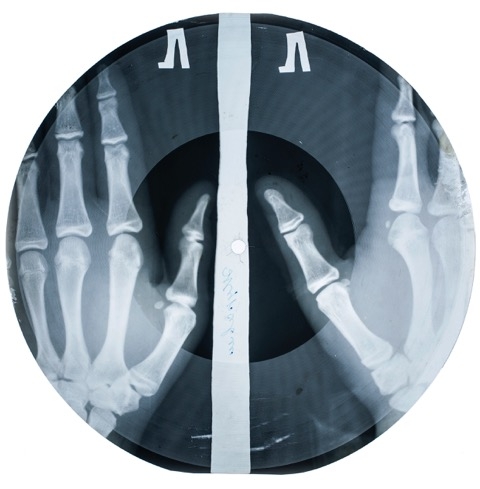
X-Ray Music from Soviet Times
From 1946 to 1964, many people in the Soviet Union listened to banned music (like western jazz and rhythm 'n blues) on bootleg records made on x-ray film:
In Leningrad (today’s Saint Petersburg), young music lover Ruslan Bogoslowsky managed to build a transcription lathe – a 3-kilogram “portable” device able to record live sounds on waxed or acetate discs, then mainly used by radio journalists.Fascinating. I suppose the thrill of listening to forbidden music on bootleg records helped to make up for the poor sound quality.
When it came to choosing the recording material, Coates says, discarded X-rays were an obvious choice. “ X-ray film is soft enough to be recorded on, but strong enough to hold the groove,” he explains. “It was also very easy to find: Russian hospitals had to get rid of their X-rays within one year because they were flammable, back then.”
Bogoslowsky teamed up with some friends to create the “Golden Dog Gang”: a bootlegger outfit able to get hold of smuggled vinyls and churn out tens of copies of “bone” records.
It was a laborious process yielding mediocre results: a lathe had to be positioned next to the gramophone playing the vinyl original, and it could only make one record at a time – one song at a time, in fact, as its maximum length was three minutes.
Sound quality wasn’t great either – some of the bootleggers Coates spoke with said X-ray music “sounded like sand” – and the records tended to wear off over time. Still, they were the only thing around, and they cost a few rubles. (The trade wasn’t particularly lucrative.)
Quickly, Bogoslowsky’s technique spread across Russia, as peddlers of X-ray records mushroomed at every corner of every major city.
The Chariot Mosaic at Akaki, Cyprus
Archaeologists working in Akaki, Cyprus this spring uncovered a spectacular, 85-foot long (26 m) mosaic depicting a race between four chariots. Each chariot is accompanied by two names, probably those of the driver and one of the horses. The mosaic dates to the 4th century CE.
There don't yet seem to be good photographs of the mosaic, especially of the whole thing. All the photos and videos I have found online were taken on the same day, as an archaeologist wandered around spraying the tiles with water. Each damp spot was clearly visible only for a moment before it dried out and faded to near invisibility.
So it may be that we won't have really good images until this is reassembled in some museum. For now, though, we at least have these news photos and videos.
There don't yet seem to be good photographs of the mosaic, especially of the whole thing. All the photos and videos I have found online were taken on the same day, as an archaeologist wandered around spraying the tiles with water. Each damp spot was clearly visible only for a moment before it dried out and faded to near invisibility.
So it may be that we won't have really good images until this is reassembled in some museum. For now, though, we at least have these news photos and videos.
The Research Bubble
The Last Psychiatrist used to write a blog full of angry, cynical rants about his profession and the world. In 2009 he wrote about a plan to force any researcher who received government money to publish the research in an open access journal where any taxpayer can read it:
Would anything in AJP be worth reading if it wasn't actually in AJP?I also like the plan to make taxpayer-funded research available to everyone, and I enjoy the thought that universities and grant givers might have to find some other way of evaluating scientists and scholars than by which journal their articles appear in. Journal publication is a game that has as much to do with citing the right people and taking the right tone as on the quality of the underlying work, and we really need a better scheme.
If you think about it, the entire past 15 years in psychiatry have produced no discoveries at all. None. We have different medicines, okay; but they're not better, just different. We don't have a better handle on the anatomic or genetic or anything causes of anything-- we're not even any further along in defining our terms. Thousands of articles rehashing the same old ground have kept thousands of academics employed, to no benefit whatsoever for mankind.
Take away the journals and the system collapses. Force researchers with NIH grants to publish their findings without the marketing and packaging of a journal, and you've effectively halted half of the NIH research, until another generation of researchers with a different research model show up for work. For sure, unquestionably, you've killed off psychiatry as it functions today.
Academic research is a bubble, money keeps flowing into it as long as it produces quality research. Who decides quality? Journals are the rating agencies, Moody's, they keep it sustainable by giving it AAA rating. The ratings agencies are precisely what keeps the bubble inflated, just like with the mortgages, they are what keeps research money pouring into the system.
If someone could look behind the ratings, and take measure of the actual value of the research, the bubble would pop faster than, well, you get the idea. Then there's the "systemic risk." Journals collapse, academic centers collapse from lack of funding, Pharma loses the AAA rating on their studies which are done by academics, published in journals, etc.
Research would be forced to change completely-- and for the better. But you'll have a decade or so recession in science and education while the old generation dies out and the new one becomes old enough to start work.
Sunday, August 6, 2017
Rage and Constructive Politics in the Trump Era
Allow me to recommend a book review/essay in the Post by Carlos Lozada, titled Sorry, but I Don't Care How You Felt on Election Night Any More.
What might work is long-haul, determined, calm defense of things believed in deeply: democracy, the rule of law, empathy, dialogue, compromise, and perhaps most importantly a reasoned, orderly approach to the world and the problems it presents.
You saw them. You probably read a few. Maybe you even wrote one.Bunches of these horrified reaction/calls to resistance how been published as books that make Lozada cringe.
Seething political takes. Overwrought open letters. Emotional manifestos. They began invading our inboxes and Facebook feeds in the early hours of Nov. 9, 2016, and continued for days and weeks. They frothed from keyboards across the country, countless renditions of what became an instantly recognizable genre: the How I Felt on Election Night essay.
The first one I recall was by New Yorker editor David Remnick, who proclaimed “revulsion and profound anxiety” at Donald Trump’s victory. But it was Aaron Sorkin, America’s leading purveyor of political self-righteousness, who typified the form in an open letter to his teenage daughter and former wife in which he pledged to “f—ing fight” Trump and reassured Americans that “our darkest days have always — always — been followed by our finest hours.”
As fear passes, some hope does emanate from the pages of “Radical Hope.” Writer Parnaz Foroutan addresses women who are immigrants, exiles and refugees in America, urging them to “pay no heed to the darkness, the open mouth of greed, the hateful speech, the walls and the guns. . . . America is yours.”Lozada finds a useful contrast in another book titled Rules for Resistance: Advice From Around the Globe for the Age of Trump, edited by David Cole and Melanie Wachtell Stinnett. In this book people who have actually experienced authoritarian takeovers of their countries pretty much tell Americans liberals that they are doing everything exactly wrong:
But fear also morphs into anger and judgment, including toward Trump voters. “F— being nice and polite,” writes Egyptian feminist Mona Eltahawy. “These are not nice or polite times. Be angry. Be loud. And be free!” Poet Mohja Kahf breaks down Trump’s support, concluding wryly that “hey, really only about one-fourth of the country hates us and/or hates Black people, LGBTQ folk, Latinx peoples, Indigenous peoples, and immigrants. And we already knew that, right?”
Even some of the contributors seeking to reach out to Trump’s base — at least in a think-piecey, theoretical sense — find ways to demean. . . .
Dismissing Trump voters as racists is an “idiotic simplification of extremely complex human beings,” writes Satyen K. Bordoloi, a Mumbai filmmaker. “We in India have been doing the same thing for two and a half years, and the results have been devastating. Our society has fractured much more because of these blanket accusations. Those who voted for [Prime Minister] Narendra Modi have gone into their defensive shells after such accusations and became more protective of their leader as their very sense of self became attached to him.”Anger, fear, hate, and talk of Resistance will change nothing. Anger, fear, and hate are the weapons of demagogues, the very life blood of tyranny. They are the One Ring: you will be tempted to use them but they will destroy you.
In Venezuela, the opposition to the late Hugo Chávez made similar mistakes. “We wouldn’t stop pontificating about how stupid Chavismo was, not only to international friends but also to Chavez’s electoral base,” journalist Andrés Miguel Rondón explains. “ ‘Really, this guy? Are you nuts? You must be nuts,’ we’d say.” As a result, “whole generations were split in two [and] a sense of shared culture was wiped out.”
Rondón’s appeal to American readers is simple: “This does not have to be your fate. . . . Recognize that you’re the enemy Trump requires. Show concern, not contempt, for the wounds of those who brought him to power.”
What might work is long-haul, determined, calm defense of things believed in deeply: democracy, the rule of law, empathy, dialogue, compromise, and perhaps most importantly a reasoned, orderly approach to the world and the problems it presents.
The Dolomites
Today's place to daydream about is the Italian Dolomites, a strangely beautiful part of the Alps.
These mountains are made of limestone that erodes more quickly than granite or gneiss; the only reason they are so tall is that the Alps are still being pushed higher by the ongoing collision of Europe and Africa. It is the rapid erosion of rising peaks that creates the spectacular ragged scenery.
Located within easy reach of Venice and the Po Valley, the Dolomites were one of Europe's first climbing and skiing meccas, and they remain so.
But there is also a sizable national park which preserves several ranges and valleys in a more natural state, home to chamois, goshawks, and other wildlife.
The Dolomites were on the front line of fighting between Italy and Austra-Hungary during World War I. Both sides built fortified outposts on mountain peaks where they conducted a strange "Battle in the Clouds." Some of the ladders and cables installed by the combatants to reach these posts are still there.
Spectacular.
These mountains are made of limestone that erodes more quickly than granite or gneiss; the only reason they are so tall is that the Alps are still being pushed higher by the ongoing collision of Europe and Africa. It is the rapid erosion of rising peaks that creates the spectacular ragged scenery.
Located within easy reach of Venice and the Po Valley, the Dolomites were one of Europe's first climbing and skiing meccas, and they remain so.
But there is also a sizable national park which preserves several ranges and valleys in a more natural state, home to chamois, goshawks, and other wildlife.
The Dolomites were on the front line of fighting between Italy and Austra-Hungary during World War I. Both sides built fortified outposts on mountain peaks where they conducted a strange "Battle in the Clouds." Some of the ladders and cables installed by the combatants to reach these posts are still there.
Spectacular.
Saturday, August 5, 2017
Louis Menand, The Metaphysical Club
What does it mean to think like a modern person, and how did we come to think that way?
I don't mean by this to think like most people in the 21st century; I mean, what is the distinctively modern way of understanding the world, that sets us apart from intellectuals in the past?
Try this: until recently most intellectuals believed that the Truth was out there somewhere, and our task was to find it. This might be difficult. The Truth might be hidden, and to reach it might require years of careful study, meditation, ordeal, prayer, revelation, or shamanistic journeying into other realms. But somehow, some way, we can reach the truth and know.
But what if we can't? What if no matter how hard we try, we can never find any certain knowledge about the universe? It is easy enough to show that our senses fool us all the time, and that our dreams are at best an unreliable guide. What if revelation is just another sort of dream? And what if science can provide all sorts of technical knowledge but never expose the foundations of the universe; what if there is no Final Theory, just partial, incompatible theories stretching all the way down, theories that with every step become harder for humans to understand? What if we never figure out how life arose from dead matter? And what if our science, for all its power, never sheds any light on questions of ethics or politics?
I have always imagined this state as being like those cartoon characters who run off the cliff but keep going for a while over empty space until they look down, realize nothing is holding them up, and fall. This, it seems to me, is the distinctively modern condition; to keep going on with a life of purpose and moral choice while realizing that there may well be nothing holding up our pretensions.
One of the major attempts to come to terms with this situation, and the most important American contribution to philosophy, is Pragmatism. Louis Menand's wonderful book, The Metaphysical Club (2002), explains the origin of Pragmatism by examining the careers of four American thinkers: Oliver Wendell Holmes, Charles Peirce, William James, and John Dewey. Holmes, Peirce and James were all young men when the Civil War broke out; Dewey was a generation younger. Two of the key events in the lives of the older men were the war itself and the publication of Darwin's Origin of Species in 1859. These both had the effect of undermining old certainties. In the face of the war's destruction and science's ever-increasing demolition of what we thought we knew about the world, these men tried to find new reasons for the ongoing exercise of philosophy, new ways to defend democracy, and a new understanding of how and why we make moral choices.
Pragmatism is philosophy for the statistical age. These men did not believe that knowledge was a sham; but they believed that it was always provisional and partial. Every belief, they thought, was a bet. Some bets are better than others; the bet that living things evolve is a very good one. The bet that God handed the law to Moses on Mount Sinai, they thought, was a lot more dubious, but they nonetheless saw why some people chose to make it.
All of the Pragmatists were strong believers in democracy and in the free circulation of ideas. After all, if you went around suppressing other people's ideas, you might by accident suppress one that is right – or, in Pragmatist terms, one that works better than yours does. You can never arrive at the final truth about anything so complex as how to administer society, so maximum openness to every idea is essential. The Pragmatists all taught tolerance for other people's ideas and ways of life; John Dewey coined the term "pluralism" for his ideal society, one that allowed groups of people to live in their own way, so long as that way did not involve oppressing anyone else.
One of the best ways to see what Pragmatism means in a down-to-earth sense is through the jurisprudence of Oliver Wendell Holmes and his leading disciple, Learned Hand. Holmes and Hand were both very reluctant to overturn laws passed by legislatures, because, well, if you don't really believe in Truth, on what basis would you do that? Their idea of justice was best expressed by Hand, who defined it as "the tolerable accommodation of the conflicting interests of society." To them politics was how competing interests in society work out their differences, and a judge was very unlikely to understand their concerns better than they themselves did. The judge's role was to serve as a sort of referee, ensuring that competing parties did so on fair, nonviolent terms. That the Constitution embodied some sort of great, timeless wisdom seemed to them a quaint, almost absurd idea; what did Madison and Hamilton know about industrial trusts, birth control or anarchist cells? The problems of our own time must be solved by people who understand them, that is, us.
Because they thought that all ideas were provisional bets, the Pragmatists hated ideology. In 1937, in one of the strange little events of history, 78-year-old John Dewey ended up part of a delegation of American leftists who traveled to Mexico to interview Leon Trotsky and assess his charges against Stalin. Dewey found Trotsky to be highly intelligent and on the side of the masses, but ultimately "tragic" because his brilliance was "locked up in absolutes." Given his commitment to non-commitment, his insistence that all knowledge is partial and all insights provisional, Dewey could not makes heads or tails of an ideologue like Trotsky. Dewey and Learned Hand came back again and again to the notion that liberty and tolerance were connected to a lack of dogmatic certainly in our beliefs. Instead of the Ten Commandments, Hand thought that every courtroom should have on its wall a quotation from a letter Oliver Cromwell sent to the Scots before he slaughtered them at the Battle of Dunbar: "I beseech you in the bowels of Christ, think that ye may be mistaken."
The Pragmatists considered all the time that they might be mistaken. It is this that makes their writings – James on psychology, Dewey on education, Peirce on science – so much more accessible than almost any other non-fiction of the period. (Consider Freud, who drove James's ideas out of psychology for 50 years but is now almost unreadable.) The Pragmatists went through a long eclipse in the mid-twentieth century, when Americans fighting the Cold War seemed almost embarrassed by their lack of fiery principle. But these days they have come back both in philosophy, where Richard Rorty restored them to the center of American academic life, and in politics; Barack Obama is the nation's most prominent political Pragmatist, but there are many others.
The Metaphysical Club is by far the best book I know on these men and their movement. In fact it is the best book on American intellectual history I have ever read, a model of how to write about intellectuals and ideas. It is, like the Pragmatists, open-minded and undogmatic. It considers influences from many directions – the disillusioning horror of the Civil War, the explosion of industrialization and commercial capitalism, the triumphs of science, the philosophy of Kant and Hegel, the professionalization of the university, Jane Addams and her writings about Hull House, and more. Because it focuses mainly on biography it never becomes a dry exposition of philosophy, but it has enough on the ideas to give them heft. It is gracefully written, judicious, and clear-minded. I loved it.
____________________
Good encyclopedia article on pragmatism.
Probably the best book by any of the Pragmatists is The Varieties of Religious Experience by William James. I recommend this for any agnostic curious about why religion is so important. This also exists in audio versions (one of which is on Audible) if you prefer to listen to it, which works well since it started as a series of lectures.
I don't mean by this to think like most people in the 21st century; I mean, what is the distinctively modern way of understanding the world, that sets us apart from intellectuals in the past?
Try this: until recently most intellectuals believed that the Truth was out there somewhere, and our task was to find it. This might be difficult. The Truth might be hidden, and to reach it might require years of careful study, meditation, ordeal, prayer, revelation, or shamanistic journeying into other realms. But somehow, some way, we can reach the truth and know.
But what if we can't? What if no matter how hard we try, we can never find any certain knowledge about the universe? It is easy enough to show that our senses fool us all the time, and that our dreams are at best an unreliable guide. What if revelation is just another sort of dream? And what if science can provide all sorts of technical knowledge but never expose the foundations of the universe; what if there is no Final Theory, just partial, incompatible theories stretching all the way down, theories that with every step become harder for humans to understand? What if we never figure out how life arose from dead matter? And what if our science, for all its power, never sheds any light on questions of ethics or politics?
I have always imagined this state as being like those cartoon characters who run off the cliff but keep going for a while over empty space until they look down, realize nothing is holding them up, and fall. This, it seems to me, is the distinctively modern condition; to keep going on with a life of purpose and moral choice while realizing that there may well be nothing holding up our pretensions.
One of the major attempts to come to terms with this situation, and the most important American contribution to philosophy, is Pragmatism. Louis Menand's wonderful book, The Metaphysical Club (2002), explains the origin of Pragmatism by examining the careers of four American thinkers: Oliver Wendell Holmes, Charles Peirce, William James, and John Dewey. Holmes, Peirce and James were all young men when the Civil War broke out; Dewey was a generation younger. Two of the key events in the lives of the older men were the war itself and the publication of Darwin's Origin of Species in 1859. These both had the effect of undermining old certainties. In the face of the war's destruction and science's ever-increasing demolition of what we thought we knew about the world, these men tried to find new reasons for the ongoing exercise of philosophy, new ways to defend democracy, and a new understanding of how and why we make moral choices.
In January of 1872, a group of young intellectuals in Cambridge, Mass., formed a conversation society. One of them, a prodigy in math, science and philosophy named Charles Sanders Peirce, said later that they called themselves the Metaphysical Club ''half-ironically, half-defiantly . . . for agnosticism was then riding its high horse, and was frowning superbly upon all metaphysics.'' Among the other members were William James, three years out of medical school, and Oliver Wendell Holmes Jr., the future justice of the Supreme Court. ''They wrangle grimly and stick to the question,'' James's brother Henry wrote to a friend that January. ''It gives me a headache merely to know of it.''That particular club existed for only a few months, but some of those men never stopped wrestling with those questions. They ended up sharing a key insight, what we might call an idea about ideas:
They all believed that ideas are not "out there" waiting to be discovered, but are tools– like forks and knives and microchips–that people devise to cope with the world in which they find themselves. They believed that ideas are produced not by individuals, but by groups of individuals–that ideas are social. They believed that ideas do not develop according to some inner logic of their own, but are entirely dependent, like germs, on their human carriers and the environment. And they believed that since ideas are provisional responses to particular and unreproducible circumstances, their survival depends not on their immutability but on their adaptability.The Pragmatists did not mean that we should believe whatever makes us feel good. "The utility of a theory," Dewey wrote, "is a matter of its problem-solving power." They had in mind theories of physics that allow us to launch rockets with high accuracy, medical theories that allow us to cure diseases, political theories that lead to countries where people want to live.
What is essential is that theories pay their way in the long run—that they can be relied upon time and again to solve pressing problems and to clear up significant difficulties confronting inquirers. To the extent that a theory functions or “works” practically in this way, it makes sense to keep using it—though we must always allow for the possibility that it will eventually have to be replaced by some theory that works even better.One of the new sciences that had a huge effect on all these men was statistics. Peirce in particular was fascinated by the discovery that no matter how careful the astronomer or how gigantic his telescope, he will never take two measurements of a star's position that agree exactly. The best approximation of the star's position comes not from relying on any one measurement but on averaging them all together, or even better treating them all as points on a graph. The graph of all the observations every made on that star will almost certainly trace out the familiar bell curve, and the best value will be the peak of that curve, whether or not that value corresponds to even a single measurement.
Pragmatism is philosophy for the statistical age. These men did not believe that knowledge was a sham; but they believed that it was always provisional and partial. Every belief, they thought, was a bet. Some bets are better than others; the bet that living things evolve is a very good one. The bet that God handed the law to Moses on Mount Sinai, they thought, was a lot more dubious, but they nonetheless saw why some people chose to make it.
All of the Pragmatists were strong believers in democracy and in the free circulation of ideas. After all, if you went around suppressing other people's ideas, you might by accident suppress one that is right – or, in Pragmatist terms, one that works better than yours does. You can never arrive at the final truth about anything so complex as how to administer society, so maximum openness to every idea is essential. The Pragmatists all taught tolerance for other people's ideas and ways of life; John Dewey coined the term "pluralism" for his ideal society, one that allowed groups of people to live in their own way, so long as that way did not involve oppressing anyone else.
One of the best ways to see what Pragmatism means in a down-to-earth sense is through the jurisprudence of Oliver Wendell Holmes and his leading disciple, Learned Hand. Holmes and Hand were both very reluctant to overturn laws passed by legislatures, because, well, if you don't really believe in Truth, on what basis would you do that? Their idea of justice was best expressed by Hand, who defined it as "the tolerable accommodation of the conflicting interests of society." To them politics was how competing interests in society work out their differences, and a judge was very unlikely to understand their concerns better than they themselves did. The judge's role was to serve as a sort of referee, ensuring that competing parties did so on fair, nonviolent terms. That the Constitution embodied some sort of great, timeless wisdom seemed to them a quaint, almost absurd idea; what did Madison and Hamilton know about industrial trusts, birth control or anarchist cells? The problems of our own time must be solved by people who understand them, that is, us.
Because they thought that all ideas were provisional bets, the Pragmatists hated ideology. In 1937, in one of the strange little events of history, 78-year-old John Dewey ended up part of a delegation of American leftists who traveled to Mexico to interview Leon Trotsky and assess his charges against Stalin. Dewey found Trotsky to be highly intelligent and on the side of the masses, but ultimately "tragic" because his brilliance was "locked up in absolutes." Given his commitment to non-commitment, his insistence that all knowledge is partial and all insights provisional, Dewey could not makes heads or tails of an ideologue like Trotsky. Dewey and Learned Hand came back again and again to the notion that liberty and tolerance were connected to a lack of dogmatic certainly in our beliefs. Instead of the Ten Commandments, Hand thought that every courtroom should have on its wall a quotation from a letter Oliver Cromwell sent to the Scots before he slaughtered them at the Battle of Dunbar: "I beseech you in the bowels of Christ, think that ye may be mistaken."
The Pragmatists considered all the time that they might be mistaken. It is this that makes their writings – James on psychology, Dewey on education, Peirce on science – so much more accessible than almost any other non-fiction of the period. (Consider Freud, who drove James's ideas out of psychology for 50 years but is now almost unreadable.) The Pragmatists went through a long eclipse in the mid-twentieth century, when Americans fighting the Cold War seemed almost embarrassed by their lack of fiery principle. But these days they have come back both in philosophy, where Richard Rorty restored them to the center of American academic life, and in politics; Barack Obama is the nation's most prominent political Pragmatist, but there are many others.
The Metaphysical Club is by far the best book I know on these men and their movement. In fact it is the best book on American intellectual history I have ever read, a model of how to write about intellectuals and ideas. It is, like the Pragmatists, open-minded and undogmatic. It considers influences from many directions – the disillusioning horror of the Civil War, the explosion of industrialization and commercial capitalism, the triumphs of science, the philosophy of Kant and Hegel, the professionalization of the university, Jane Addams and her writings about Hull House, and more. Because it focuses mainly on biography it never becomes a dry exposition of philosophy, but it has enough on the ideas to give them heft. It is gracefully written, judicious, and clear-minded. I loved it.
____________________
Good encyclopedia article on pragmatism.
Probably the best book by any of the Pragmatists is The Varieties of Religious Experience by William James. I recommend this for any agnostic curious about why religion is so important. This also exists in audio versions (one of which is on Audible) if you prefer to listen to it, which works well since it started as a series of lectures.
Friday, August 4, 2017
Art of World War I
Some pieces from a new exhibit at the Met. Above, Returning to the Trenches by British artist Christopher Nevinson, 1916.
Käthe Kollwitz, Mothers, 1919
Natalia Goncharova, a Russian-born French artist, Doomed City, 1914.
Gino Severini, Train in the City, 1915
Käthe Kollwitz, Mothers, 1919
Natalia Goncharova, a Russian-born French artist, Doomed City, 1914.
Gino Severini, Train in the City, 1915
Thursday, August 3, 2017
Trump Lets the Generals Have It
The latest leak from within the sieve of the Trump administration allowed NBC news to publish a remarkably detailed account of a top secret meeting of the National Security Council in mid July. It seems the point of the meeting was to get Trump to endorse the Pentagon's plan to send 4,000 more troops to Afghanistan and commit to years more of combat.
But Trump wasn't having it. He lambasted the generals for failing, saying "We're not winning, we're losing." He said that Gen. John Nicholson, currently in command in Afghanistan, should be fired.
Trump had recently spoken to some regular soldiers who told him the war was a disaster, and he compared Afghanistan to a troubled Manhattan restaurant where, he said, the waiters knew what was going on but the owners didn't have a clue.
I love this; one thing about Trump is that he is not afraid to say what he thinks to anybody. But can he actually have any impact on the situation? He may not like the Pentagon's plan, but does he have any clue what to do instead? Do any of his close advisers? In the end some decision has to be made, and if nobody can come up with an alternative to the Pentagon's strategy, that will be chosen by default.
Personally I would have pulled out of Afghanistan a decade ago, figuring that if the Afghans want a democracy they can damn well fight for it themselves. Keeping 10,000 Americans in country at great expense just seems to be prolonging the stalemate. I wonder what they really think in the Pentagon. Do they think that with some level of troops and planes they could finish off the Taliban and win the war? Do they wish they had 200,000 men but know they won't get them? Or would they rather walk away? It's puzzling, really. What do we think we are doing?
But I'm glad to see Trump calling bullshit on somebody.
But Trump wasn't having it. He lambasted the generals for failing, saying "We're not winning, we're losing." He said that Gen. John Nicholson, currently in command in Afghanistan, should be fired.
Trump had recently spoken to some regular soldiers who told him the war was a disaster, and he compared Afghanistan to a troubled Manhattan restaurant where, he said, the waiters knew what was going on but the owners didn't have a clue.
I love this; one thing about Trump is that he is not afraid to say what he thinks to anybody. But can he actually have any impact on the situation? He may not like the Pentagon's plan, but does he have any clue what to do instead? Do any of his close advisers? In the end some decision has to be made, and if nobody can come up with an alternative to the Pentagon's strategy, that will be chosen by default.
Personally I would have pulled out of Afghanistan a decade ago, figuring that if the Afghans want a democracy they can damn well fight for it themselves. Keeping 10,000 Americans in country at great expense just seems to be prolonging the stalemate. I wonder what they really think in the Pentagon. Do they think that with some level of troops and planes they could finish off the Taliban and win the war? Do they wish they had 200,000 men but know they won't get them? Or would they rather walk away? It's puzzling, really. What do we think we are doing?
But I'm glad to see Trump calling bullshit on somebody.
Wednesday, August 2, 2017
The Naturally Happy
In The Varieties of Religious Experience, William James discourses for a few pages on those people who are just naturally happy and can hardly be made downcast by any combination of events, or convinced by any argument that there is evil in the world. People like Walt Whitman:
“His favorite occupation,” writes his disciple, Dr. Bucke, “seemed to be strolling or sauntering about outdoors by himself, looking at the grass, the trees, the flowers, the vistas of light, the varying aspects of the sky, and listening to the birds, the crickets, the tree frogs, and all the hundreds of natural sounds. It was evident that these things gave him a pleasure far beyond what they give to ordinary people. Until I knew the man,” continues Dr. Bucke, “it had not occurred to me that any one could derive so much absolute happiness from these things as he did. He was very fond of flowers, either wild or cultivated; liked all sorts. I think he admired lilacs and sunflowers just as much as roses. Perhaps, indeed, no man who ever lived liked so many things and disliked so few as Walt Whitman. All natural objects seemed to have a charm for him. All sights and sounds seemed to please him. He appeared to like (and I believe he did like) all the men, women, and children he saw (though I never knew him to say that he liked any one), but each who knew him felt that he liked him or her, and that he liked others also. I never knew him to argue or dispute, and he never spoke about money. He always justified, sometimes playfully, sometimes quite seriously, those who spoke harshly of himself or his writings, and I often thought he even took pleasure in the opposition of enemies. When I first knew [him], I used to think that he watched himself, and would not allow his tongue to give expression to fretfulness, antipathy, complaint, and remonstrance. It did not occur to me as possible that these mental states could be absent in him. After long observation, however, I satisfied myself that such absence or unconsciousness was entirely real. He never spoke deprecatingly of any nationality or class of men, or time in the world's history, or against any trades or occupations—not even against any animals, insects, or inanimate things, nor any of the laws of nature, nor any of the results of those laws, such as illness, deformity, and death. He never complained or grumbled either at the weather, pain, illness, or anything else. He never swore. He could not very well, since he never spoke in anger and apparently never was angry. He never exhibited fear, and I do not believe he ever felt it.”Whitman, says James “infected others with his own gladness that he and they exist,” and meant quite literally his famous line,
What is called good is perfect and what is called bad is just as perfect.How amazing that there should be such people. Do they serve some evolutionary purpose, or do they just sometimes appear by sport, among the many unlikely outcomes of the complex wiring of our brains?
Teasers
Just a few of the odd teaser links I have seen lately. I don't recommend clicking on any of them, I simply supply the links as proof for the skeptical. Except for those I simply couldn't bear to click on myself:
Scientists Stumble On 'Breakthrough' Fix for Men
They Had No Idea This Kitten Was Different
Scientists Stumble On 'Breakthrough' Fix for Men
I mean, we certainly need one. Sadly this article is just about hair loss.There Are Over 200 Bodies on Mount Everest, And They’re Used as Landmarks
Turn left at the guy with yellow boots.Would Your Dog Eat You if You Died?
Is that the sort of thing you worry about?Liberals Have Turned Trump Into a Gay Villain Because Our Worst Villains Must Be Gay
I think this is about Trump/Putin bromance memes. But tell me, which of our worst villains are gay?The most manly men in the world all share these ten habits.
I had a feeling that if I clicked on this I would be haunted by similar ads for a decade, and I just couldn't risk that.Katy Perry Adds Emotional Complexity to Orlando Bloom’s Naked Paddleboard Moment
The mind boggles.Justin Bieber Wears Women's Pants
This I feared to click on for obvious reasons. What sort of category would caring about Justin Bieber's pants put me in?Why It's Nearly Impossible to Castrate a Hippo
Inquiring minds. . . .Are You Overcomplicating Astral Travel?
No link because it wouldn't work for me. Probably I was overcomplicating. . . .Watching plants grow has never been this exciting
They Had No Idea This Kitten Was Different
Part of a vast genre of internet stories about strange kittens, puppies, etc., which is interesting to me partly because such stories are ancient; European folklore is full of odd baby animals that grow into monstersCould Space Travelers Melt As They Accelerate Through Deep Space?
Yes, actually.Are These Birds too Sexy to Survive?
A real science article, if a tad sensationalist
Not a Stranger
You did not come into this world, you came out of it, like a leaf from a tree. You are not a stranger here.
–Alan Watts
–Alan Watts
A Map of Opioid Prescriptions per Capita
Fascinating map from 538. (It's a big image, so click if you want more detail.) Notice two things: first, the opiate belt in southern Appalachia, that zone of increasing immiseration. Second, all the major cities show up as low-prescription zones, from Boston to Miami to Los Angeles to Seattle. I wonder is that is because this really is a rural/exurban crisis, or if heroin is just more readily available in big cities.
Trumpets
Under the trimmed willows, where brown children
are playing
And leaves tumbling, the trumpets blow. A quaking of cemeteries.
Banners of scarlet rattle through a sadness of maple trees,
Riders along rye-fields, empty mills.
Or shepherds sing during the night, and stags step delicately
Into the circle of their fire, the grove’s sorrow immensely old,
Dancing, they loom up from one black wall;
Banners of scarlet, laughter, insanity, trumpets.
–Georg Trakl
Tanslated by Robert Bly and James Wright
And leaves tumbling, the trumpets blow. A quaking of cemeteries.
Banners of scarlet rattle through a sadness of maple trees,
Riders along rye-fields, empty mills.
Or shepherds sing during the night, and stags step delicately
Into the circle of their fire, the grove’s sorrow immensely old,
Dancing, they loom up from one black wall;
Banners of scarlet, laughter, insanity, trumpets.
–Georg Trakl
Tanslated by Robert Bly and James Wright
Tuesday, August 1, 2017
What Are We Supposed to Do About It?
I must have seen a hundred headlines and cover stories like the above, coming from both liberals and conservatives. They frustrate me. Yes, I get it that wide swathes of America are not doing very well economically. If you need more numbers, Harold Meyerson has them in his contribution to the Wages of Neglect feature.
But what are we supposed to do about it? What magic wand do we have that will create jobs in the towns and small cities of Pennsylvania, Wisconsin, and West Virginia? Meyerson makes the usual noises about infrastructure spending, but honestly the places that most need new infrastructure are rapidly growing cities, and the places that most need spending on repairs and maintenance are old cities. There just isn't much infrastructure to build in central Kansas or southern West Virginia. Other than wind and solar farms, I guess, but those aren't very popular with working class voters and we're already building them pretty fast anyway. Otherwise Meyerson just says vague things about "regional development policies" that I find utterly unimpressive.
In his contribution, Stanley Greenberg dwells at length on the bad politics of bailing out Wall Street while regular people in small towns were losing their houses. Which I agree was bad politics, but was it really bad economics? Does anybody think the economy of small towns would have been better if we had let Wall Street implode? And would jailing a few dozen executives, however morally righteous, have created a single job? Greenberg also spends some time on trade, but whatever the politics of trade agreements their impact on the economy is fiendishly complex; they kill jobs but they also create them, leaving economists to argue furiously about the overall result.
Paul Ryan conservatives just push for lower taxes and less regulation, which if you ask me is how we got to this place. Trump's people have no ideas at all.
Manufacturing employment is declining almost everywhere, from China and India to Switzerland and Sweden. I do not believe we can do anything about this. Maybe different trade and regulatory policies crafted by all-knowing experts would have led to a smaller decline in the US, but I doubt the overall story would be different. The world economy is leaving factory workers behind.
There are a few things we could do, especially in the line of health care policy. Real national health insurance would pay for thousands of jobs in declining areas, besides helping the people who live in them. And if that health insurance paid for addiction treatment and other mental health care, that would also both create jobs and make life better. If we raised taxes on the rich even more we could do other things, like free community college (which would at least create jobs for teachers) and subsidies for upgrading houses, and so on.
But on the whole I doubt the ability of any government to change the basic economic facts. Consider: the places that are troubled include Democratic bastions like Detroit and Republican strongholds like rural Kansas. The two states that have lately been most spectacularly successful are California and Texas, which are pretty much political opposites.
I believe that Obama understood perfectly well how poorly neo-liberalism was working both economically and politically in much of the country. Yet he also believed that there was no other course: more openness, more trade, more immigration, more education, more meritocracy is the only path that might possibly lead to a more prosperous future.
I hate to write off so many people and places, but I also don't really see what we could be doing instead.
But what are we supposed to do about it? What magic wand do we have that will create jobs in the towns and small cities of Pennsylvania, Wisconsin, and West Virginia? Meyerson makes the usual noises about infrastructure spending, but honestly the places that most need new infrastructure are rapidly growing cities, and the places that most need spending on repairs and maintenance are old cities. There just isn't much infrastructure to build in central Kansas or southern West Virginia. Other than wind and solar farms, I guess, but those aren't very popular with working class voters and we're already building them pretty fast anyway. Otherwise Meyerson just says vague things about "regional development policies" that I find utterly unimpressive.
In his contribution, Stanley Greenberg dwells at length on the bad politics of bailing out Wall Street while regular people in small towns were losing their houses. Which I agree was bad politics, but was it really bad economics? Does anybody think the economy of small towns would have been better if we had let Wall Street implode? And would jailing a few dozen executives, however morally righteous, have created a single job? Greenberg also spends some time on trade, but whatever the politics of trade agreements their impact on the economy is fiendishly complex; they kill jobs but they also create them, leaving economists to argue furiously about the overall result.
Paul Ryan conservatives just push for lower taxes and less regulation, which if you ask me is how we got to this place. Trump's people have no ideas at all.
Manufacturing employment is declining almost everywhere, from China and India to Switzerland and Sweden. I do not believe we can do anything about this. Maybe different trade and regulatory policies crafted by all-knowing experts would have led to a smaller decline in the US, but I doubt the overall story would be different. The world economy is leaving factory workers behind.
There are a few things we could do, especially in the line of health care policy. Real national health insurance would pay for thousands of jobs in declining areas, besides helping the people who live in them. And if that health insurance paid for addiction treatment and other mental health care, that would also both create jobs and make life better. If we raised taxes on the rich even more we could do other things, like free community college (which would at least create jobs for teachers) and subsidies for upgrading houses, and so on.
But on the whole I doubt the ability of any government to change the basic economic facts. Consider: the places that are troubled include Democratic bastions like Detroit and Republican strongholds like rural Kansas. The two states that have lately been most spectacularly successful are California and Texas, which are pretty much political opposites.
I believe that Obama understood perfectly well how poorly neo-liberalism was working both economically and politically in much of the country. Yet he also believed that there was no other course: more openness, more trade, more immigration, more education, more meritocracy is the only path that might possibly lead to a more prosperous future.
I hate to write off so many people and places, but I also don't really see what we could be doing instead.
St. Alban, Kirch Brombach
St. Alban from a 16th-century wooden altarpiece in Kirch Brombach, Germany. Other images of the same church below.
Shall We Fight Them All?
Under this title, Pat Buchanan takes on the latest wave of American aggression. After noting that North Korea presumably wants missiles that can hit the US for the same reason other nuclear powers do – to deter attack – Buchanan takes a tour of other trouble spots:
Apparently, U.S. wars in Afghanistan, Syria, Iraq, Yemen and Somalia are insufficient to satiate our War Party. Now it wants us to lead the Sunnis of the Middle East in taking down the Shiites, who are dominant in Iran, Iraq, Syria and South Lebanon, and are a majority in Bahrain and the oil-producing regions of Saudi Arabia.I always think that when I end up agreeing with people like Pat Buchanan, strange things are happening in the world.
The U.S. military has its work cut out for it. President Trump may need those transgender troops.
Among the reasons Trump routed his Republican rivals in 2016 is that he seemed to share an American desire to look homeward.
Yet, today, our relations with China and Russia are as bad as they have been in decades, while there is open talk of war with Iran and North Korea.
Was this what America voted for, or is this what America voted against?
Jeff Flake Sounds Off
Republican Senator Jeff Flake is not happy with how things are going in Washington:
Who could blame the people who felt abandoned and ignored by the major parties for reaching in despair for a candidate who offered oversimplified answers to infinitely complex questions and managed to entertain them in the process? With hindsight, it is clear that we all but ensured the rise of Donald Trump.Is he setting up to run against Trump in 2020? I hope so. For the honor of the Republic, some Republican has to, and it should be somebody not afraid to take these stands.
I will let the liberals answer for their own sins in this regard. (There are many.) But we conservatives mocked Barack Obama’s failure to deliver on his pledge to change the tone in Washington even as we worked to assist with that failure. It was we conservatives who, upon Obama’s election, stated that our No. 1 priority was not advancing a conservative policy agenda but making Obama a one-term president—the corollary to this binary thinking being that his failure would be our success and the fortunes of the citizenry would presumably be sorted out in the meantime. It was we conservatives who were largely silent when the most egregious and sustained attacks on Obama’s legitimacy were leveled by marginal figures who would later be embraced and legitimized by far too many of us. It was we conservatives who rightly and robustly asserted our constitutional prerogatives as a co-equal branch of government when a Democrat was in the White House but who, despite solemn vows to do the same in the event of a Trump presidency, have maintained an unnerving silence as instability has ensued. To carry on in the spring of 2017 as if what was happening was anything approaching normalcy required a determined suspension of critical faculties. And tremendous powers of denial. . . .
There was a time when the leadership of the Congress from both parties felt an institutional loyalty that would frequently create bonds across party lines in defense of congressional prerogatives in a unified front against the White House, regardless of the president’s party. We do not have to go very far back to identify these exemplars—the Bob Doles and Howard Bakers and Richard Lugars of the Senate. Vigorous partisans, yes, but even more important, principled constitutional conservatives whose primary interest was in governing and making America truly great.
But then the period of collapse and dysfunction set in, amplified by the internet and our growing sense of alienation from each other, and we lost our way and began to rationalize away our principles in the process. But where does such capitulation take us? If by 2017 the conservative bargain was to go along for the very bumpy ride because with congressional hegemony and the White House we had the numbers to achieve some long-held policy goals—even as we put at risk our institutions and our values—then it was a very real question whether any such policy victories wouldn’t be Pyrrhic ones. If this was our Faustian bargain, then it was not worth it. If ultimately our principles were so malleable as to no longer be principles, then what was the point of political victories in the first place?
Subscribe to:
Posts (Atom)