Tuesday, October 25, 2011

Yay, it's Endangered!

The latest World Monument Fund list of threatened monuments includes one of my least favorite buildings, Southbank Centre in London. (The old part, not the new part, which is much nicer.) Completed in 1976, as the Great Age of Uglification was winding down into stagflation and disco music, it is considered in some quarters a masterpiece of brutalism, which in this quarter is considered a good reason to dynamite the whole thing. Why, oh why, was it ever considered a good idea to make buildings deliberately ugly?

Great News from Tunisia

In Tunisia, the first election of the Arab Spring has come off peacefully and all sides are accepting the results. This is great news for Tunisians and good news for everyone in the Middle East. Tunisia is probably the most westernized Arabic-speaking country, so if they could not make democracy work, it is unlikely that anyone in the region could. Their success will encourage democrats elsewhere.

The party that won 40% of the vote, Ennahda, is described as "Islamist," but this is a little tendentious. So far as anyone can tell at this point, they are Islamic in about the same sense that Italy's Christian Democrats are Catholic. Their Islam does not pose any great threat to democracy or human rights. They will probably turn out to be more conservative about social issues and women's issues than I would like, but, hey, they won the election. Since every poll ever taken in the Arab world shows that most people want their governments to be explicitly Islamic, it is not possible to have states in the region that are democratic without being Islamic in some sense. Parties like Ennahda or the Turkish Justice and Development Party represent the liberal side of what is possible, and we should cheer that.

Monday, October 24, 2011

Treasure Hunting

Russia plans to raise the schooner Frau Maria, which sank off Finland in 1771 carrying a cargo of gold, silver, and 20 paintings by Dutch masters that Catherine the Great had purchased for the collection that became the Hermitage Museum.

Not Knowing What to Do about the Economy

I found a flaw. . . . a flaw in the model.
—Alan Greenspan, October 2008
One of my themes here has been that although most people agree there are real problems with the global economy and that many of them reside in the financial sector, nobody knows what to do about it. Brian Collins has a long review in the LA Times of two books making similar arguments. Collins writes,
The global financial system still teeters on the brink of collapse, and virtually nothing has been done to avert another disaster. One would have to be pretty cynical to accept that only greed and personal political ambition are to blame for such thoroughgoing paralysis. In view of the spectacle of “extend and pretend” presently unfolding in power centers from Washington to Frankfurt, what needs explaining is why even the well-informed and quite high-minded remain committed to so unpromising a status quo. . . .
One reason for this dismal state of affairs, he suggests, is that economics as a science does not provide the knowledge we need:
Mainstream economists failed to predict the crisis because — though smart, hardworking, and for the most part well-meaning — they are formed in a discipline where adherence to market theory, and only market theory, is rewarded, and the fact that it doesn’t tell the whole story is unimportant. The theory works well enough. Until it doesn’t.
Summarizing the views of economist Yanis Varoufakis, Collins writes,
The great insight here is that, along with whatever reckless self-interest was at work, the crisis occurred and persists because an alternative was and is mostly unthinkable.
And here we reach the nub of the problem. What is the alternative to the current system? What the big banks mostly do these days, it seems, is sell each other ever more complicated financial products, earning money by adding another layer of risk at each step in the process. The numbers involved are huge; in 2007, the nominal value of all the derivatives traded on the markets was 8 times global income. To invest huge sums in such complex securities is a formula for recurrent financial disasters. But what can we do about it? To ban all derivatives (securities whose value depends on the value of something else) would seriously crimp important parts of the economy: global firms depend on derivatives to protect themselves from currency fluctuations, to take just one example. What we want to do is ban needlessly risky, useless derivatives, but how do you write rules to do that?

Economist Varoufakis and his colleagues wrote that
The only hope for a rational future is a massive transfer in social power away from the ‘markets’ (i.e. the banks) to those who cannot be captured by them because they are too many to bribe, threaten and extort.
That is, to workers. But what does it mean to transfer social power from bankers to workers?

All the reform plans I have ever heard, right or left, are dismal slurries of ideology, hope, hand waving, ax grinding, special pleading, and electioneering. The world economy is a complex system that we understand no better than we understand the weather, and I do not think anyone knows how to make it safer without stifling it.

The Scarecrows of Middletown

I just discovered today that the lovely little town of Middletown, Maryland has one of the greatest holiday traditions ever: a Halloween scarecrow contest. This year there are about 40 in all, spread out along a mile or so of Main Street (Alternate 40).

Homage to an old Carol Burnett skit.

I wonder if somebody else has a teenage goth daughter to whom they entrusted the family effort.

Mother Nature, who I suppose is scary because she has a lot to be mad about.

This one was designed to scare away single men.

Some movie-themed entries.

And some views that include the wonderful houses.

Aphrodite Returns to Sicily

The Getty Museum has returned its looted statue of Aphrodite, which had been the centerpiece of the museum's classical collection, to the Sicilian town from which it was taken in the 1980s. Given how much they have had to return lately -- 47 works, according to Smithsonian -- what do they have left?

I remain, as ever, ambivalent about all of this. I fail to see what right the Italian government has to these works, many of which were probably stolen from Greece by greedy Romans. The practical effect will be to force looted works off the public art market, where they can be bought by museums, and into clandestine sales to secretive collectors. But I guess that the clear evidence of recent criminal activity made it necessary to do something about these pieces.

This image, of the official welcome reception for the returned statue, is captioned by Smithsonian "The goddess was greeted like a long-lost daughter in the Sicilian town of Aidone, where it was installed in the local archaeological museum." Yeah, right. If the townspeople were excited by the statue's return, it was because the press had riled them up about rich Californians stealing their heritage. After this year is out, I bet only the barest trickle of Sicilians will bother to visit this thing. They have so much classical statuary in Italy that most of it is just lying around in unheated warehouses, or even in open yards, slowly crumbling. You can't build anything in much of Italy without endless hassles over classical ruins, with nosy Germans and Englishmen demanding careful excavation, and most Italians are sick of it. Tombaroli, as they call looters in Italy, are folk heroes to much of the population. Greece is the same way; I once stumbled into a yard behind the municipal museum in Athens, where I discovered dozens of columns and other bits of classical buildings stacked piled in no particular order, covered with a dusting of snow. Why not send some of those columns to museums or universities in other parts of the world, that would take care of them and display them proudly? It bugs me that nationalism gets in the way of properly caring for the past.

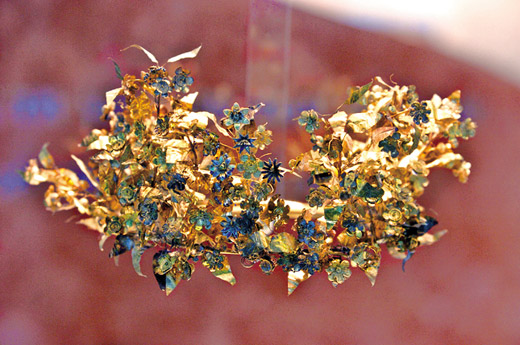
This wreath, no doubt looted from a tomb, is my personal favorite in the recent crop of repatriated items.

Sunday, October 23, 2011

Marriage and the Spectacular


Stacia Brown has been watching cool wedding ads, like the Subaru ad above, and the experience has led her to ponder why she is still single:
I haven’t married, in part, because of this. I am expecting something more spectacular than I’ve experienced.
My first reaction to this was to gag, but really I have no interest in judging Stacia Brown. If she can't imagine being happy without feeling overwhelming love and excitement, then she should stay single. In our age there is no reason why anyone has to get married.

But the idea that people can be so moved by advertising that uses wonderful wedding images to sell stuff that they change what they expect in love and marriage is quite disturbing to me. Are we so cut off from any other models of life -- family, friends, community, novels -- that we draw our expectations from advertising?

Certainly not all of us do; here is a commenter on Brown's blog:
See, when I watch those commercials, my reaction is completely different. I don’t see real people; even when I tried to watch them through the lens of this piece, all I see is a fantasy being sold. Things like this were not really part of my thought process when I got married- I figured, we’re both flawed now, we’ll continue to be (and hark! we have), but we work well together and are likely to continue to. I don’t know that it would be fair to either of us to place expectations for undying passion and romance on one another (especially since we plan to have kids at some point!) and I think that I’d have been much more wary about getting married had the decision only been about the emotional side of love rather than also looking in a very pragmatic way about who we fundamentally are.
Which actually sounds a little cold and practical to me, but at least she didn't get her ideas from car commercials.

Irish Zombies and Archaeological Fashion

Discovery has a news story with the title, "Did Zombies Roam Medieval Ireland?" Which made me think, well, there are some questions that are so difficult they may never be answered, and then there are the easy ones.

The subject of the story is the discovery of two more bodies, these dating to the 8th century AD, with stones stuffed in their mouths:

The "deviant burials" were comprised of two men who were buried there at different times in the 700s. One of the men was between 40 and 60 years old, and the other was a young adult, probably between 20 and 30 years old. The two men were laid side by side and each had a baseball-sized rock shoved in his mouth. "One of them was lying with his head looking straight up. A large black stone had been deliberately thrust into his mouth," Chris Read, head of Applied Archaeology at IT Sligo, said. "The other had his head turned to the side and had an even larger stone wedged quite violently into his mouth so that his jaws were almost dislocated," he added.

Initially, Read and colleagues thought they had found a Black Death-related burial ground. Remains of individuals buried at the end of the Middle Ages with stones stuck in their mouths have hinted at vampire-slaying rituals. It was believed that these "vampire" individuals spread the plague by chewing on their shrouds after dying. In a time before germ theory, the stone in the mouth was then used as a disease-blocking trick.

Since the vampire phenomenon didn't emerge in European folklore until the 1500's, the archaeologists ruled out this theory for the 8th century skeletons. "In this case, the stones in the mouth might have acted as a barrier to stop revenants from coming back from their graves," Read told Discovery News.

It seems to me like there have been a lot of similar stories over the past few years. I wonder if this is because archaeologists are sensitized to the issue, so they are making more careful notes of such oddities, or if they always have and now the press is paying more attention.

I also wonder about these confident assertions that villagers of the early Middle Ages were not afraid of disease-spreading vampires. There were frequent epidemics throughout medieval times, and the plague had come to Ireland in the 530s. I am not sure that the modern distinction between vampires and zombies makes any sense in this context. I am also not sure that information about how the dead attack the living collected in Renaissance Italy necessarily applies to 8th-century Ireland. Fear of the evil dead is an all-to-common feature of many societies, but it appears in myriad forms.

A Sunny Day in Autumn

All taken during my walk with the dog today.

And my wild mums, taking over the herb garden.

Bridges of Amsterdam

City of canals and bridges.

Saturday, October 22, 2011

Missing Links Found

Since creationists still like to complain about all the "missing links" they imagine in the fossil record, I decided to post some of the most famous, recently discovered "transitional" species.

The "Link" Between Fish and Amphibians: Tiktaalik roseae

This creature lived around 375 million years ago, and it has an almost perfect mix of fish and amphibian features. The fossils were found on Ellesmere Island in the Canadian arctic.

Some "Links" Between Hippos and Whales

Genetic studies show that the land animals most closely related to whales are hippos. Fossils found in Pakistan over the past 20 years give an almost complete sequence from hippo-like animals to true whales. Above, Skeleton and reconstruction of Ambulocetus natans. Based on the structure of the skull and neck bones, this animal was a cetacean, but it had large legs with bones strong enough to support its weight. It lived about 50 million years ago.

Rodhocetus. This animal lived about 46 million years ago. It is clearly more like a whale than Ambulocetus, and its fossils are found in marine sediments, indicating that it spent time in deep water.

Basilosaurus, about 40 million years ago. This animal -- mistaken for a dinosaur when it was found, hence the name -- is clearly a whale, a full-time marine creature, but with features of land life no modern whale has, like developed hind limbs. Creationists used to mock the notion that whales could have evolved from land animals, but this is now one of the most complete evolutionary sequences.

The "Link" Between Humans and Chimps: Australopithecus afarensis

The species of the famous "Lucy" fossil, with a chimp-sized brain but fully upright gait and useful hands.

Australopithecus afarensis lived in Africa between 3.9 million and 2.9 million years ago. They are recognizably somewhere between humans and chimpanzees. And they are only part of a chain of fossils that extends from even more apelike forms through Homo habilis, Homo erectus, and archaic Homo sapiens to us. The notion that there is a "missing link" between humans and apes is fatuous.

A Van Gogh Drawing

In the shop at the Phillips Collection today I found a card showing this Van Gogh drawing, which they own. I asked the clerks if it was on display, and they said no. Ack -- I like this ten times more than most of what they have on their walls, although I suppose it isn't really part of their mission.

I wrote some time ago about how much I love Van Gogh's drawings, of which there is a fabulous collection here.

The Phillips Collection

This started yesterday, when I left my phone in my office. I didn't want to be phoneless all weekend, and I am supposed to be in the field Monday, so I started toying around the idea of driving down to Washington to get it. But I wasn't going to drive all that way just to pick up the phone. It occurred to me I have been vaguely intending to take my elder daughter to an art museum, and I have also been vaguely intending to someday visit the Phillips Collection, which is only a few blocks from my office. Aha! A plan was formed. Mary seemed enthusiastic, so we did it.

The Phillips Collection is a private museum founded by Duncan Phillips in 1921 to showcase contemporary painters. The most famous parts of the collection are the Impressionist works, including Renoir's The Luncheon of the Boating Party -- Phillips paid a huge sum for this in 1923, knowing it would put his museum on the map -- and some Van Goghs. My favorite of the impressionist works was Pierre Bonnard's The Riviera, above.

There is sizable collection of mid 20th-century American works, including this famous Georgia O'Keefee, Red Hills, Lake George (1927).

This was my favorite work that I had never heard of, Window Shade by Loren MacIver. You may laugh, but I think this is cool. There was a bunch of strange stuff in the collection, and I liked that. There was also a bunch of stuff that just left me shrugging. But that's the price you pay for idiosyncrasy.

My daughter is still in the anti-Modernist phase of youth, and she doesn't like the Impressionists, so there wasn't much here for her. I'll have to take her to the Walters soon. I had fun.