Wednesday, June 10, 2015

Joseph Wright of Derby

Joseph Wright (1734 – 1797), often called Joseph Wright of Derby, was an English painter best known for his Enlightened interests and his friendships with leading scientists and reformers. He supported himself for decades doing portraits, but once he got rich enough to do whatever he wanted he painted mainly landscapes. Above is one of his many interesting self-portraits, completed around 1763.

Wright's portraits strike me as a mixed bag. Some are very fine, like this rendering of John Whetham of Kirklington and his handsome dog (1780)

But some are a bit off, like this portrait of Erasmus Darwin. What's with the hand? Darwin was one of the leaders of the Lunar Society, and Wright was much involved with those men; one of his main patrons was Josiah Wedgwood, industrial potter and another leader of the society. The Society met in Birmingham but Darwin lived in Derby, so he may have introduced Wright to the lunar gentlemen.

Darwin's best-known pictures these days are these group scenes of people doing Enlightened things. This is A Philosopher Giving a Lecture on the Orrery, in which a Lamp is put in the Place of the Sun, 1766.

An Experiment on a Bird in an Air Pump, a common demonstration in which a vacuum was created and the audience watched the bird die. You can see that Wright was much interested in contrasts of light and dark, Chiaroscuro as the Italians called it.

Famous painting titled (really) The Alchymist, in Search of the Philosopher’s Stone, discovers Phosphorus, and prays for the successful conclusion of his operation, as was the custom of the ancient chymical astrologers. This was first exhibited in 1771 but it was reworked in 1795 and bears that date. This is said to depict the "discovery" of the element phosphorus by German alchemist Hennig Brand in 1669: "A flask in which a large quantity of urine has been boiled down is seen bursting into light as the phosphorus, which is abundant in urine, ignites spontaneously in air." Even the bored assistants in the back are suddenly paying attention. I am not sure in what sense Brand discovered Phosphorus, since it is all around us and alchemists had known it in various forms since antiquity, so I can't believe he was the first person to isolate the pure form. But that's story.

The Forge, 1777, one of a set of four paintings Wright executed of iron forges and blacksmith's shops. Notice the large hammer powered by a water wheel.

Here's an interesting self-portrait, done around 1765, all in gray pastel. When I saw this I thought it must be a black and white photograph, but no.


A Lady with Her Lace Work, and detail. Oddly enough it was the detail, which is making the rounds on Tumblr, that started me working on this post. I am not sure how the fad got started, but on Tumblr you often see portraits with the faces cut off, so that you focus on the clothes and hands. I once asked my Tumblr-famous daughter to explain this and she said, "It's an aesthetic thing."

Fleetwood Hesketh, 1769.

Hannah Wright in a Feather Hat.

In 1773 Wright took a long journey to Italy and came back with several paintings of Vesuvius erupting.

Self-portrait at the age of 50. He looks like someone I would like to know.

One of Wright's late landscapes. Bridge through a Cavern by Moonlight, 1791.

The Terrifying Vistas of Reality

The most merciful thing in the world is the inability of the human mind to correlate all its contents. We live on a placid island of ignorance in the midst of black seas of infinity, and it was not meant that we should voyage far. . . . But some day the piecing together of dissociated knowledge will open up such terrifying vistas of reality, and of our frightful position therein, that we shall either go mad from the revelation of flee from the deadly light into the peace and safety of a new dark age.

--H.P. Lovecraft, "The Call of Cthulhu"

Tuesday, June 9, 2015

Iceland vs. Ireland, or, Bailing out Banks vs. Prosecuting Bankers

Before the crash, Iceland and Ireland both had bloated, overheated banking systems. After the crash, Ireland bailed out its banks and imposed strict austerity to reduce its deficit. Iceland let the banks fail, prosecuted their executives as criminals, and then spend lots of money to restore the economy. Behold the results. In terms of unemployment, Iceland weathered storm better than almost any other country.

Now nothing is free. Iceland suffered a bout of high inflation, the result of letting their currency depreciate in a place that imports many necessities of life. And they also ran up a lot of debt. But by spending its way out of recession Iceland ran up less debt than Ireland incurred when it assumed the debts of its failed banks.

Serious people like to say that while it was unfortunate that governments had to bail out the banks to protect the economy, there was no alternative. The example of Iceland suggests that this is not true.

Hate

Hate is our true enemy. It has no other function than simply destroying us, both in the immediate term and in the long term.

--the Dalai Lama

At the Velasquez Exhibit

When I saw this photograph I laughed out loud. Pity the artist who worked in a time when all of his subjects dressed exactly the same, and expected to be painted in pretty much the same way.

Slavery, Capitalism, and 21st Century Politics

Over the past few decades there has been a raft of books emphasizing the connection between slavery and the origins of capitalism. Capitalism in this sense doesn't mean trade or business, but the modern apparatus of capital markets, insurance pools, and joint-stock companies that allows both the rapid mobilization of wealth for investment and the spreading of risk across a large group of investors who may never even have met. Modern capitalism developed in northwestern Europe in the 17th and 18th centuries. Its beginnings were very much bound up with international trade, especially trade with Asia and the Americas. Many of the first joint-stock companies were trading ventures, such as the Dutch and English East India companies. From 1495 on one of the most important products in the Atlantic trade was African slaves. Those slaves went to plantations where they grew crops for export back to Europe: tobacco, sugar, cotton. These crops became big parts of the world economy, and the first modern commodity exchanges were set up to trade them.

The argument made in books like The Half has Never Been Told, by Edward Baptist, and Empire of Cotton by Sven Beckert, is that capitalism and slavery were inextricably linked; that the wealth of the trading states was extracted from the labor of African slaves, not the genius of European businessmen. The point is made again and again that capitalism was not in any way opposed to slavery, or in any meaningful sense based on a model of free labor. Capitalists were simply out to make as much money as possible, and cared not a whit who suffered as a consequence.

As an argument about the past, this view has much to recommend it. The vast expansion of slavery in the Americas was part of a crazed rush toward riches, a sort of mania that took over thousands of Europeans in those days. Reading a book like Edmund Morgan's American Slavery, American Freedom, or Matthew Parker's The Sugar Barons, you are overwhelmed by the vicious greed of many leading colonists. They were determined to get rich or die trying, and if that meant ethnic cleansing of Indians, abuse of indentured servants, or the systematic persecution of slaves, they would do so happily. The cutting edge of European expansion was often cruelty.

But, really, these books are not about the past, and this is where I start to wonder. I have no quarrel with the assertion that 18th-century capitalism was much bound up with slavery and plantation agriculture. I am at a loss to say why this matters very much in the 21st century. There are boosterish champions of capitalism who like to claim that it is always a force for freedom, and they are wrong. But neither is it true that capitalism is always a force for oppression. Much of the energy and money for the abolition movements in both Britain and the United States came from business interests, including many businessmen involved in textiles and therefore dependent on cotton grown by slaves. Nor was all of early capitalism involved in slavery; slaves had little role in the spice trade with the Indies, for example. It is simply not possible to equate capitalism with slavery.

I suppose there are many people who like to think about capitalism in moral terms, and who want to believe that it is either good or bad in some fundamental way. I see it differently. To me capitalism is a neutral technology, no more good or bad than a knife or a railroad locomotive. For some purposes it works very well; a recent example was the transformation of the internet in just a few years from an obscure communications channel into a whole online world, funded by billions raised on Wall Street. For other purposes, e.g., providing poor people with clean water, it works terribly. C'est la vie. When properly regulated and supported by government insurance schemes and so on, it seems to make more people better off than any other system.

Does it matter that the first great modern commodity market was for cotton raised by slaves? Or that much of the profit that enriched 18th-century Europe came from plantations worked by slaves, on land stolen from Indians? I have a sense that these books will persuade nobody who does not already agree with them; the Scott Walkers and David Kochs of the world will just roll their eyes and say, "There they go again."

But maybe I am being too flip. Perhaps in the long run the only way to persuade Americas that capitalism must be controlled is to equate it in people's minds with slavery, satanic mills, violent strikebreaking, coups in Central America engineered by American companies, and so on. There does seem to be a strand of thought in America that goes Business = Good, Government = Bad. But if someone is already so divorced from reality as to believe such things, can he be moved by any sort of argument?

I like my history to be about the past. Of course I draw lessons from it, but the main lesson I almost always end up with is things are complicated. Books that make capitalism out to be an unmitigated evil simply irritate me, and I usually put them down.

Monday, June 8, 2015

Voter Information vs. Voter Understanding

What does it mean to be a well-informed voter?

Political scientists have developed all sorts of questionnaires to measure political knowledge. Some questions focus on the basic structure of the government -- how many Supreme Court justices are there, who runs the House of Representatives. Others ask voters to name their own Congressman and Senators, or even state legislators (which I can't do). Other focus on current political issues, questions like what TARP was or whether budget deficit is going up or down. These surveys repeatedly show that the voters who know the most about the government are often wrong about current hot-button issues:
In 2006, the political scientists Christopher Achens and Larry Bartels presented a paper titled "It Feels Like We're Thinking: The Rationalizing Voter and Electoral Democracy." In it, Achens and Bartels make a point that is so obvious we often forget its implications: "Very few politically consequential facts are subject to direct, personal verification."

In other words, an informed voter rarely knows anything firsthand, the way we know the sky is blue and the sun rose this morning. Everything she knows is taken on trust; an informed voter is only as good as her information sources. And because we all get to choose which information sources to believe, voters with more information are not always more informed. Sometimes, they're just more completely and profoundly misled.

Looking at the 1996 election, for instance, Achens and Bartels studied whether voters knew the budget deficit had dropped during President Clinton's first term (it had, and sharply). What they found will shake anyone who believes more information leads to a smarter electorate: how much voters knew about politics mattered less than which party they supported. Republicans in the 80th percentile of political knowledge were less likely to answer the question correctly than Democrats in the 20th percentile of political knowledge. . . .

Similar experiments have shown similar self-deception among Democrats when the questions favor Republican ideas or politicians. Achens and Bartels's conclusion is grim: much of what looks like learning in American politics is actually, they argue, an elaborate performance of justifying the beliefs we already hold. "Most of the time, the voters are merely reaffirming their partisan and group identities at the polls. They do not reason very much or very often. What they do is rationalize."
This effect becomes strongest when you look at conspiracy theorists; people who think JFK was assassinated by Martians know many more facts about the assassination than people who think Oswald probably shot him.

And this is why Democrats (like Hillary Clinton this year) have been pushing so hard to  get more poor and minority people to vote, and Republicans keep trying to stop them. Because how people vote is very largely determined by who they are, not what they know.

What Happens to Some Men in War

Sgt. Robert Bales, who pleaded guilty to murdering 16 Afghan villagers in 2012, wrote a very interesting letter to the judge considering his plea for clemency. Not saying, mind you, that he deserves clemency, but he is hardly the first soldier to go crazy in the way he did, so what he says about his experience has a claim on our attention:
"My mind was consumed by war," Bales wrote late last year.

"I planted war and hate for the better part of 10 years and harvested violence," he added. "After being in prison two years, I understand that what I thought was normal was the farthest thing from being normal." . . .

Bales, an Ohio native and father of two from Lake Tapps, Washington state, shot 22 people in all, including 17 women and children, during pre-dawn raids on two villages in Kandahar Province in March 2012. The massacre prompted such angry protests that the U.S. temporarily halted combat operations, and it was three weeks before Army investigators could reach the crime scene.

Bales pleaded guilty in a deal to avoid the death penalty, and he apologized in a statement at his sentencing in 2013. He described the perpetual rage he felt, his heavy drinking and reliance on sleeping pills, and his steroid use. He also said he couldn't explain what he did, a sentiment he repeated in the letter.

"Over my past two years of incarceration, I have come to understand there isn't a why; there is only pain," he wrote. . . .

"I didn't want to make a decision on the ground and lose one of my guys," he wrote. "Normally that would be a good thing, but now I know it made me paranoid and ineffective."

Over his combat tours he came to hate "everyone who isn't American," he wrote, and he became suspicious of local residents who might be supportive of those fighting Americans.

"I became callous to them even being human; they were all enemy. Guilt and fear are with you day and night. Over time your experiences solidify your prejudice," he wrote.
To me one of the biggest errors Bales made, and which seems to be at the heart of how the US military talks and thinks about war, is dividing the world into good guys and bad guys. Most of the time moral judgment falls more properly on the act than the person: "hate the sin, love the sinner" is the Christian formulation. It is easy for people involved in war or any other kind of strife to believe that since they are on the right side -- the good guys -- whatever they do is right. But in fact people whose cause is generally right commit terrible crimes in all conflicts. Being in the right should not make you indifferent to what you do, but ever more careful about it.

Meanwhile, let me emphasize again that no good comes from sending young men to fight again and again until they are "consumed by war."

More Feminists against Transgendering

Old school feminist Elinor Burkett is not at all happy with the fooferaw surrounding Bruce/Caitlyn Jenner:
Do women and men have different brains?

Back when Lawrence H. Summers was president of Harvard and suggested that they did, the reaction was swift and merciless. Pundits branded him sexist. Faculty members deemed him a troglodyte. Alumni withheld donations.

But when Bruce Jenner said much the same thing in an April interview with Diane Sawyer, he was lionized for his bravery, even for his progressivism.

“My brain is much more female than it is male,” he told her, explaining how he knew that he was transgender.

This was the prelude to a new photo spread and interview in Vanity Fair that offered us a glimpse into Caitlyn Jenner’s idea of a woman: a cleavage-boosting corset, sultry poses, thick mascara and the prospect of regular “girls’ nights” of banter about hair and makeup. Ms. Jenner was greeted with even more thunderous applause. ESPN announced it would give Ms. Jenner an award for courage. President Obama also praised her. Not to be outdone, Chelsea Manning hopped on Ms. Jenner’s gender train on Twitter, gushing, “I am so much more aware of my emotions; much more sensitive emotionally (and physically).”

A part of me winced.

I have fought for many of my 68 years against efforts to put women — our brains, our hearts, our bodies, even our moods — into tidy boxes, to reduce us to hoary stereotypes. Suddenly, I find that many of the people I think of as being on my side — people who proudly call themselves progressive and fervently support the human need for self-determination — are buying into the notion that minor differences in male and female brains lead to major forks in the road and that some sort of gendered destiny is encoded in us.

That’s the kind of nonsense that was used to repress women for centuries. But the desire to support people like Ms. Jenner and their journey toward their truest selves has strangely and unwittingly brought it back.
After two centuries of arguing that men's and women's brains are really not so different, feminists like Burkett are very suspicious of this "I was born with a female brain" stuff. Burkett believes that our brains are shaped much less by some inborn gendered paradigm and much more by experience, and she is very reluctant to award the label of "woman" to someone who has lived a life of male privilege.

My sister, a professor at a women's college, has also expressed concern about the way transgender issues are muddying the feminist program, turning attention back to who has what body parts and away from the insistence that your gender is not your destiny.

Scanning the anthropological literature, you can see that many societies have recognized people who do not identify with the bodies they were born in. In some places (certain Siberian and American Indian tribes) people of mixed-up gender are according a special spiritual status. So there is nothing new about the idea of trans identities. But the current explosion of interest makes me nervous. We live in a world where anything can become a fad, including things that seem psychologically fundamental. Consider "recovered memories" of child sexual abuse, or multiple personality disorder. Those things may exist, just as people with transgender identities may exist, but for a brief period they both raced through the population, claiming thousands of victims. Right now to be transgender is in some circles the coolest thing, and who knows how many people will embrace it at least partly for that reason, and then come to regret it? I do not subscribe to a binary male/female notion of the brain, any more than I subscribe to a binary gay/straight notion of the brain. So far as I can see, all psychological traits exist on a continuum. I make no claim to know the shape of the curve, but it strikes me as perfectly possible that people in the middle far outnumber those who truly could never be happy with the bodies they were born in. Does anyone know what would be the right advice to give such people? I doubt it. Shouldn't this make us careful?

I am not interested in telling Caitlyn Jenner or anyone else how to live, but I refuse to get heavily invested in this debate, because I think we are already paying quite enough attention to it.

The Sistine Chapel Ceiling

Why not? When was the last time you really looked at these? Not bad for a man who hated painting, eh?

God

Creation of the Sun and the Moon

The Creation of Eve


The Expulsion from Eden.

Ezekiel hears the call of God.

The Deluge (detail)

The Sibyl

Christ as Judge

Heralds of the Last Judgment

Charon

Septic Tanks, Dead Fish, and the Tea Party

At the eastern end of Long Island is a complex of delightful bays wetlands that have helped draw a million people to Southampton County. Sadly, these ecosystems are not very healthy. As with many other American estuaries, the bays are regularly troubled by algae booms and low oxygen levels that are caused by too much nitrogen in the water. But whereas in most places the main source of nitrogen is fertilizer washed from farm fields, on Long Island it is human waste. Hundreds of thousands of people on Long Island rely on septic tanks and drain fields to process their sewage, and as a result millions of gallons of untreated waste flow into the streams and bays. Hence the repeated mass die-offs of fish and turtles.

Septic tanks are an ok technology as long as people are living at low density; in farm country they are not a problem. But when population density rises, they cease to be effective. Many American suburbs are effectively floating on an underground lake of sewage, and when all that crap flows into streams or wetlands the effect can be disastrous.

And here is where the politics comes in. Tea Party types love septic tanks, which are the waste management expression of rugged individualism. The government is minimally involved -- each homeowner takes care of his own property. No need to pay monthly bills to some public or semi-public utility. Plus, septic systems are very common in the rural and exurban neighborhoods where the Tea Party is strongest. So wherever local or state politicians have tried to ban the construction of new homes with septic systems, or to force communities to pay for new sewers, they have met big opposition. One of the main issues that brought a conservative Republican governor to liberal Maryland was moves by Democratic politicians to raise sewer fees to pay for upgrades, limit stormwater runoff, and other measures to protect the Chesapeake Bay. Because once population density rises beyond a certain level, pollution can only be controlled by expensive sewer systems and intrusive regulations.

I bring all this up because I think it is a good lesson in the relationship between politics and population density. The more crowded our living conditions, the more we need intrusive government to make things work. For national governments to have large numbers of detailed regulations is a recent phenomenon, but cities have had them since ancient Babylon. Medieval cities were in some ways more closely regulated than modern ones, since medieval governments liked to fix things like the price and dimensions of a loaf of bread, the wages of many workers, and the size and position of windows.

In crowded places, intrusive government is necessary to protect us from each other; in an increasingly crowded country (and planet), many of those regulations have to be nationwide. If we want clean air, clean water, and waterways full of fish, there is no alternative.

Sunday, June 7, 2015

Feather Jewelry in the Ancient World

These earrings from Roman Egypt, c. 300 CE, are made of feathers, cloth, and glass beads. No doubt there were once many pieces of jewelry made from feathers and other perishable substances -- leather, wood, plaster, etc. -- but almost all of them have disappeared, That makes this pair from the Egyptian desert an  important reminder of a whole class of missing things from the ancient world. From the Getty's Tumblr.

Jenny Uglow, In These Times

In These Times: Living in Britain through Napoleon's Wars, 1793-1815 (2014) is an extraordinary book. I did not love it as much as Jenny Uglow's last book, The Lunar Men, because it is too vague and unfocused to tell much of a story. But by piling detail on detail, quotation on quotation, anecdote on anecdote, it creates one of the fullest and richest evocations of any past society I have ever encountered.

The wars launched by the French Revolution lasted 22 years, with only one year-long interval of peace in 1802-1803. The soldiers who fought in the last battles had been infants at the beginning, if they had been born at all. These were enormous wars, too, fought across the globe by huge armies; 600,000 men took part in the Battle of Leipzig, and 120,000 were killed or wounded. More than a million British men served in the army and navy during this period, and at least 310,000 died, in a population of around 12 million.The British government spent more than £1,600,000,000 on the war and ran up a debt of £850,000,000, this in time when most people had no words for such numbers. The war dominated Europe for a generation.

Uglow's goal is to show what life was like in Britain through this ordeal. She looks in on dozens of people, from weavers and farmers to princes and prime ministers. Her main source is letters and diaries. This was the great age of English letter writing, when everyone from Byron and Wordsworth to the butcher and the baker wrote letters by the hundred, tens of thousands of which have survived. One of the naval officers Uglow follows is Jane Austen's brother, which allows her to draw on the vast and well-indexed archive of Austen family papers. She also brings in newspaper stories and editorials, bits of speeches and pamphlets, and poems that comment on contemporary events. It is a wonderful array of sources, skillfully deployed.

Uglow presents the main events of the war, but with little focus on how they happened. Her interest is in how the news was received at home, and how it came to be remembered. She has two main themes: the home front of the war, and the conflict spawned by radical political and labor agitation. British politics was unnerved by the democratic thinking that launched revolutions in America and France, and also by the labor strife that accompanied the beginning of the industrial revolution. Especially in the early years of the war the British government was at least as much worried about insurrection a home as it was about French invasion, and it responded with violent crackdowns on any sort of opposition. The war interrupted trade, which led to hard times in the textile towns, which fed the radicalism of the weavers and led to widespread strikes and riots. This was also a time of repeated bad harvests caused by cold, wet weather, one of the worst periods of the Little Ice Age. Old-fashioned bread riots fed into the broad stream of violent dissent. Uglow folds the Irish uprising of 1798 into this broader picture; in her telling the event is inspired as much by the new politics as Irish nationalism or Catholic resentment, and of course the rebels cherished the hope of French intervention.

Phlip de Loutherbourg, Coalbrookdale by Night

The real wonder of In These Times is the many detailed portrayals of various parts of British society. We meet modernizing farmers experimenting with different breeds of cattle and mixes of feed, the sort of men whose diaries mention the Battle of Trafalgar in a single sentence in between page-long notes on the weather or doings in the hog market. We follow private bankers, smugglers, businessmen who get rich as war contractors, miners, manufacturers, society ladies, evangelicals agitating against the slave trade, and more. Here, one example of many, is part of Uglow's description of the gun making district of Birmingham in 1803:
There were no guilds here to dominate the industry and specialised workshops took on different parts of the process. At the barrel rolling mill, men shaped the finished steel plates round a cylindrical mandrel, welded them along their length to make the barrel and then smoothed and planed the rough barrels, inside and out. At another workshop,using water power or a hand-turned crank, they bored the barrels, finishing them to a precise internal gauge. Larger makers like the Galtons had their own boring mills, but sent the barrels out to be ground to a smooth finish at a grinding mill.

Different workers made the gun locks, shaping and fitting more than a dozen parts, while other workshops made the wooden stocks. . .  Behind every trade lay the tool-makers and their tools, even special cutters for making bullet molds. There was a poetry to the making, a host of names: 'stock-makers, barrel welders, borers, grinders, filers, and breechers; rib makers, breech forgers, and stampers; lock forgers, machiners and filers; furniture forgers, casters, and filers; rod forgers, grinders, polishers, and finishers; bayonet forgers, socket and ring stampers, grinders, polishers, machiners, hardeners, and filers; band forgers, stampers, machiners, filers, and pin makers; sight stampers, machiners, jointers, and filers; trigger boxes and oddwork makers.' Then came the 'setters up,' the jiggers -- who tested the fit of lock to stock -- and stockers, percussioners and screwers, smoothers, polishers and engravers. Everywhere small boys ran between the workshops and warehouses carrying the parts ready for the next stage. Finally the three parts -- lock, stock, and barrel -- were assembled and sent to the Ordnance and from there, often haphazardly, to the regiments that needed them. (52-53)
Or this:
Crawshay's life was like a chapbook romance: he ran away from Yorkshire after a quarrel with his father, apprenticed himself to a London iron merchant, married his master's daughter and won his starting capital in the lottery. At Cyfarthfa, he was one of the first to use Henry Cort's new puddling process, which involved stirring molten iron in a reverbatory furnace to make malleable bar iron. (201)
After reading 600 pages of such descriptions, along with thousands of words from the many contemporary voices, one is immersed in the age. I often felt as if one of the characters were in the room beside me and I could strike up a conversation with him or her, ready to exchange opinions about the war, politics, court gossip or even the weather.

One of the most striking things to me about this period is the very high level of violence that had little or nothing to do with the war. Like the grain riots:
Watching the local corn sold to agents, leaving none for the people, the tinners of Cornwall and the weavers of Devon took to the streets and lanes. The first move made by angry people, here and elsewhere, was to keep the price of food in the markets down to pre-war levels and to persuade -- or force -- the farmers, millers and market traders to accept this. There were furious gatherings in Truro, Penzance and Plymouth: magistrates called in militia from other counties and rioters in Truro were dispersed by a bayonet charge. Some gentry and mine owners bought grain for their own workers, but gangs of miners still set upon grain dealers. Near Chudleigh in Devon, labourers wearing skirts to look like housewives marched through  villages crying, 'We cannot starve,' and wrecked a mill that supplied the fleet. The ringleader, a blacksmith, Thomas Campion, was tried at the August assizes and hanged at the same mill 'with great ceremony'. (140)
British soldiers and sailors were theoretically volunteers. But in wartime there were never enough volunteers to meet the need, so the army and especially the navy relied on "press gangs" to fill out their ranks. You can think of this as a sort of draft, except that in this still pre-modern world the draft was accomplished by violent, random kidnapping rather than bureaucracy. Uglow has a wonderful account of the press gangs, including this:
The gangs met increasing resistance. Men were rescued from the tenders carrying them to the ships and mobs ran press-men out of town. The keelmen of the Tyne had been protected during the previous war, but now the protection was removed and the gangs, armed with short swords called hangers, seized shipwrights, tradesmen and gentry as well as seamen. The Newcastle Advertiser spoke out vehemently against these 'scandalous outrages' where men in useful trades were 'dragged like felons through the streets, beat and cut with hangers, and put on board a tender, merely because it pleased a set of ruffians called a Press Gang to do so.' When the North Shields Regulating Officer impressed fifty Tyne men, their fellow keelmen went on strike, halting the coal trade, and their wives marched on the North Shields rendezvous house wielding pots and pans, broom handles and rolling pins. . . . Ports like South Shields and Whitby became refuges where the gangs dared not tread; over a thousand sailors were said to be living in the North Yorkshire moors. At Whitby, in May 1803, townsfolk attacked the Eagle cutter which had come to impress men, killing two of the crew, and two months later a gang of women cursed and stoned the new regulating officer. A few months later, when the officer tried to press returning Greenland whalers, a great cry went up from the crowds on both sides of the river and the whaling boat's crew grabbed their harpoons, took to the boats and rescued their fellows, 'approved by loud huzzas from the shore.'
Most of all there was the violence in the mill towns, as underemployed textile workers agitated against low pay, new machines that took their jobs, the war, and the political system that systematically favored capital and ignored the grievances of labor. In the 1790s many radical groups sprang up, working secretly or openly for a French-style revolution. The government responded savagely, sending the militia after strikers and prosecuting dissenters for treason. One gentleman who took the side of the workers and gave a not-particularly inflammatory speech in favor of the minimum wage was arrested, prosecuted for "inciting riot," convicted, and sentenced to two years in prison. In 1811-1812 the American war cut off supplies of cotton and the textile industry was in dire straits. It was then that the "Luddite" attacks on new machines began in earnest:
On 11 March 1811 knitters began destroying these frames and by the end of the month there were attacks every night. Although these faded over the summer, in the autumn they began again, and manufacturers opened threatening letters from 'General Ned Lud and the Army of Redressors.' . . . Special constables began patrolling, a curfew was imposed, innkeepers were ordered to close at ten o'clock, and troops were kept on constant alert. Several men stood trial at the Nottingham Assizes in March 1812; two were acquitted and the rest transported. By now the saboteurs were calling themselves 'Luddites.' . . . (546)
Machine wrecking was made a capital crime, on par with murder. This bill inspired a famous speech from Byron in the House of Lords, denouncing the elevation of mere machines over the lives of men, but it passed anyway. Even the threat of execution did not end the violence. In 1812:
Violence erupted simultaneously on both sides of the Pennines, with Luddite attacks in Yorkshire and peace protests in Lancashire. In Yorkshire, on the night of Saturday 11 April, about fifty masked and armed men, led by George Mellor, a young cropper from Huddersfield, marched on Rawfolds Mill again, stoning the building and breaking all the windows. This time Cartwright was ready, having barricaded his mill and placed booby traps around, including barrels pierced with spikes. When the crowd drew near, his small group of defenders fired: two men were killed and many wounded. Cartwright's stand, the first by a mill owner, checked the raids and his fellow manufacturers presented him with a sword and £3000, but local people turned so firmly against him that he dared not even go to church. (550)
And so it went for decades. There is, I think, a profound lesson in all of this. Britain, convulsed by riots, troubled by poverty, bitterly divided in politics, menaced by the apparently invincible Napoleon, was by many measures thriving. Over these 22 years the population grew from 10 to 14 million and the economy grew even faster, since new manufacturing techniques were introduced at a pace never before seen in human history. Thanks largely to the achievements of their navy they were enlarging their vast worldwide empire. British art reached its highest pinnacle since the days of the Tudors (which were also a time of widespread violence, crop failures, hunger, and the threat of foreign invasion).

Human societies are robust. They can absorb enormous punishment and endure through terrible ordeals. We long for peace, plenty and agreement, but sometimes it seems to me that we thrive best when divided against each other and violently threatened from both within and without.

Saturday, June 6, 2015

Suburban Milestones


An important day in the life of every young suburban man: 12-year-old Ben cuts the grass for the first time. These days he is also shooting skyward, his voice is changing, he has his first pimples, and when he saw me with the camera he said, "Really? Really? Really?"

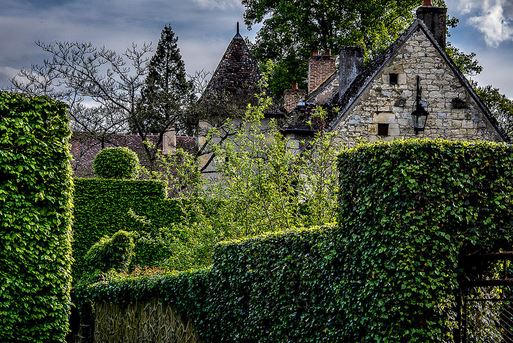
Today's Place to Daydream About: Apremont sur Allier, France

Apremont sur Allier is a tiny village on the Allier River near the exact center of France. It was founded in the twelfth century for quarry workers who worked nearby, extracting stone used in Orleans cathedral and many other monuments.The church dates to the 13th century, the oldest standing house to the 15th.

The town's web site has the motto, "where time has stopped," although as we shall see this is not really true at all.

The town was the site of of a castle from the twelfth century, but nothing of the medieval castle remains. The oldest parts of the standing structure date to the late 1400s, most of it to the 17th and 18th centuries.

In 1722 the castle was sold to Louis Marie Victoire, comte de Béthune. The castle descended through his family until the 1890s. Then, according to French wikipedia,
The family is ruined. The Comte de Saint Saveur squanders his fortune on parties and gambling, then commits suicide. The land, cars and furniture are sold at auction. Abandoned, the house decays.
But in 1894 a daughter of the family, Antoinette Rafelis-Saint-Sauveur, married wealthy ironmaster Eugene Schneider. Taking their honeymoon in Apremont sur Allier, they decided to rebuild the chateau and make it their home.

Reading this story I wonder: was this a romance, or was the daughter sold to an evil capitalist to save the estate? Did he have a top hat and a waxed mustache, which he twirled as he bundled he weeping bride into his black carriage? Have I read too many stories?

The Schneiders' son was a fighter ace during World War I, shot down and killed in 1918. Of course.


Meanwhile, the town was steadily disappearing; the population fell from 600 in 1860 to 325 in 1930 and 210 in 1940. Surrounded by decaying buildings, the Schneiders decided to rebuild their town into a medieval showplace. As the English page of the town's web site says,
Between the two wars, Eugène Schneider, ironmaster of Le Creusot, helped by the architect M. de Galéa, undertakes a heavy renovation project in order to valorise the village: What is not in harmony with the site is demolished and replaced by houses built in regional middle ages style.
So the town became a sort of French Colonial Williamsburg.


The wonderful garden (officially listed by the Ministry of Culture as a "Jardin remarquable") was laid out in 1976, designed by Gilles de Brissac, with structures by Russian painter and architect Alexander Serebriakoff. It occupies the old quarry.

The garden buildings are supposed to evoke the spirit of the mid 1700s. This is the Turkish Pavilion.

And the Chinese Bridge.

The chateau still belongs to the Schneider family, but the garden is open to the public six months a year.

It looks like a perfectly delightful place, and I don't care if much of it is modern reconstructions -- I used to live in Williamsburg and I always loved the reconstructed colonial town.

So tonight my thoughts wander to Apremont sur Allier, where I wish I were exploring the gardens, or walking along the river and imagining the barges carrying stone down to the Loire, so long ago.

Friday, June 5, 2015

The Islamic State vs. The Taliban

Today's confounding news from Afghanistan:
Throughout the month, fighters claiming allegiance to the Islamic State’s caliph had been attacking veteran Taliban units south and east of Jalalabad, the provincial capital. In one district, Islamic State loyalists have replaced the Taliban as the dominant insurgent power, and elsewhere they have begun making inroads in Taliban territory, one tribal elder, Mohammad Siddiq Mohmand, said in an interview. . . .

In places where militants in Afghanistan have adopted the Islamic State creed of embracing atrocity and ruling by fear, their strategy has been to aggressively attack the Taliban, just as in Syria where the group early on picked fights with more established units affiliated with Al Qaeda. And the evidence so far this spring suggests the influence of the Islamic State is growing. . . . Islamic State-inspired militants have created a significant shift: The Taliban insurgency, even as it advances against the Western-backed government, is having to wrestle with an insurgent threat of its own.

After more than a decade of remaining remarkably unified around the elusive figure of Mullah Muhammad Omar, the Taliban are splintering to a degree not seen before, as hundreds of insurgents have shifted their loyalty to Abu Bakr al-Baghdadi, the leader of the Islamic State and self-declared caliph of the Muslim world.
What are to to think of this? Celebrate that our enemies are fighting each other? Worry that if the Islamic State defeats the Taliban, they will be even worse? Worry, more existentially, that the only people who will stand up to Taliban fanatics are motivated by an even more extreme ideology? Scratch our heads and think about something else?

Realism about China

James Palmer has a great essay in the Post about China's role in western political debates:
For Chinese residents, daily life is a constant reminder of both how far the country has come and how far it has to go. One morning recently I went to the coffee shop at the end of my central Beijing alley for a superb latte, where the owner teasingly chastised me, as he has before, for paying with cash like some peasant rather than with my mobile phone through the WeChat Wallet service. That evening, I came home to one of our small compound’s regular power failures, and I wrote this in the dark on a laptop battery and a neighboring building’s thankfully unshielded WiFi signal. In heavy rain, our alley becomes a swimming pool, and even newly built Beijing streets disappear under a foot of water because the drainage is so bad; in storms in 2012, people drowned in cars stuck under bridges.

China’s mega-projects are often awesome, but they’re also often costly and corrupt. The more than 10,000 miles of recently built high-speed rail came in well over the original $300 billion budget, and all but a few lines run at a loss. The process of creating them was so crooked that the Ministry of Railways ended up broken into three parts and most of the top officials ended up in jail. It’s understandable why visitors, especially those who don’t stray beyond the metropolises, might be overwhelmed. What’s not forgivable is how rarely pundits try to look further, content with an initial vision of glittering skyscrapers and swish airports that can be conveniently shoehorned into whatever case they’re trying to make.
After all, Chinese officials and businessmen are adept at creating false facades of success:
Finding China’s realities can be hard simply because lying is so common here, whether it’s fraudulent government data, false ambulances or tainted baby formula. The collapse of social trust as a result of decades of Maoism, followed by a get-rich-first ethos, has made honesty a rare quality. With no external controls from a free media or civil society, Potemkinism is an everyday skill across the country, whether directed at outside investors or official inspectors.
As Palmer rightly complains, a great example is China's glittering education statistics:
Program for International Student Assessment (PISA) statistics, which show China topping the lists in reading, math and science, are often cited by Common Core advocates in the United States and by proponents of traditional teaching methods in Britain, such as former education minister Michael Gove. Yet these PISA statistics cover just an elite group of Shanghai schools, where entry depends on bribery and string-pulling. In the rest of the country, classes average 50 students, only a third of rural children make it to high school, and I’ve found innumeracy to be just as common as in the United States.
Using China as a prop to support political arguments in the west is a technique that goes back to eighteenth-century France, and most of the time you should pay no attention. China is hugely different from the US or Britain, and all of its undoubted successes have been accompanied by costs that we probably don't want to pay. I am sure there are many technical and administrative areas in which the Chinese have made useful advances, but when it comes to broad, big issues, there are no useful lessons for the US in the recent Chinese experience.

Flibanserin and the Politics of Medicine

After huge pressure, an FDA panel has approved the drug flibanserin to treat the lack of sexual desire in women. This has been very controversial because the positive effects of flibanserin barely meet the standard of statistical significance, and it comes with serious side effects (low blood pressure, fainting, dizziness, nausea).

In this case the usual lobbying by a manufacturer in search of fat profits was supported by a coalition of women's groups who call themselves Even the Score:
which accused the F.D.A. of gender bias because it had approved Viagra and other drugs to help men have sex while leaving women without options. The participants in the campaign had been brought together by a consultant to Sprout Pharmaceuticals, the developer of flibanserin.
I think this is crazy. Viagra treats a physical inability to have sex, not a lack of desire; without desire it makes no sense to take Viagra. Women's desire for sex is, as all men of my generation have been hearing since we were 16, a hugely complicated thing all wrapped up with emotions and relationships and so on. I suppose the point is that many women have lost desire even when all the things that used to make them hot are there, which implies some sort of physiological factor. Maybe. But if that is true, flibanserin isn't the cure, since as I said it performs only a little better than placebos in the biggest trials.

The positive way to spin the FDA panel's decision would be like this:
The unmet need seems to be so strong that even for a drug with rather modest benefit, I think approving the product with strong limitations seems to be the right step at this point.
But you could also wonder why we are always looking to drugs to solve our problems, and why we are always blaming complex physiological or technical problems on Bad People -- we don't have a male pill because of sexism! we don't have affordable electric cars because of oil companies! If any company came up with a drug that would make women want and enjoy sex, they would earn billions overnight; since no such drug exists despite the huge incentives, this must be a very hard problem. Lobbying and wishful thinking will not solve it.