Friday, November 23, 2012

The Lady of the North

The Lady of the North, alias Northumberlandia, is an enormous earth and stone sculpture designed by Charles Jencks, part work of art and part exercise in environmental remediation. It is formed from 1.5 million tons of British earth and stone. It is said to be the largest human figure on the planet; its breasts are 100 feet tall, and there are 4 miles of walking paths. Its origin:
The Lady is a joint project of the Blagdon Estate, a 10,000-acre family property that dates to 1698, and the Banks Group, an energy company. Banks is extracting coal from a surface mine next to the site. The entities wanted to create an iconic feature that would enhance a part of the site, given its visibility near a major highway and rail line, and they shared its $5 million cost.
This seems like a good idea to me; Britain needs coal, which means destructive mining, and the people profiting from the mining are trying to replace some of the lost beauty with something new and exciting. But what, you ask, does it mean? Charles Jencks is, after all, a man with a lot of ideas, a harsh critic of modernism and the designer of the famous Garden of Cosmic Speculation.

Jencks, 73, is part of the post-Modern generation. He is fascinated by contemporary science, but with the eye of an artist rather than that of a scientist. To him,
"We are living in a new paradigm. We now know the universe back to the beginning; we know so many things that upset the modernist Newtonian worldview." While the old sciences “were linear, deterministic and relatively simple,” Jencks said, the new cosmic age brings a cauldron of fractals, spirals, soliton waves and other shapes. He sees their effects everywhere — in the chaotic dance of a hurricane, the stormy Great Red Spot of Jupiter, a draining bathtub or even the nerve impulses of our brains. 
The attitude toward Newton is the key clue to where Jencks is coming from; real scientists still idolize Newton and think that his work has more in common with quantum mechanics than either has with philosophical speculation. But like many other artists, Jencks is fascinated by the new language of chaos and strange attractors, and the way an overarching order -- like, say, the climate, or life -- emerges from a mass of madly disordered details.

This seems to be the vision of Northumberlandia. Many Britons have taken her as a pagan symbol, and some Evangelicals protested the project, fearing that pagans would have to have sex on key parts of the Lady. But Jencks explicitly denied this:
She’s not a pagan god, and people aren’t going to lose their moral compass if they walk all over her.
She is life rising from the dead earth; order from disorder; a new, higher level of being "emergent" from simpler ones. Like humans evolved from bacteria, the Lady represents the self-organizing forces of the universe, the appearance of organisms within the cosmos that are coming to understand the rules by which they themselves came to be. This is the "statement" Jencks put on his web site:
To see the world in a Grain of Sand, the poetic insight of William Blake, is to find relationships between the big and small, science and spirituality, the universe and the landscape. This cosmic setting provides the narrative for my content-driven work, the writing and design. I explore metaphors that underlie both growing nature and the laws of nature, parallels that root us personally in the cosmos as firmly as a plant, even while our mind escapes this home.

Generators vs. a Better Electrical Grid

Nicholas Kristof:
Generac, a Wisconsin company that dominates the generator market, says it is running three shifts to meet surging demand. About 3 percent of stand-alone homes worth more than $100,000 in the country now have standby generators installed. “Demand for generators has been overwhelming, and we are increasing our production levels,” Art Aiello, a spokesman for Generac, told me.

That’s how things often work in America. Half-a-century of tax cuts focused on the wealthiest Americans leave us with third-rate public services, leading the wealthy to develop inefficient private workarounds. It’s manifestly silly (and highly polluting) for every fine home to have a generator. It would make more sense to invest those resources in the electrical grid so that it wouldn’t fail in the first place.

But our political system is dysfunctional: in addressing income inequality, in confronting climate change and in maintaining national infrastructure.

The National Climatic Data Center has just reported that October was the 332nd month in a row of above-average global temperatures. As the environmental Web site Grist reported, that means that nobody younger than 27 has lived for a single month with colder-than-average global temperatures, yet climate change wasn’t even much of an issue in the 2012 campaign. Likewise, the World Economic Forum ranks American infrastructure 25th in the world, down from 8th in 2003-4, yet infrastructure is barely mentioned by politicians. 
As a nation, we continue to slight what we have in common in favor of private wealth and comfort. We have a first-class military, but almost everything else our government does is budget bin. It is a route to a third world future, and honestly Obama tax increase is only a very small step toward re-investing in our common good.

Thursday, November 22, 2012

Social Change in Pakistan, or, Why Honor Killings?

A few years ago Pakistani professor Alif Hasan went to a rural part of Sindh to investigate a rash of "honor killings," that is, when a man kills a female member of his family he thinks has shamed them.
   I asked an elder from the taluka whom I had met in 1983, now much older, “Sahib, did you have honour killings before?”
   He said, “Yes, we used to have one in perhaps ten years. It was a rare occurrence, and we would discuss one for ten years until another happened.”
   “Then why it is happening now with such regularity?”
   He said, “Now, everyone has become shameless, without honour, so honour killings are taking place.”
   I asked, “Why is there no honour today?”
   He responded, “The young people, they’ve gone to the city, and they’ve done all the wrong things. The girls have learned how to read and write, they’ve gone to school, some of them have gone to university as well. They have no morals left, so this is bound to happen.”
   “You mean this is going to continue like this forever?”
   “No, no, it will stop!”
   “How and when will it stop?”
   His reply was educative: “The honour killings will stop when everyone becomes shameless, then it will end.” Then he added, “But I hope that I die before that day.”
So, Hasan says, honor killings are a symptom of social change, from a feudal (his word), rural society to urban capitalism. He then lists other signs of the collapse of feudalism:
This collapse is also heralded by the advances in women’s education. According to 2006 figures, fully 72 percent of the University of Karachi student body is today female. Among medical students, 87 percent are women, and the figure for architecture and planning is as high as 92 percent. In fact, our vice chancellor was so concerned that he suggested a quota for men. I used to teach a class with one boy and 15 girls. That has changed a little now as we have tried to even it out. But the reason is simply that women do better on the entrance tests. There’s no other reason for it. In 1971, I started working in low-income settlements in Karachi, and a decade later I joined the Orangi Pilot Project (OPP). The settlements that we worked in at that time were primarily working-class, and when we went over we were met by older men who were mostly illiterate. They spoke to us in very formal, feudal language – janaab, huzoor, sahib, miyan, “We are all your children and need your protection,” and all that. At that time, in the 1980s, the women hardly worked. Things are entirely different when you go to the OPP today; it’s not what you would call a shanty settlement. It’s mostly the younger generation who will meet you, and they will address you as ‘uncle’ rather than ‘sahib’. The people you meet are bank managers, school teachers, professionals working in the service sector of Karachi. The additional phenomenon of the past decade has been the growing anarchy linked to the Afghan war, and the further demise of feudal institutions. Spending a week in northern Sindh earlier this year, I was struck by three elements. Firstly, I noticed the immense physical mobility women have gained from the end of feudalism. Nothing can control them or contain them anymore. Secondly, there are protests against the excesses both of the landlords and of the establishment. If the landlord has been harsh, or if the state has not delivered on some demand, the men come out and block the highway. Often it is women who carry out the blockade because the police action against them is not so harsh. Thirdly, the nature of landlord-ship has changed. The landlord is now married to a modern, urban woman, and that heralds significant shifts. When I asked villagers about the difference between the old landlords and the new, the reply was, “The young landlord has married into the city and stays in Karachi. His children never come here either, so we are alright.” The result is that sharecropping has given way to contracting, and this has transformed the society of rural Sindh.
The transition from peasant societies to urban, industrial ones may be the most profound in human history, affecting almost everything we do. The speed and power of this transition is what has made modern life so bewildering for so many people around the world.

Wednesday, November 21, 2012

Rubio vs. Obama on the Age of the Earth

Since I was just mocking Marco Rubio's inane statement about the age of the earth, it seems only fair that I pass on Daniel Engber's observation that when he was asked the same question, the President did not do much better. Rubio:
I’m not a scientist, man. I can tell you what recorded history says, I can tell you what the Bible says, but I think that’s a dispute amongst theologians and I think it has nothing to do with the gross domestic product or economic growth of the United States. I think the age of the universe has zero to do with how our economy is going to grow. I’m not a scientist. I don’t think I’m qualified to answer a question like that. At the end of the day, I think there are multiple theories out there on how the universe was created and I think this is a country where people should have the opportunity to teach them all. I think parents should be able to teach their kids what their faith says, what science says. Whether the Earth was created in 7 days, or 7 actual eras, I’m not sure we’ll ever be able to answer that. It’s one of the great mysteries.
Obama:
What I've said to them is that I believe that God created the universe and that the six days in the Bible may not be six days as we understand it … it may not be 24-hour days, and that's what I believe. I know there's always a debate between those who read the Bible literally and those who don't, and I think it's a legitimate debate within the Christian community of which I'm a part. My belief is that the story that the Bible tells about God creating this magnificent Earth on which we live—that is essentially true, that is fundamentally true. Now, whether it happened exactly as we might understand it reading the text of the Bible: That, I don't presume to know. 
Sigh. At least the President went on to add this:
Let me just make one last point on this. I do believe in evolution. I don't think that is incompatible with Christian faith, just as I don't think science generally is incompatible with Christian faith. I think that this is something that we get bogged down in. There are those who suggest that if you have a scientific bent of mind then somehow you should reject religion, and I fundamentally disagree with that. In fact, the more I learn about the world, the more I know about science, the more I am amazed about the mystery of this planet and this universe—and it strengthens my faith as opposed to weakens it.
Since only a small minority of Americans thinks humans evolved by natural selection -- around 10 percent, with about 45 percent holding for Biblical creation and 45 percent for evolution guided by God -- I suppose it's too much to expect that our political leaders would make much sense on this issue.

The Hope for Humanity vs. the French Government

The Pic de Bugarach in southwestern France has long had an eerie reputation, and many rumors swirl around it:
For decades, there has been a belief that Pic de Bugarach, which, at 1,230 metres, is the highest in the Corbières mountain range, possesses an eery power. Often called the "upside-down mountain" – geologists think that it exploded after its formation and the top landed the wrong way up – it is thought to have inspired Jules Verne's Journey to the Centre of the Earth and Steven Spielberg's Close Encounters of the Third Kind. Since the 1960s, it has attracted New Agers, who insist that it emits special magnetic waves. Further, rumours persist that the country's late president François Mitterrand was transported by helicopter on to the peak, while the Nazis, and, later, Israel's Mossad, performed mysterious digs there. Now the nearby village is awash with New Agers, who have boosted the local economy, though their naked group climbs up to the peak have raised concerns as well as eyebrows. Among other oddities, some hikers have been spotted scaling the mountain carrying a ball with a golden ring, strung together by a single thread. 
Some of the people who expect a global cataclysm on December 21 think that one of the few safe refuges will be the Pic de Bugarach. Some say there is an alien spaceship waiting inside the mountain to carry people away; others say it is where the spaceship will land. Either way, the mountain is clearly the place to be on the solstice. Sadly, the French state is not having any of this unauthorized survival:
France on Friday dashed the hopes of those who had planned to take refuge in one of the few places on Earth some believe will be spared when the world ends on December 21. Local officials banned access to the Pic de Bugarach, a mountain in the southwest where rumour has it the hilltop will open on the last day and aliens will emerge with spaceships to save nearby humans. Eric Freysselinard, the state's top representative in the area, said he was blocking access to the mountain for public safety reasons to avoid a rush of New Age fanatics, sightseers and media crews.
I mean, surviving the Apocalypse? Without a permit? Non!

Marijuana Reform and the War on Drugs

I have seen several news and op-ed items lately that conflate marijuana legalization with "ending the war on drugs." The latest is from Katrina vanden Heuvel in the Post, which has the title "Time to End the War on Drugs" but turns out to be mostly about marijuana.

The campaign against marijuana is certainly the most ridiculous part of our drug policy -- it isn't any worse for you than whiskey, and is a lot less likely to kill you. So I support moving ahead with marijuana legalization, and think the ballot measures in Colorado and Washington are good news.

But  that is only a small part of the "war on drugs," which is mostly about cocaine, methamphetamine, and opiates. Most of our drug prisoners are in for offenses related to those harder drugs. The Mexican cartels do make money from marijuana, but it is really a side business for them and they could get along quite well without it. So legalizing marijuana will not solve the problem of bulging prisons, rampant drug violence, and untreated abuse.

Does anybody think that the US might, any time soon, legalize cocaine or heroin? I don't. In fact, I can't really imagine it. I support an approach that emphasizes treatment over prison, but I fear the war on drugs will be with us for a long time yet, whatever comes out of the legalization experiments in Washington and Colorado.

Tuesday, November 20, 2012

The Changing Diet of the Greenland Norse: New Data

If there is a received wisdom about the failure of the Norse colony in Greenland, it is that they failed because they held too much to their old, farming ways and did not adapt to their new environment. This may have worked in a minimal way during the warm years of the high middle ages, but when the climate turned cold, after 1300, the society died out. New evidence may contradict this account:
Norse society did not die out due to an inability to adapt to the Greenlandic diet: an isotopic analysis of their bones shows they ate plenty of seals.

“Our analysis shows that the Norse in Greenland ate lots of food from the sea, especially seals,” says Jan Heinemeier, Institute of Physics and Astronomy, Aarhus University.

“Even though the Norse are traditionally thought of as farmers, they adapted quickly to the Arctic environment and the unique hunting opportunities. During the period they were in Greenland, the Norse ate gradually more seals. By the 14th century, seals made up between 50 and 80 per cent of their diet.” . . .

“Nothing suggests that the Norse disappeared as a result of a natural disaster. If anything they might have become bored with eating seals out on the edge of the world. The skeletal evidence shows signs that they slowly left Greenland. For example, young women are underrepresented in the graves in the period toward the end of the Norse settlement. This indicates that the young in particular were leaving Greenland, and when the numbers of fertile women drops, the population cannot support itself,” Lynnerup explains.
I am not as convinced by those isotopic analyses as some people are, and the sample could be bigger, but this is certainly an interesting finding. I find the news that women were emigrating even more interesting.


Airport Security is Killing Us

Charles Kenny at Business Week:
Of the 150,000 murders in the U.S. between 9/11 and the end of 2010, Islamic extremism accounted for fewer than three dozen. Since 2000, the chance that a resident of the U.S. would die in a terrorist attack was one in 3.5 million. . . .  In fact, extremist Islamic terrorism resulted in just 200 to 400 deaths worldwide outside the war zones of Afghanistan and Iraq—the same number as die in bathtubs in the U.S. alone each year. Yet the TSA still commands a budget of nearly $8 billion—which is why the agency is left with too many officers and not enough to do.

According to one estimate of direct and indirect costs borne by the U.S. as a result of 9/11, the New York Times suggested the attacks themselves caused $55 billion in “toll and physical damage,” while the economic impact was $123 billion. But costs related to increased homeland security and counterterrorism spending, as well as the wars in Iraq and Afghanistan, totaled $3,105 billion. . . .

There is lethal collateral damage associated with all this spending on airline security—namely, the inconvenience of air travel is pushing more people onto the roads. Compare the dangers of air travel to those of driving. To make flying as dangerous as using a car, a four-plane disaster on the scale of 9/11 would have to occur every month, according to analysis published in the American Scientist. Researchers at Cornell University suggest that people switching from air to road transportation in the aftermath of the 9/11 attacks led to an increase of 242 driving fatalities per month—which means that a lot more people died on the roads as an indirect result of 9/11 than died from being on the planes that terrible day. They also suggest that enhanced domestic baggage screening alone reduced passenger volume by about 5 percent in the five years after 9/11, and the substitution of driving for flying by those seeking to avoid security hassles over that period resulted in more than 100 road fatalities.
Couldn't some of those Tea Party Congressmen who hate government spending get to work on this? Could an alliance of liberals and libertarians be formed that would force cutbacks in this madness?

The Wheel of Fortune Turns in Burma

President Obama embraces former political prisoner, now member of Parliament Aung San Suu Kyi, in Burma yesterday.

Aung San Suu Kyi's life has ridden the whole arc of the Wheel of Fortune. She left a comfortable academic life in Britain and returned to Burma in 1988, hoping to contribute in some modest way to a democratic opening then underway. But then the military leaders crushed that movement and placed Suu Kyi under house arrest for 15 of the next 20 years. From her modest home, by saying next to nothing, she somehow became the spiritual leader of the Burmese resistance and won the Nobel Prize. Her stature grew so great that when the generals decided that real democratization was the only path forward for the country, they released her and brought her into the government to help them manage the transition. Now she receives the President of the United States in her home.
I suppose the point of the visit is to reward the Burmese for their partial opening and to make it harder for them to go back to hermit dictatorship. I think this is well worth the President's time, since the Burmese situation is far from settled and the new hybrid government has yet to take up any of the country's long-standing problems -- economic decay, ethnic separatism, the belief of the generals that they deserve a big say in running the country even though they couldn't get 10% of a fair vote. I wonder if fate doesn't have more shocks in store for Aung San Suu Kyi and her country.

Monday, November 19, 2012

Birds of Paradise

Evolution's jewels.


And Now from the Senate Science Committee

Senator Marco Rubio, the Florida Republican often mentioned as a possible 2016 Presidential candidate, sits on the Senate Commerce, Science, and Transportation Committee. Asked about the age of the earth, he said:
I'm not a scientist, man. I can tell you what recorded history says, I can tell you what the Bible says, but I think that's a dispute among theologians and I think it has nothing to do with the gross domestic product or economic growth of the United States. I think the age of the universe has zero to do with how our economy is going to grow. I'm not a scientist. I don't think I'm qualified to answer a question like that. At the end of the day, I think there are multiple theories out there on how the universe was created and I think this is a country where people should have the opportunity to teach them all. I think parents should be able to teach their kids what their faith says, what science says. Whether the Earth was created in 7 days, or 7 actual eras, I'm not sure we'll ever be able to answer that. It's one of the great mysteries.
Now that's the sort of incisive thinking and clear speaking we need in the White House.

Sunday, November 18, 2012

Twelfth-Century Pulpit at the Basilica of Orta San Guilio

The basilica is located on a small island in Lake Orta, in the Italian Piedmont. It's foundations date back to Roman times. The ancient church was severely damaged in a siege of the island by Emperor Otto I in 962, and it was rebuilt in the twelfth century.

It great glory now is its intact twelfth-century pulpit, carved from local serpentine.

 Besides the symbls of the four evangelists, the pulpit has numerous other figures, including a crocodile and a griffin locked in combat.

And these two whatever they ares, killing a deer.


 A green man.

I am not sure that I would recommend seeking out the basilica in person, because, as you can see from this photo, the interior was redecorated in the 18th century at the height of twee mannerism, which must be rather jarring.

Today's Medieval Church: Cercles, France

The priory church of St. Cybard in Cercles, part of the Perigord region of France, was built in the 12th century.


The church was added to and rebuilt over the years; the transept dates to the later 13th or 14th century, and the upper vaulting of the nave to the 15th or 16th.


The church is best known for its sculptures, which include numerous “masques feuillus” or Green Men. These are mostly in the old part of the church, the lower story of the nave. They were carved and added to the church over many years. Different styles are employed, indicating different master sculptors or workshops. Most are dated by experts to between the late 12th and mid 13th century, although a few may be Renaissance additions.


Below, the cemetery. Much more about the sculptures at The Green Man of Cercles.


Saturday, November 17, 2012

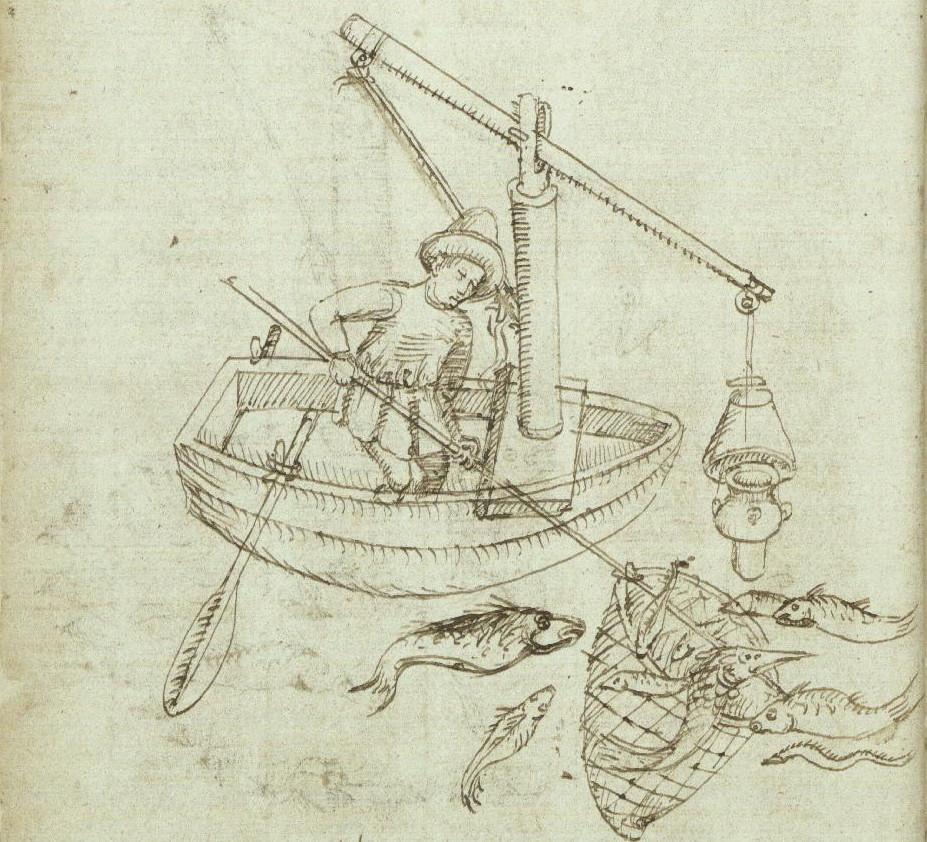
The Archimedes of Sienna: Mariano Taccola

Mariano di Jacopo (1382-1453), alias Mariano Taccola ("Crow"), was an Italian engineer and a forerunner of Leonardo da Vinci in many ways. Some of his contemporaries called him the Archimedes of Sienna. His fame rests on two collections of his drawings and plans, known as De Ingensis, and De Machinis. You can see that dreaming about new machines of war and peace, some of them wildly impractical, was a pastime for other Italians before Leonardo came along. Di Jacopo was a sculptor, a notary, and a city official for most of his career; he did not start publishing these designs until he was around 50. Most of these images are from BibliOdyssey.

 
One account of his career:
At one time or another he has been credited with the invention of the explosive undermining of city walls, the suction pump, underwater breathing apparatus, the box-caisson method for building bridges, water mains and sluice gates, and vertically axled windmills and watermills. Taccola's importance was encyclopedic account of contemporary machine practice. Two ideas of great importance first appeared in Taccola's manuscripts: the chain transmission system and the compound crank with connecting rod. By the latter, rotary motion could be converted to reciprocal motion, a technical concept that has been considered crucial for the postmedieval development of Western technology.
That's his drawing of a piston pump above, the first surviving rendering, although Taccola certainly did not invent it.


The Headline Tea Partiers Have Been Dreading


U.N. attack helicopters hit rebels in eastern Congo

Are they black?

Today's Castle: Methoni, Greece

Methoni is a Venetian fortress on the west coast of the Peloponnesus, built in the thirteenth century and rebuilt in the fifteenth. The Venetians began to develop a foothold in this area in the twelfth century, to suppress pirates. After they helped the Fourth Crusade take Constantinople, they were rewarded with lands all over Greece, including two towns in this area. They built the fortress to control their new possessions, and their sea routes to Constantinople and Egypt.

The famous fifteenth-century watch tower. The Venetians held Methoni until 1500, when it was taken by the Turks after a bloody siege:
Methoni fell after haveing been in the hands of the Venetians for about three hundred years. Happy for his trophy, Vagiazit made the yenitsar who first climbed the walls a santakbei, meaning a provincial commander, and on the first Friday after the invasion, when the fire went out, he went to the desecrated cathedral to offer his thanks to the god of battle, to whom, as he confessed when he was looking into the deep moat, owed the conquering of this fortified city.
(No idea where that came from; I got it from this site.)


The Turks slaughtered most of the inhabitants and then forced towns all over Greece to send people to repopulate the place. According to some of the tourist sites I have looked at this morning, locals say that wind the wind blows through the watchtower you can still hear the ghosts of the massacre victims wailing their cruel fate.

The Venetians conquered it again in 1680, and then in 1715 the Turks took it back again. After that it slowly decayed into a ruin.


I had no knowledge of the many French and Venetian castles in southern Greece until I went there in 1991. Driving around the Peloponnesus, my mother and I stumbled across a huge French castle, utterly unguarded and unpromoted. The Greeks, after all, care not a whit about these monuments to their humiliation by the crusaders, so a huge fortress that in France or Britain would be thoroughly roped off, guard-railed, caution-signed and interpreted was just sitting in the countryside, slowly crumbling. I climbed around that castle like I have never climbed around another since.

I have no idea what castle it was that I climbed (it wasn't this one). But I post this castle in remembrance of that day, and to call my readers' attention to the unpromoted medieval wonders of Greece.