Wednesday, October 9, 2013

Orbicular Granite, Chile

Now that is one weird rock. Below, more pictures of orbicular granite.


Tuesday, October 8, 2013

Dutch Ships of the Seventeenth Century

In the sixteenth and seventeenth centuries the Seven Provinces of the Netherlands embarked on one of those amazing explosions of energy and productivity that sometimes make small countries leaders of the world. In the case of the Dutch, their prominence was all about ships and the sea. So when they got rich enough to have a great artistic tradition one of the things that their artists liked to depict was ships. Their paintings, done for sea captains and shipowners, were often exact to the last rope and spar. We thus have a record of Dutch ships in this period far more rich and detailed than for the ships of any prior era.

Other nations of this time also embarked on programs of building ships and exploring the seas, but the Dutch were just better. Dutch ship yards could build a vessel for about half the cost of an English or French yard. More, they had hit on some very important advances in design. This is a fluyt or fluytschip, the standard Dutch cargo vessel of the seventeenth century. It was built to do one thing, carry cargo from port to port. It was not built to be fast, or to be an effective warship should trouble arise. Instead the designers emphasized efficiency. It could be handled by a smaller crew than other ships of the time, and loaded more quickly. Using these sturdy, utilitarian vessels, the Dutch dominated the trade in staples like salt fish and lumber.


For voyages to the Indies, different vessels were needed. They had to be well armed, since pirates were a constant danger and the European countries were so often at war.

It is these East Indiamen and the closely related warships that were painted most often. Above is a famous painting showing the return of the second Dutch expedition to the spice islands in 1599.


Dutch naval power reached its peak in about 1670. At that time about ten per cent of Dutch adult males were sailors, and the Dutch had more ships than England, France, Germany, Portugal, Scotland, and Spain combined.

This is called The Canon Shot and it is a nice reminder of how much smoke artillery produced in the days of black powder.

Dutch naval dominance was constantly challenged by others, especially the English and French. As a result, there were many naval battles. And many paintings of the ones the Dutch won.


Eventually the English and French, with their bigger populations and bigger budgets, overmastered the Dutch. But for a century their tiny country rules the waves.

Living in a Gray World

James Hall bemoans the decline of color:
The last quarter century must rank as one of the nadirs in the history interior design. The palette of permissible wall colours consists of cool whites and greys. These constitute about 30 percent of the colours on the Farrow and Bal paint chart, but must account for a far higher proportion of sales. They are currently featuring French Grey (a name coined in the early nineteenth century), and recommend it with a range of like-minded colours --Off-White, Clunch, Lime White, Slipper Satin, Bone, Mouse's Back and Studio Green (which looks charcoaly). That old faithful Magnolia is too warm to exist in our dirty ice age. 
When it comes to art museums, he writes, everything is gray: "After ten years of planning, the new Rijksvuseum in Amsterdam opted for five shades of grey." And it isn't just the colors:
This is an age of metal and concrete techno-minimalism, with status defined by the sheer volume of forensically lit, textureless, patternless empty space we inhabit. Metal-framed glass walls and doors, blinds and shutters, serried ranks of skylights and halogen downlighters banish sensuality, shape and shadow.
To which I can only nod. But Hall wrote this rant for a review in the July 5 TLS of an exhibit of neoclassical design in Britain. So I have chosen to illustrate it with pictures of Syon House rather than more of those dreary gray walls. You all know what they look like anyway, and I've seen enough for one lifetime. Better to post pictures of rooms with real style.

Of course neoclassical designers like Robert Adam could work in muted colors when they wanted to. Nobody wants bright colors all the time. But does every wall have to be flat and gray?

Monday, October 7, 2013

The Accidental Shutdown

Byron York and other reporters sat down with a senior Republican Congressman who asked to remain anonymous and then delivered an account of how the shutdown came about that makes it seem accidental:
I would liken this a little bit to Gettysburg, where a Confederate unit went looking for shoes and stumbled into Union cavalry, and all of a sudden found itself embroiled in battle on a battlefield it didn't intend to be on, and everybody just kept feeding troops into it. That's basically what's happening now in a political sense. This isn't exactly the fight I think Republicans wanted to have, certainly that the leadership wanted to have, but it's the fight that's here.
According to this version, the leadership thought they could avoid a shutdown and get the continuing resolution until Ted Cruz launched his "defund Obamacare" drive during the August recess
They got surprised a little bit by the Obamacare thing. This was something that blew up in August. Nobody really saw it coming — probably should have a little bit, I'm not being critical of anybody in that regard, on either side of this — but it just happened.
This is what Harry Reid has been saying. He insists that he and Boehner had a deal on a continuing resolution, which was that the House would pass it if it continued the cuts made by the sequester, which Democrats have been trying to rescind. Reid, said, ok, if that's what you can pass I can live with that level of funding for two months while we negotiate the budget. But then all the Tea Party guys started talking about defunding Obamacare, and Boehner told Reid that he did not have the votes to pass a continuing resolution that did not involve some cut or delay to the health care law. Reid blew up at Boehner and said that if he didn't have the votes he should send over somebody who did, so they could make a deal. This is a big part of the reason why Democrats have been able to stick together on every vote so far; they think Boehner reneged on a deal, so they have little interest in trying to make another one that he might just renege on in turn. Asked what will happen next, this Congressman said he has no idea and neither does anybody else.

Boehner has done this at least three times now, coming to a verbal agreement with Reid and then backing off because, he said, he doesn't have the votes.  If our government goes into its first ever default, his incompetence will be a big part of the reason.

Today's Cathedral: St. Stephen's, Vienna

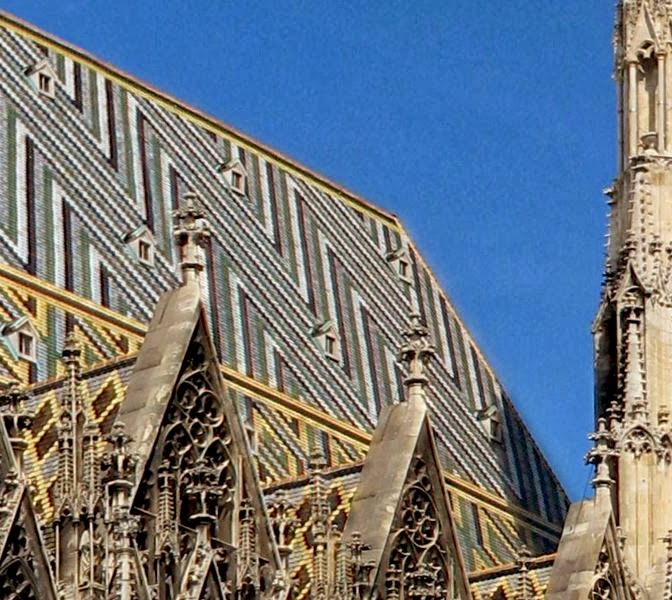
Vienna was rather a late starter among medieval cities, not much of a place until the twelfth century. Until then it was confined within the walls of an old Roman frontier fortress, Vindobona. But as trade along the Danube grew and the city's political importance increased it burst those bounds, and the walls had to be extended to take in the growing settlement. Vienna was not then a cathedral city, but the wealthy merchants who controlled it wanted a great church that would give physical expression to the faith and money. So in 1137 they began building a major new church in the Romanesque style. You can still see the facade of this church, incorporated into the west front of the later cathedral. The towers are called the Heidentürme or "pagan towers," I suppose to indicate how ancient they are.

There are also still numerous bits of Romanesque sculpture in various nooks and crannies.

The main entrance is known as the Riesentor or Giant's Door. Depending on what you read, this might be because of its size, or because the thighbone of a mastodon hung over it for decades after turning up in 1443 during the excavation of the foundations for the north tower. The old church was damaged by fire in the mid thirteenth century, and it was reconstructed larger than before. The fabric of that church was almost entirely removed during the fourteenth-century enlargement.

In the fourteenth century, as the town grew ever larger and the Dukes of Austria ever more important, The church was greatly enlarged and transformed into a gothic masterwork. The expansion began in 1304 and was not completed until 1459.

The great south tower was completed in 1433.

In 1469 the Pope agreed to make Vienna a bishopric, so the church became a cathedral at last.

The church was badly damaged by a fire in April, 1945. The date is usually given as Friday, April 13, but wikipedia insists on April 12. (Spoilsports!) The fire was caused by looting of shops in the central city, not allied bombs.


The roof had to be completely rebuilt. Steel beams were used rather than wood, and the famous roof tiles were all replaced with new ones bought by Vienna's citizens.


The most important interior sculptures had been removed or bricked in before the fire, so they survived the disaster.

The pulpit, completed in 1515, is a particular wonder. I thought that this was attributed to Anton Pilgram, but wikipedia says that now opinion has shifted and more experts think the carving was done by Pilgram's teacher, Niclaes Gerhaert van Leyden. Those are the Doctors of the Church, looking delightfully cartoonish.

The Viennese, as you will discover if you ever visit, are not much into scenic ruins. Vienna is the neatest, cleanest big city I have ever been in, with the best maintained buildings and the best-dressed people. So of course they are not much interested in a crumbling cathedral. Some part of the building has been under restoration since World War II, and that includes all of the altars, sculptures, and so on. No noseless saints here. I like it this way.


Lies They Told Me in School

I have a file in my head of all the lies foisted on me by books I had to read in school. The first entry comes from my 3rd grade science book, which said that Mercury always keeps one face toward the sun, and that the dark side of the planet is as cold as Neptune. Not only is that not true, but it was shown to be false by radar observations the year I was born.

All through high school and college the list of lies kept growing, and in graduate school it grew by leaps and bounds. I exposed one of these lies during my own dissertation research. I read in at least two books that Magna Carta was not a big deal in medieval England but only became one when 17th-century lawyers brought it ought as part of their rebellion against the king. Then I started reading medieval court rolls and discovered that Magna Carta was cited all the time in perfectly ordinary legal disputes, always with the idea that it was about the highest law there was. It was cited in almost every case that turned on the boundary between the king's authority and that of the church, always a sensitive issue for any medieval monarch.

I also read in several places that there was no close connection between the scientific and industrial revolutions. Science, the idea goes, was something done by university-trained gentlemen who had nothing to do with the sort of vulgar mechanics -- Arkwright, Watt, etc. -- who actually built the new machines. I suppose the point of this was to break down the view that science was ultimately behind the modernization of the world, and the Whiggish notion that all forms of progress went hand in hand. I discovered long ago that this was not so, but only after reading Jenny Uglow's The Lunar Men do I realize what an outrageous lie it is. The mechanical innovators were close friends with the top scientists; in fact in a few cases they were top scientists themselves. The members of the Lunar Society in Birmingham included two of the century's top manufacturers, Josiah Wedgwood and Matthew Boulton; one of its top scientists, Joseph Priestley; and one man, James Watt, who was both a builder of improved steam engines and one of the world's top experts on what we call thermodynamics. Erasmus Darwin was both a font of mechanical inventions and a founder of biological science. James Keir's chemical works drew on cutting edge science. Wedgwood used Priestley's work on gases as well as up-to-date mineralogy in developing new types of ceramic, and he was elected to the Royal Society for his invention of a new way of measuring very high temperatures. When Watt learned, through Priestley, about the discovery of chlorine gas, he immediately sent a report to some relatives of his in the cloth bleaching business. There was no separation whatsoever between the new science and the new manufacturing technology. And while I'm at it there absolutely was a close connection between science, technology, and political reform, as anyone who had ever read Thomas Paine or Benjamin Franklin ought to know.

It really irks me that books so obviously and utterly wrong can be taken seriously and get good reviews and be assigned to graduate students because they fit into somebody's ideology or need to reject the received wisdom.

UPDATE: While I'm on the subject, it is not true that medieval people craved pepper to hide the taste of rotten food. They used pepper because they liked it.

Some Business Roundtable Republicans Angry with the Tea Party

Interesting story by Philip Rucker in the Post about attempts by business interests to mount primary challenges to Tea Party congressmen who have been prominent in engineering the shutdown, like Justin Amash of Michigan:
Within Grand Rapids’ powerful business establishment, patience is running low with Amash’s ideological agenda and tactics. Some business leaders are recruiting a Republican primary challenger who they hope will serve the old-fashioned way — by working the inside game and playing nice to gain influence and solve problems for the district. They are tired of tea party governance, as exemplified by the budget fight that led to the shutdown and threatens a first-ever U.S. credit default.

Similar efforts are underway in at least three other districts — one in the moneyed Detroit suburbs and the others in North Carolina and Tennessee — where business leaders are backing primary campaigns against Republican congressmen who have alienated party leaders. The races mark a notable shift in a party in which most primary challenges in recent years have come from the right.

“It’s a new dynamic, and we don’t know how far it’s going to go,” said Vin Weber, a former GOP congressman who is close to the House leadership. “All the energy in the Republican Party the last few years has come from the tea party. The notion that there might be some energy from the radical center, the people whose positions in the conservative mainstream are more center-right but who are just furious about the dysfunctionality of government — that’s different.”
I am not hopeful about this, really; Republican primary voters are increasingly tuning out business interests, and many of them are as angry at Wall Street as they are at Washington. But maybe the threat will  induce some Congressmen to look harder for a budget deal.

Sunday, October 6, 2013

Dog Days in the Garden

It has been in the mid 80s here all week, up near 90 a couple of days, with plenty of sun and no rain to speak of in weeks.

I have been watering a lot, so things haven't wilted too badly. But the fall flowers that opened in our first spell of cool weather, like these asters, are already fading.


But some flowers still look good, and we are supposed to get some rain and then cooler weather starting tomorrow.


Cavasback Ducks, Maryland, by Paul Bramble

From National Geographic.

Jenny Uglow, "The Lunar Men"

There are ages in human history when it seems nothing can be done. The dreary round of wars and oppressions grinds on, and hope of real change is a will-o-the-wisp that serves mainly to lure optimists to disaster. Great efforts come to naught; schemes unravel; voyages of discovery sink in storms; reform recedes ever into the future; grand plans are undermined by reaction, starved by poverty, and buffeted by violence, and ground down by indifference. Yet there are also in history extraordinary moments when everything seems possible and change advances with startling speed. One of these was the late 1700s, especially in Britain and France. Democracy and reform were in the air, but politics had not yet settled into the trench warfare of revolution and reaction that would dominate the next century. Industry was booming, but wages were rising and most work was still done by skilled adults; steam power was being perfected, but had not yet clogged the skies with soot. Science was advancing rapidly yet amateurs could still recreate cutting-edge experiments in their living rooms. Serious men wrote books about a coming utopian age, when democracy and science would perfect our world. The eighteenth-century world had its horrors, from smallpox to the slave trade. But in that era the promise of modernity was in the air, its terrible price not yet even guessed at.

Of late I have been much distracted by the woes of my own time, too agitated to be of much of use to anyone. The one thing that has held my attention has been The Lunar Men (2002), a wonderful book by British writer Jenny Uglow. I am in awe of this book, and of her. The Lunar Men takes us to Birmingham, England between about 1760 and 1794, where a small group of men were for a time able to achieve wonderful things, and to imagine that progress would stretch from their own time up a smooth road to future perfection.

The characters at the center of The Lunar Men were all born between 1728 and 1736. They are Erasmus Darwin, doctor, mechanical wizard, botanist, evolutionary theorist and grandfather of Charles; Matthew Boulton, metal manufacturer; James Watt, a Scottish engineer who made great improvements to the steam engine and then entered into partnership with Boulton to manufacture them; Josiah Wedgwood, pioneer of mass production in pottery and leading opponent of slavery; and Joseph Priestley, chemist and dissenting preacher. Some of them met through the effort to build canals through the Midlands, in which all were involved; others were introduced by mutual connections. From 1775 to 1794 they met at each other’s houses on the Monday night closest to the full moon, so as to drive home by its light. When they met they did scientific experiments and argued over their own results, or over results and theories they read about from all over the world. Chemistry exercised them most, especially Priestley’s work on gases and the debate between Priestley and Lavoisier over combustion and the composition of matter. They also explored electricity, geology, mineralogy, botany, and medicine; perhaps the most important discovery to emerge from their circle was the effect of digitalis on the heart, identified by young doctor William Withering with Darwin’s help. They all drew on each other’s inspiration in many ways. Priestley perhaps spoke for all when acknowledged his friends in the preface to his most famous book, saying that the society was “almost an equal partner” in his work.

The Lunar Men is a dense, massive book, 500 pages in which anecdote follows anecdote at a furious pace. Besides science there is much about business, especially Wedgwood’s potteries and Boulton & Watt’s steam engine works. Both made great technical advances, but they were always only a step ahead of many rivals, for this was age of furious competition when to be six months ahead or behind made the difference between riches and bankruptcy. There is also politics; united by love of science, these men were diverse in their political views. All were generally on the side of reform, but some were radicals, especially Priestley, and others, especially Boulton, more comfortable with the establishment. Uglow also draws in much about the private lives of these men. Most of her books have been biographies, we get in this one book a decent biography of all five main characters. As they made the inventions or wrote the books that insured their fame, they were courting and marrying, raising children, skating on the edge of financial ruin, and experiencing the tragic losses that were so much a part of every life at the time. All the men lost children, and most lost their first wives. They consoled each other with heartfelt letters, and always gave each other the same advice: get back to work. There had to be some time off to mourn, but real, long-term healing was found only in throwing yourself back into science and business. I found this interweaving of career success and personal loss fascinating and deeply moving. I have the sense that the trials of life in the old regime, with so much death and loss, were like a winnowing. The weak gave up and died young, sad, and defeated, but the strong forged on.

All of Uglow’s subjects were amazing men. Darwin was a mechanical genius, inventing among other things the gas turbine and a steering system that would one day be used in most of our cars. When an extremely bright meteor blazed a trail over Europe, he paused in his experimental gardening to triangulate its height above the earth as 58 miles, which was probably about right. His work on botany convinced him that all life was descended from a common ancestor. The discovery of evolution’s main mechanism was left to his famous grandson, but the fact of evolution was perfectly clear to him. Wedgwood brought experimental science into the potteries, drawing on chemistry and geology to perfect new kinds of ceramic and new ways of organizing labor to manufacture it faster and cheaper. His new jasper ware had to be fired at just the right temperature, but there was no technology available for measuring such heat; so Wedgwood invented one, using clay that changed color with increasing temperature. Wedgwood was a younger son who inherited nothing and started as an apprentice in his older brother’s pottery, yet his elder daughter’s dowry was £25,000. Boulton and Watt, after years of struggle during which Watt worked as a canal surveyor and Boulton spent much of his energy keeping creditors at bay, eventually emerged even richer. Their engines were mechanical marvels, five times as efficient as anything that had come before. Priestley appears in every one-volume history of science. Think what those meetings must have been like: so much scientific firepower, backed by so much experience of business and knowledge of the world, tongues loosened by real friendship. We have no records, but working from their frequent letters and their voluminous journals, Uglow gives us a sense of the wonder.

The moment of freedom that energized the Lunar Men was closed off in the 1790s. War with revolutionary France led to economic hard times and a surge of conservative xenophobia in Britain. Mobs of unemployed workers, encouraged by conservative preachers and Tory politicians, smashed the newfangled factories and burned the houses of radicals like Priestley (above) and chemical manufacturer James Keir, another member of the club. The Lunar Men stood up for each other as best they could in this crisis. Boulton and Wedgwood risked their own lives and slots in the establishment by giving shelter to Priestley and Keir, and Boulton mobilized his own mostly loyal workmen to carry Keir’s library and scientific instruments to safety. They were too late to help Priestley, though, and he lost everything. Viciously attacked in the press and fearing prosecution, he fled to America in 1794. That same year his great rival Lavoisier was guillotined during the Terror; one of the items introduced into evidence against him was his extensive correspondence with fellow scientists in Britain. The dual persecution of the age’s two greatest chemists, both accused of treasonable dealings with foreigners, brought to an end the international era of the Enlightenment and set the stage for growing nationalism.

The Lunar Men is a breathtaking glimpse of the industrial revolution as it took off, and of the society from which it emerged. This group portrait of friends who shared a passion for science shows like no other book I have read the tangled connections of industry, politics, money, scientific advancement, technical progress, and sentimental family life that, in Uglow words, "nudged their whole society and culture over the threshold of the modern." It is the best book I have ever read on the eighteenth century.

Saturday, October 5, 2013

The Snowden Files

The Guardian asked novelist John Lanchester, who is something of a security hawk, to spend a week reading through the trove of documents brought to life by Edward Snowden. Most of the activity, he says, is the sort of stuff you want the government to be doing -- tracking suspected terrorists and terrorist fundraisers, watching out for the hacking of secure computer systems. But the system gives analysts of the NSA and its British equivalents powers that Lanchester finds disturbing:
What this adds up to is a new thing in human history: with a couple of clicks of a mouse, an agent of the state can target your home phone, or your mobile, or your email, or your passport number, or any of your credit card numbers, or your address, or any of your log-ins to a web service. Using that "selector", the state can get access to all the content of your communications, via any of those channels; can gather information about anyone you communicate with, can get a full picture of all your internet use, can track your location online and offline. It can, in essence, know everything about you, including – thanks to the ability to look at your internet searches – what's on your mind.

To get a rough version of this knowledge, a state once had to bug phones manually, break into houses and intercept letters, and deploy teams of trained watchers to follow your whereabouts. Even then it was a rough and approximate process, vulnerable to all sorts of human error and countermeasures. It can now have something much better than that, a historically unprecedented panoply of surveillance, which it can deploy in a matter of seconds.

 This process is not without supervision, of course. In order to target you via one of these "selectors" – that's the technical term – the agent of the state will have to type into a box on his or her computer screen a Miranda number, to show that the process is taking place in response to a specific request for information, and will also need to select a justification under the Human Rights Act. That last isn't too arduous, because the agent can choose the justification from a drop-down menu. This is the way we live now.
If it isn't disturbing to you that the government has this knowledge, consider how easy it was for Edward Snowden to steal it. He downloaded 58,000 pages of secure data and saved it to various storage devices without anyone noticing. In the US, 480,000 government contractors have the same Top Secret clearance as Snowden did. Of course such knowledge is compartmentalized, but the NSA must employ hundreds of mainly young, computer savvy men to do what Snowden did. Thousands of people probably have access to your whole digital life. How hard would it be for Russia or Iran or Fox News to corrupt one of those young men and get him to pass on the records of one or two people?