Nearly 90 degrees today (29 C) in Delaware, under a bright sun. This makes keeping the site from drying out the top priority. This is a good shot showing how we work on one part of a pit feature while still keeping the rest covered.
One of our pits half excavated, and fully exposed for the photo.
Close up of the array of mysterious iron objects in the pits. I think the item at lower right may be the iron tip to a wooden shovel, but I don't have a clue about the rest.
A small pit after excavation.
Sorting some of the artifacts from that pit. Notice the several different teacup rims, of Pearlware and Chinese porcelain. One of the few clear class patterns in the artifacts from rural America of this period is that better off people had matching sets of dishes, while poor people had mismatched stuff, likely bought used one piece at a time. But even if their teacups were chipped and mismatched, they still had teacups, and this was the period when tea was still "taken" in a rather formal way. That habit spread to the backwoods of British North America by 1760, and there were few cabins remote or so rude that you don't find teacups in their trash.
Friday, September 7, 2012
Thursday, September 6, 2012
Getting Down to Real Archaeology
In Delaware today, we finished mapping the features in the older part of our site and started digging them. This is the fun part. Here the crew gets two large pits cleaned up for their opening photographs, and prepares the working plan of one of them. We always take pictures of things, and make drawings of them, before we dig into them.
Cleaning up another pit for its opening photo.
This gray circle is the large pit we found in our testing last year, purpose unknown.
A large sherd from a red earthenware storage jar emerges from the ground.
And an as-yet mysterious iron thing. We may find out what it is when we dig out the next quadrant of the feature. Then again, we may never know.
Sorting the artifacts from one quadrant of one of those pits.
Cleaning up another pit for its opening photo.
This gray circle is the large pit we found in our testing last year, purpose unknown.
A large sherd from a red earthenware storage jar emerges from the ground.
And an as-yet mysterious iron thing. We may find out what it is when we dig out the next quadrant of the feature. Then again, we may never know.
Sorting the artifacts from one quadrant of one of those pits.
Bill Clinton Sums Up the Election
He summarizes the case for Romney:
In Tampa, the Republican argument against the President's re-election was pretty simple: we left him a total mess, he hasn't cleaned it up fast enough, so fire him and put us back in.And here he puts, very succinctly, the case for liberalism:
We think "we're all in this together" is a better philosophy than "you're on your own."
Wednesday, September 5, 2012
Junk DNA is Not Junk
When I was young, I often encountered the notion that we only use 10 percent of our brains. I can't recall the science behind this, but it seemed so convincing that even people who found it hard to believe had trouble getting around it. In my memory I was always dubious of this notion, although perhaps I flatter myself. I certainly did give the matter much thought. It is not true, of course; MRI studies show us using every part of our brains all the time. In fact, this was one of the stupidest scientific notions ever advanced. Our brains use an enormous amount of energy, and it is simply bizarre to think that evolution could have crafted something so utterly wasteful that served no purpose whatsoever.
When people started claiming, 15 or 20 years ago, that 98% of our DNA is "junk," this sounded to me exactly like the claim that we only use 10% of our brains. Why would evolution create a system capable of storing an astonishing amount of information, and devote so much care to preserving it, copying it, protecting it from attacks, and so on if it serves no purpose? Our cells are models of efficiency; they have no parts lying around that are not being used for something. When cellular machinery is no longer needed for one purpose, it is turned to some other purpose. All of that magnificent DNA must, I have long been certain, be doing something.
Now the molecular geneticists have finally started figuring out what all that "junk" DNA is for. It may be true that only 2% of our DNA codes for genes, but at least 75% of it is "active" in some way. A lot of it probably helps determine when the genes are turned on and off, and in what sequence. Some of it probably does other things.
The deeper lesson here is that the right way to think about living organisms is in evolutionary terms. If something does not make sense in evolutionary terms, it is probably wrong. Brain scientists were certain we weren't using big regions of our brains, even though that makes no evolutionary sense; they were wrong. Molecular geneticists were sure 98% of DNA was inactive, even though that makes no evolutionary sense; they were wrong. In biology, evolution is the master doctrine, without which nothing else can be properly understood.
When people started claiming, 15 or 20 years ago, that 98% of our DNA is "junk," this sounded to me exactly like the claim that we only use 10% of our brains. Why would evolution create a system capable of storing an astonishing amount of information, and devote so much care to preserving it, copying it, protecting it from attacks, and so on if it serves no purpose? Our cells are models of efficiency; they have no parts lying around that are not being used for something. When cellular machinery is no longer needed for one purpose, it is turned to some other purpose. All of that magnificent DNA must, I have long been certain, be doing something.
Now the molecular geneticists have finally started figuring out what all that "junk" DNA is for. It may be true that only 2% of our DNA codes for genes, but at least 75% of it is "active" in some way. A lot of it probably helps determine when the genes are turned on and off, and in what sequence. Some of it probably does other things.
The deeper lesson here is that the right way to think about living organisms is in evolutionary terms. If something does not make sense in evolutionary terms, it is probably wrong. Brain scientists were certain we weren't using big regions of our brains, even though that makes no evolutionary sense; they were wrong. Molecular geneticists were sure 98% of DNA was inactive, even though that makes no evolutionary sense; they were wrong. In biology, evolution is the master doctrine, without which nothing else can be properly understood.
Conservatives for Regulation
American conservatives like to complain that economic growth is being throttled by government regulation, and to argue that if we just lightened the regulatory burden the economy would prosper. I would say, that depends on the regulation. But one kind of regulation that we know hurts economic growth is limits on population density in urban areas, and one kind of regulatory reform that we know leads to growth is removing those limits and allowing developers to build more densely. Thus it is very amusing to see City Journal, an organ of the conservative Manhattan Institute, opposing Los Angeles' plan to allow denser development in Hollywood. Joel Kotkin's paean to L.A.'s dispersed city touches all the bases of opposition to development, from traffic to comparisons with East Germany to a plea that new development be "congruent with the area’s architectural traditions." And then a California touch, the sky:
This dispersion creates an aesthetic rarely appreciated by density boosters, enabling residents to enjoy fully L.A.’s unique ambience—its superb Mediterranean climate, lush foliage, tall trees, and, most of all, magnificent light. Even when you walk down Hollywood Boulevard, what’s most striking is not the skyline but the steep hills, framed by palms, rising toward a clear blue sky. For a glimpse of the Hollywood imagined by Villaraigosa and his confederates, take a look at the much-reviled Hollywood and Highland Center, home of the Dolby Theatre, which hosts the Academy Awards. Instead of brilliant light and blue sky, visitors confront a boxy hulk that obscures the hillside views.Obviously this is a political decision that should and will be made by the people of Los Angeles, and not really any of my business. But the lack of affordable housing is a big problem for L.A., and here we have a conservative solution to that problem: regulatory reform leading to greater private investment. Nobody who opposes this plan has any right to protest when other people defend the regulations they like, or to argue that government could help most by just getting out of the way.
Tom Friedman Makes Sense
As Tom Friedman explains, in the world as it is today, our allies pose more challenges to us than our enemies:
In this increasingly interdependent world, your “allies” can hurt you as much as your “enemies.” After all, the biggest threats to President Obama’s re-election are whether little Greece pulls out of the euro zone and triggers a global economic meltdown or whether Israel attacks Iran and does the same.Which is why the belligerent rhetoric coming from the Romney campaign makes less sense now that ever before.
In this increasingly interdependent world, your rivals can threaten you as much by collapsing as by rising. Think of what would happen to U.S. markets and jobs if China’s growth slowed to a crawl and there was internal instability there? . . . While the Pentagon worries about a war with China, the Commerce Department is trying to get China to buy more Boeing planes and every American university worth its salt is opening a campus in Beijing; meanwhile, the Chinese are investing in American companies left and right. President Hugo Chávez of Venezuela is the biggest thorn in America’s side in Latin America and a vital source of our imported oil. The U.S. and Russia are on opposing sides in Syria, but the U.S. supported Russia joining the World Trade Organization and American businesses are lobbying Congress to lift cold war trade restrictions on Russia so they can take advantage of its more open market.
Think of Egypt. I was critical of Egypt’s new president, Mohamed Morsi, from the Muslim Brotherhood, for attending the Nonaligned Movement summit meeting in Iran. I argued that he was giving legitimacy to an Iranian regime that had crushed the very kind of democratic movement that brought Morsi to power. But Morsi surprised me, for the better, by using his visit to Tehran to call out the Iranian leadership for supporting Syria’s “oppressive” regime. The Iranians were livid. You can be sure that, on other days, Morsi will say and do things that will give us indigestion.
Tuesday, September 4, 2012
What a Post Hole Looks Like
In Delaware today, where we spent much of the morning cleaning up the site after a weekend of rain. We also uncovered more features, including this blindingly clear post hole. The white ring is the hole, which was dug to set the post in and then filled back in. It is very light gray because the hole was dug down through a layer of very pale clay, which is under that yellowish brown subsoil. The dark circle in the center is the post mold, the actual stain left by the decayed post. As you can tell, this was a very big post, part of the framing for a post house or barn.
Monday, September 3, 2012
Fonthill: the Mad Archaeologist's Dream House
Fonthill is the crazy house built by Henry Chapman Mercer in 1908 to 1912. The house was built of poured concrete, which was then carved into the shape we see today. The house is in Doylestown, Pennsylvania and now belongs to Bucks County, which operates it as a museum.
Mercer was an archaeologist and a majhor proponent of the Arts & Crafts Movement; he also founded the Moravian Pottery and Tile Works to make tiles in a bewildering variety of shapes and designs.
The interior is decorated with tiles in bizarre profusion.
What a fabulous bit of weirdness this is; I wish I could go tomorrow.
Mercer was an archaeologist and a majhor proponent of the Arts & Crafts Movement; he also founded the Moravian Pottery and Tile Works to make tiles in a bewildering variety of shapes and designs.
The interior is decorated with tiles in bizarre profusion.
What a fabulous bit of weirdness this is; I wish I could go tomorrow.
David Koch Goes Centrist
Occupy Something liberals have lately made the Koch brothers into the big baddies of conservatism. But although David and Charles Koch have spent huge sums promoting laxer regulation of drilling and CO2 emissions, and a smaller government generally, they actually have a much more realistic approach to government than most of the Republican Party. Consider these recent remarks from David:
“I think it’s essential to be able to achieve spending reductions and maybe it’s going to require some tax increases,” he said. “We got to come close to balancing the budget; otherwise, we’re in a terrible deep problem.”Now, I ask you, is this not exactly Barack Obama's position? No doubt Obama and Koch disagree about what should be cut and how much, but I bet the President would have had a much easier time negotiating a budget compromise with Koch than he had with Boehner and Ryan. It seems to me that Obama had only two non-negotiable positions in last year's negotiations: rich people must pay higher taxes, and defense spending must be cut. Boehner and Ryan rejected both, but Koch accepts them. Here is the makings of a deal, if anyone in the Republican Party wants to make it.
As for whether military spending cuts should be on the table, Koch said, “I think to balance the budget, probably every federal department has to take cuts in my opinion. We have to spread it around.”
Callipige Aphrodite
One of the treasures of the National Archaeological Museum in Naples. This is thought to be a 1st century BCE copy of a Greek original made around 300 BCE. "Callipige" means, more or less, "with a beautiful ass." The head is a Renaissance replacement for the lost original.
The name recalls the well attested cult of Aphrodite Kallipygos at Syracuse in Sicily, about which Athenaeus told this story:
The Baroque sculptor Francois Barais made a more decorous version of this statue in the 1680s, now in the Louvre:
The name recalls the well attested cult of Aphrodite Kallipygos at Syracuse in Sicily, about which Athenaeus told this story:
The people of those days were so attached to their sensual pleasures that they even went so far as to dedicate a temple to Aphrodite of the Beautiful Buttocks, for the following reason. Once upon a time a farmer had two beautiful daughters. One day these girls, getting into a dispute as to which one had a more beautiful backside, went out onto the public street. And by chance a young man was passing by, the son of a rich old man. They showed themselves to him, and when he saw them he voted in favor of the older girl. And in fact, falling in love with her, when he got back to town, he took to his bed and told his younger brother everything that had happened. And the younger brother also went to the country and saw the girls, and he fell in love with the other daughter. And so when the boys' father tried to get them to marry someone of the upper classes, he couldn't persuade his sons, and so he brought the girls in from the country, with their father's permission, and married them to his sons. And so these girls were called fair-buttocked by the citizens, as Cercidas of Megalopolis says in his Iambic Verses: "There was a pair of beautiful-buttocked girls in Syracuse." And so these girls, when they got wealthy and famous, founded a temple of Aphrodite and called the goddess the Fair-buttocked, as Archelaus of Chersonesus tells us in his Iambic Verses.
The Baroque sculptor Francois Barais made a more decorous version of this statue in the 1680s, now in the Louvre:
Sunday, September 2, 2012
Wild Turkey Bourbon Visitors Center by De Leon & Primmer
Very cool building by De Leon & Primmer of Louisville, Kentucky. Now under construction, opening 2013. The architects tried to evoke the traditional rural architecture of the region, and I think they did a fabulous job. Many more interesting projects on their web site.
The Vasa
The Vasa was built for the King of Sweden's wars in 1628, but it capsized before it ever left Stockholm harbor. Many people bore blame for the disaster, including the king, who ordered that an extra gun deck be added after the keel had been laid and the basic design set.
The cannons were salvaged in 1664, using a diving bell. But otherwise the vessel languished in the mud until 1961, when it was raised and installed in a specially built museum.
It remains an extraordinary relic of the age of sail, and of the wooden technology that was once the basis of civilization.
Because it was intended to serve as a flagship, it was lavishly decorated with wooden sculptures.
These were painted, and may have looked like this; this is the 1/10 scale model installed in the Vasa Museum.
The cannons were salvaged in 1664, using a diving bell. But otherwise the vessel languished in the mud until 1961, when it was raised and installed in a specially built museum.
It remains an extraordinary relic of the age of sail, and of the wooden technology that was once the basis of civilization.
Because it was intended to serve as a flagship, it was lavishly decorated with wooden sculptures.
These were painted, and may have looked like this; this is the 1/10 scale model installed in the Vasa Museum.
Roman Furniture from Herculaneum
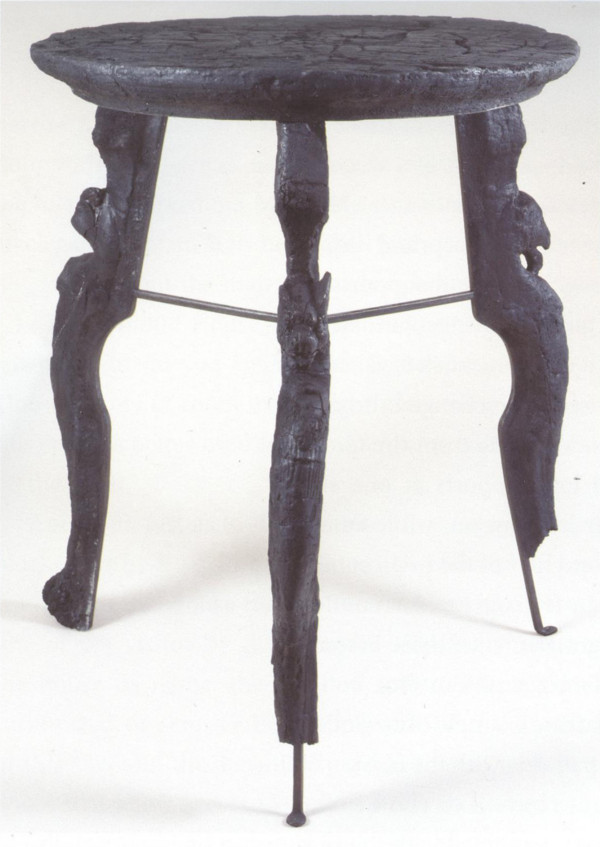
Herculeneum is the other city buried by the eruption of Mt. Vesuvius in 79 CE. Among the wonders preserved there is wooden furniture, charred in place by the pyroclastic flow that buried the town 10 meters (35 feet) deep. What got me interested in this material was that little night stand above. That is a design that has not changed one whit in 2000 years.
A cradle.
Small table.
Stool.
Wooden shrine from the House of the Wooden Shrine.
Bed frame. Even fairly wealthy Romans mostly used these simple beds, just a rectangular frame with a mattress on top stuffed with feathers or straw.
A cradle.
Small table.
Stool.
Wooden shrine from the House of the Wooden Shrine.
Bed frame. Even fairly wealthy Romans mostly used these simple beds, just a rectangular frame with a mattress on top stuffed with feathers or straw.
Saturday, September 1, 2012
Petrified Wood from Odessa, Delaware
My new treasure, a piece of petrified wood given to me by the foreman of the excavation company we used at my site in Delaware. They dug up a dumptruck load while digging a sewer line near Odessa, and the foreman said his yard is full of it. That area is well known for petrified wood, and if you do a search for "petrified wood Delaware" you find lots of accounts of collecting expeditions to the Odessa area.
Even though everybody has long known about this deposit, the exact origin of the petrified wood remains a mystery. This guy made a thorough investigation in the usual geological sources, and even called various state officials, but found no clear answer. Most of the wood is within the Columbia Formation, a mass of sand, gravel, and cobbles distributed across the state by glacial runoff during the Pleistocene (2 million to 13,000 years ago). But where did it come from, and how old is it? Uncertain. Other specimens seem to be in Miocene sediments, dating to between 25 and 5 million years ago. Either way it is very old, and very cool.
Silos Apocalypse
Beatus of Liebana was an eighth century Spanish monk who wrote an influential text called the Commentary on the Apocalypse. In the eleventh century, two monks at the Monastery of Santo Domingo de Silos, Cantabria, copied this text into a book of holy texts. Later monks of the same monastery added the wonderful illustrations. The manuscript is now in the British Museum.
Detail of the dragon image above.
Daniel in the lions' den.
Adoration of the Lamb.
Two of the Four Horsemen.
Detail of the dragon image above.
Daniel in the lions' den.
Adoration of the Lamb.
Two of the Four Horsemen.
The Illumination of the Kentucky Mountain Craftsman
Alone, he has come to the end
of the handing down of his art,
the time having little use
for such skill as his, his land
seeded with lies and scars.
So much has he suffered
in his flesh that the end of time,
the signs behind fulfilled,
the unsealing of the seals,
seems only to be borne
as he has borne the rest.
On the mountain top, stunning
him like the glance of God,
the lightning struck him. Entering
at the big tendons of his wrists,
it has stayed in his body
so that the insects no longer
bite him, and in the night
he is not afraid anymore.
-- Wendell Berry
of the handing down of his art,
the time having little use
for such skill as his, his land
seeded with lies and scars.
So much has he suffered
in his flesh that the end of time,
the signs behind fulfilled,
the unsealing of the seals,
seems only to be borne
as he has borne the rest.
On the mountain top, stunning
him like the glance of God,
the lightning struck him. Entering
at the big tendons of his wrists,
it has stayed in his body
so that the insects no longer
bite him, and in the night
he is not afraid anymore.
-- Wendell Berry
In Which I Become a Video Star: Catoctin Mountain Park Archaeology
The videos I recorded for the Catoctin Mountin Park in Maryland about their archaeology are finally up on YouTube. I led a four-year archaeological study of the park that we finished in 2010, so these final products have been a long time coming.
This one is on the farmers who used to live on the mountain, farming places that look way too rocky an steep to ever have been worth taking a plow to.
The charcoal industry was the economic mainstay of the ruggeder parts of the mountain from the Revolution until after the Civil War.
The Indians who came to the mountain were there either to hunt or to quarry a stone called rhyolite that they liked to use for tools.
This one is on the farmers who used to live on the mountain, farming places that look way too rocky an steep to ever have been worth taking a plow to.
The charcoal industry was the economic mainstay of the ruggeder parts of the mountain from the Revolution until after the Civil War.
The Indians who came to the mountain were there either to hunt or to quarry a stone called rhyolite that they liked to use for tools.
Subscribe to:
Posts (Atom)